Artist Mark Blamire announced Trainspotting to the world. He’s back to tell the story 30 years on
For Trainspotting’s 30th anniversary Blamire is curating a star-filled exhibition, Trainspotters #T30
by:
18 Feb 2026
Image: BLAM; Phill Jupitus; Stanley Donwood; Adam + Joe; Lucy Pass
Share
Mark Blamire was working for design agency Stylorouge in 1995. Then 26, he had never made a film poster before. There was a film coming out the next year based on a book.
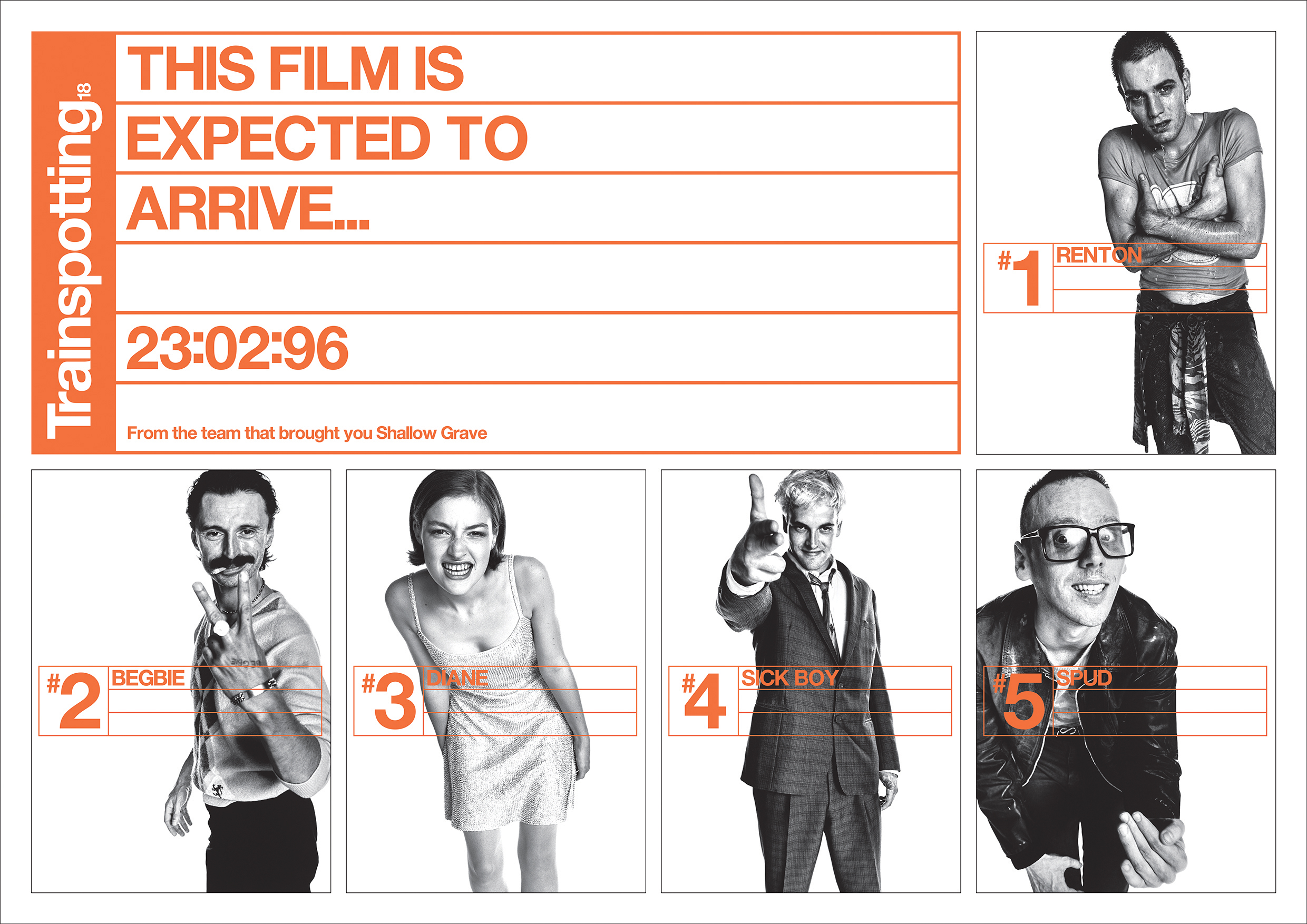
Left to right: Robert Carlyle as Begbie, two fingers up and cig in mouth; Kelly Macdonald as Diane, teeth bared; Jonny Lee Miller as Sick Boy, gun fingers to the camera; Ewen Bremner as Spud, bent over and light bright in the sunglasses; Ewan McGregor as Renton, buzzcut, tight T-shirt and soaking wet. With three colours – black, white and bright orange – and the Helvetica typeface, Trainspotting was announced to the world.
“It was the first film poster I’d ever designed, so I wasn’t bogged down with cliches or visual metaphors. I think that’s why it was refreshing and new,” Blamire says.
While the poster was destined to become a classic, he hadn’t seen the film before designing it, instead drawing from the script and Irvine Welsh’s novel.
“When I first saw the film, I was like, Jesus Christ, I’m not sure what I’ve made fits what the film’s message is,” he says.
Win 2 exclusive screen prints from the iconic film Trainspotting! Enter here
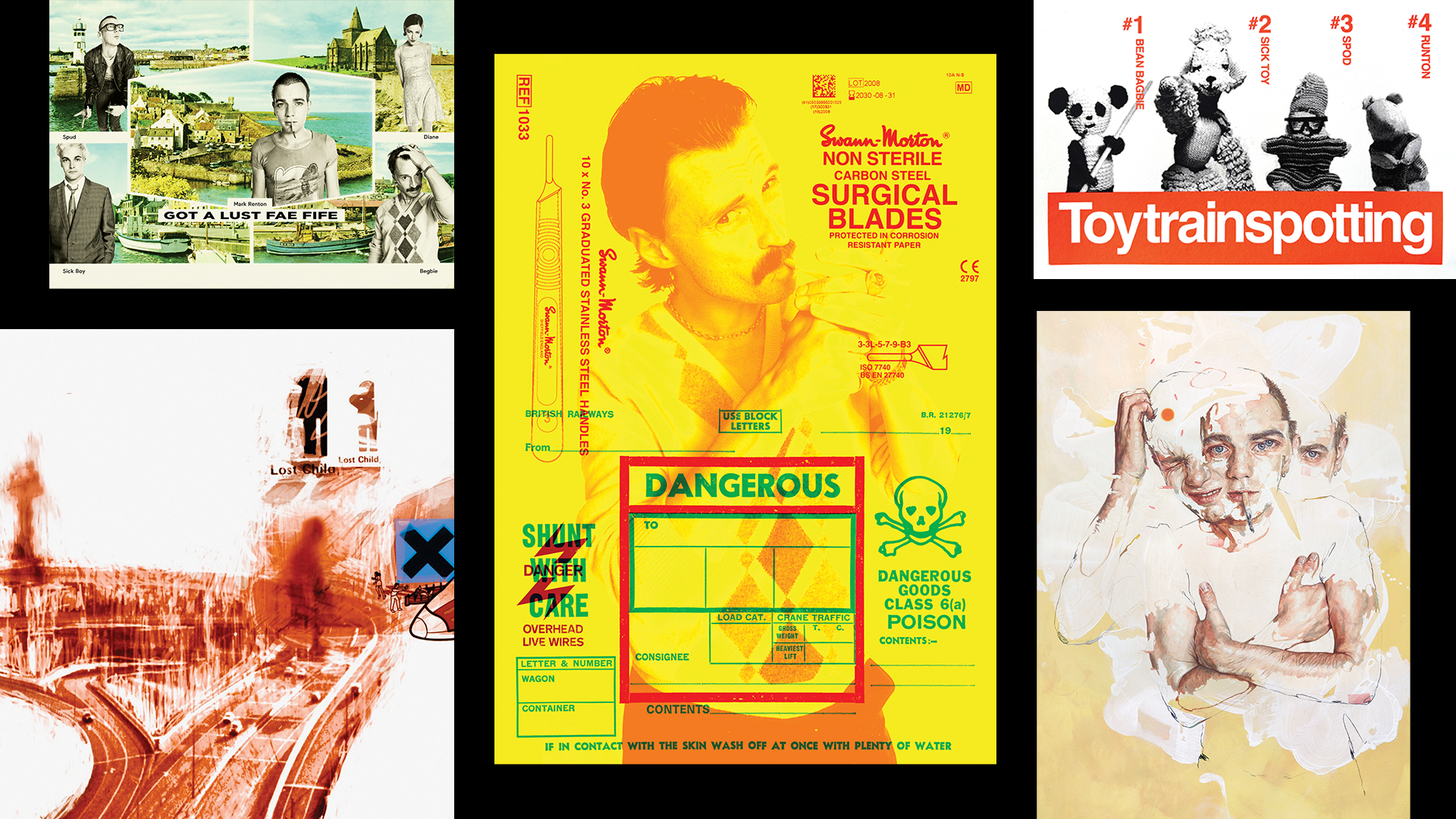
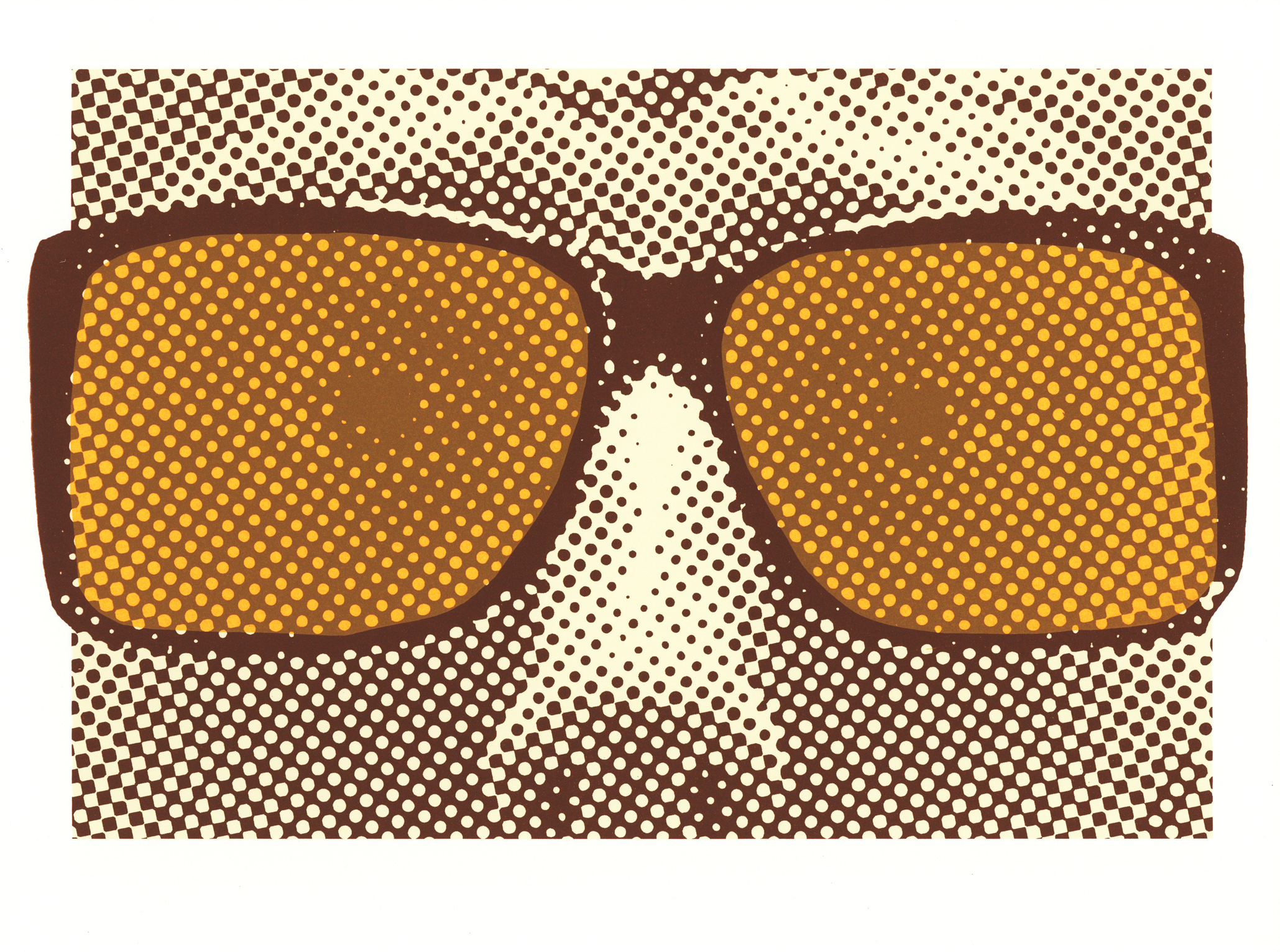
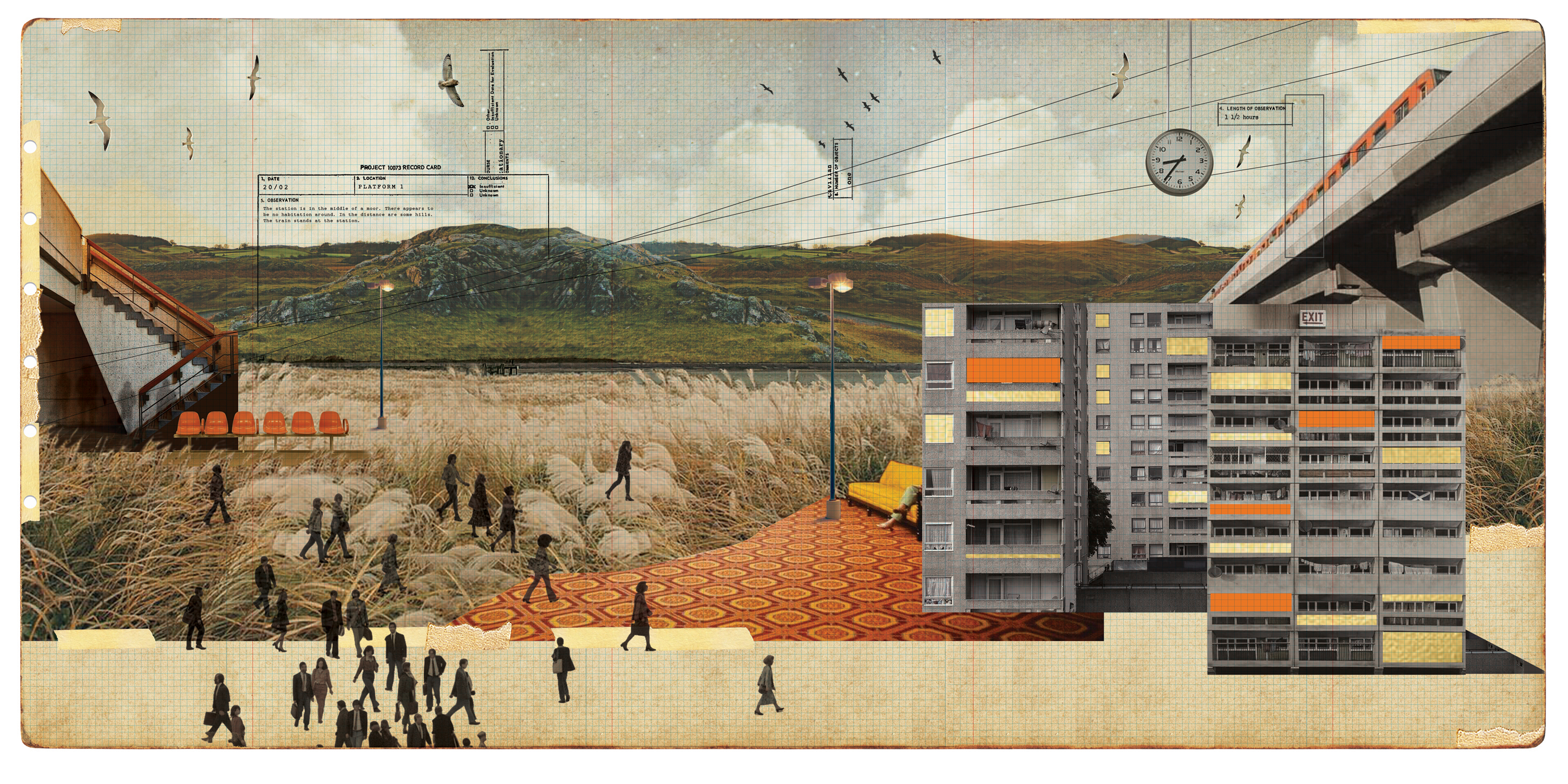
We are now 30 years on from Trainspotting’s release and Blamire – known in the art world simply as Blam – is curating a star-filled exhibition, Trainspotters #T30, which marks the anniversary. Drawing on both the legacy of the film and trainspotting as a hobby, it features work from Phill Jupitus, Adam Buxton and Joe Cornish, his son Mark Blamire, and a reinvention of Radiohead’s OK Computer album cover from original designer Stanley Donwood. It will also raise money for Big Issue.
Advertising helps fund Big Issue’s mission to end poverty
Advertisement
Perhaps as much as Trainspotting’s indelible capture of a time and a place on camera, Blamire’s poster put the film into its cultural postcode. It’s variously been called groundbreaking and one of the most influential film posters of all time, and paved the way for the oft-parodied Choose Life poster.
The young film stars arrived for their pictures the day after their wrap party, with Bremner discovering on the way down that Miller was not in fact Scottish. With all back in character, McGregor was soaked with a bucket of water.
“I was just such a massive fan of modernism and people like Saul Bass, who designed all of the Hitchcock movie posters,” says Blamire. “They were really true pieces of artform, and really great pieces of graphic design. But by the ’90s, film posters were just putting heads on the posters and then had the wrong names above the heads.
“They were turgid and laboured. They weren’t art any more,” he says. “My motivation for making the poster was to try and do something a bit more memorable; trying to match what some of my design heroes had achieved.”
Advertising helps fund Big Issue’s mission to end poverty
Before the film was even released, the poster was handed out to students in welcome packs as they started university.
“It transformed my career, really. We went on to work for Adidas, the V&A, Film4,” he says.
The exhibition was born after Blamire found his way back to Trainspotting and graphic design recently. But it wasn’t an easy sell – the artist took a few months to say yes.
With the show set to open, Big Issue felt like a natural partner. “It’s just a great brand to be associated with, because it’s got strong connections with art,” he says.
“It’s really rewarding to see people envisaging something that I made ages ago, that they still want to celebrate.”
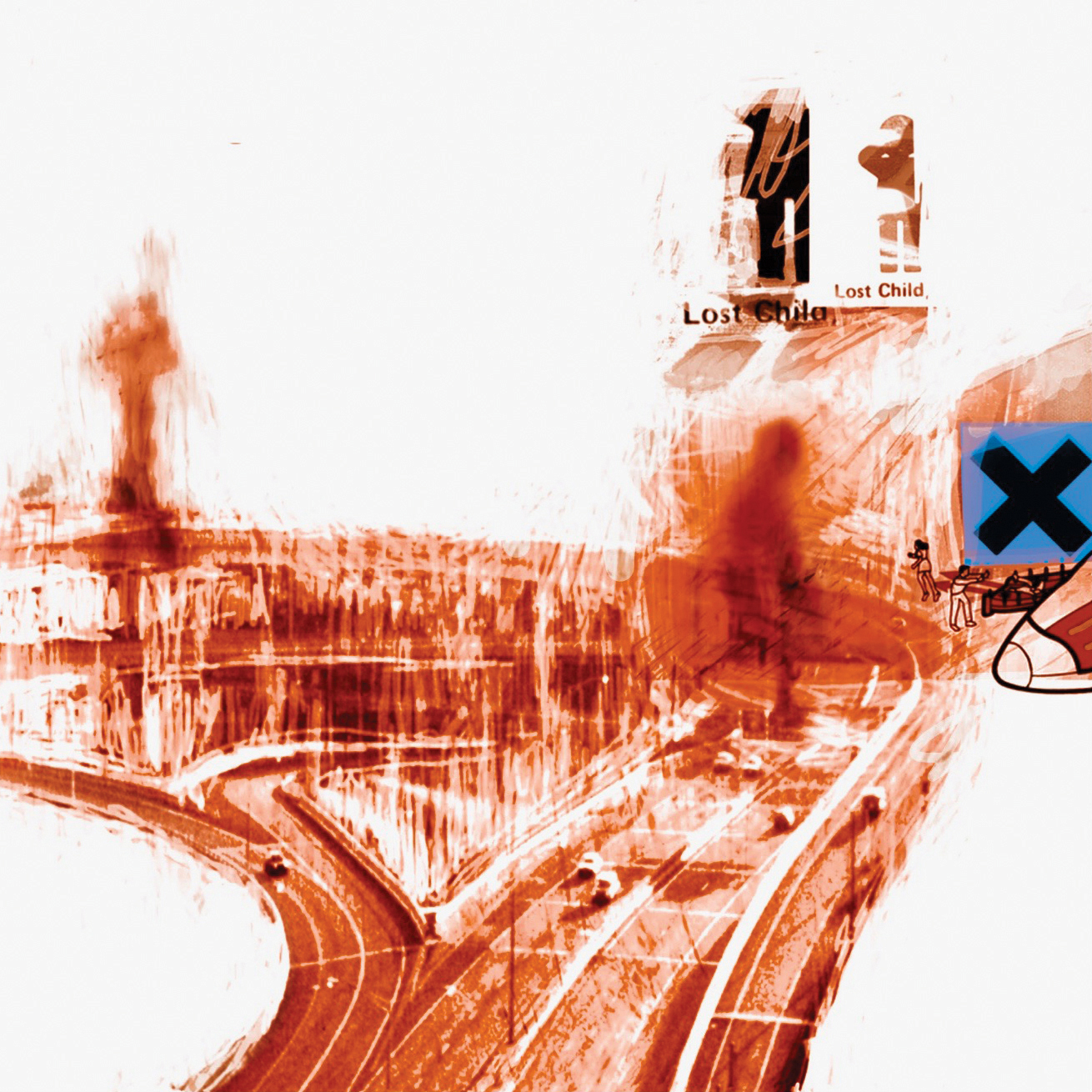
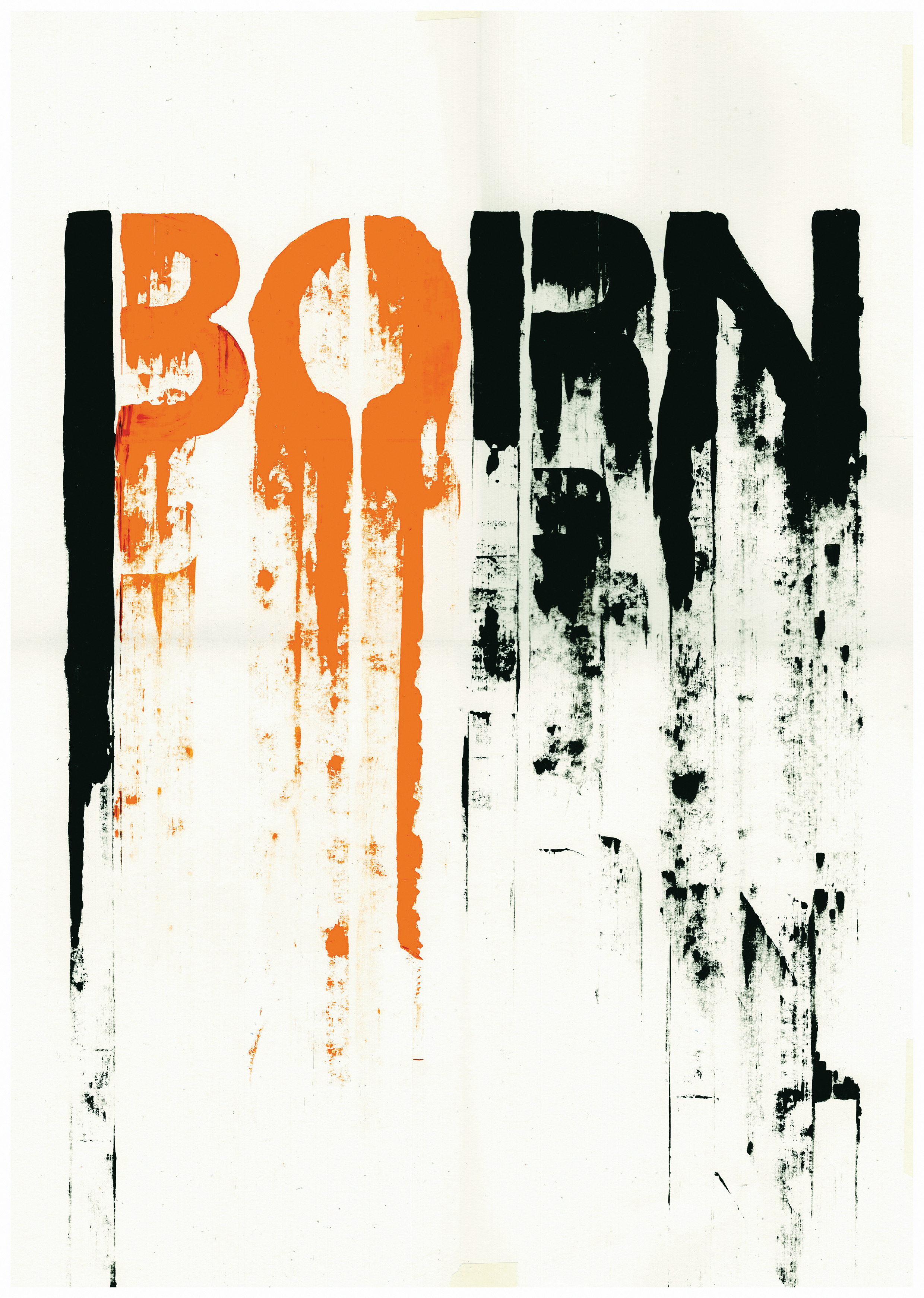
Stanley Donwood – OK Computer, Orange variant
Stanley Donwood is best known for his 30+ year collaboration with Radiohead. In his own words, he has “done many things now and should probably stop. In 1996 I was mostly making the artwork for OK Computer.”
Advertising helps fund Big Issue’s mission to end poverty
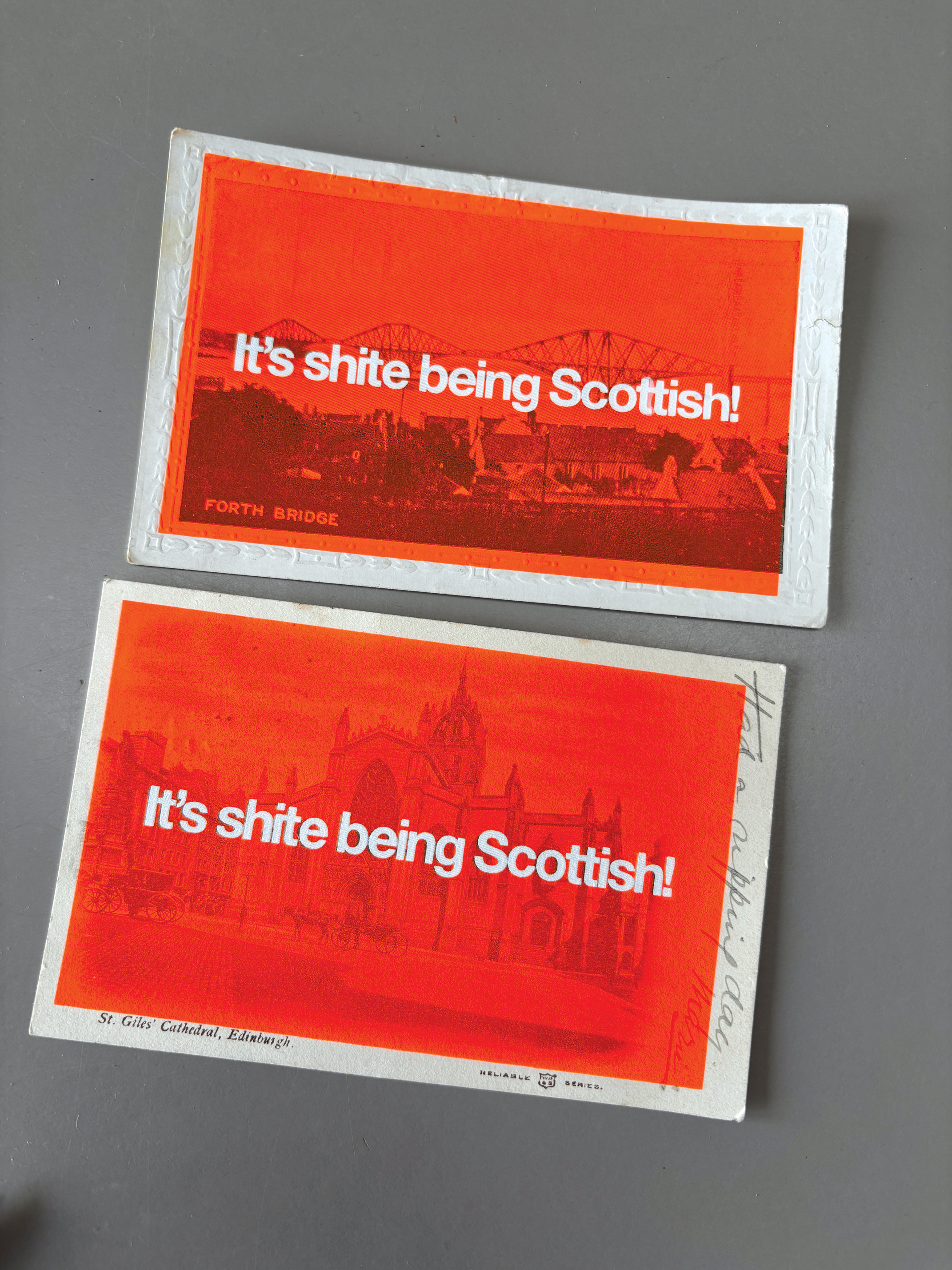
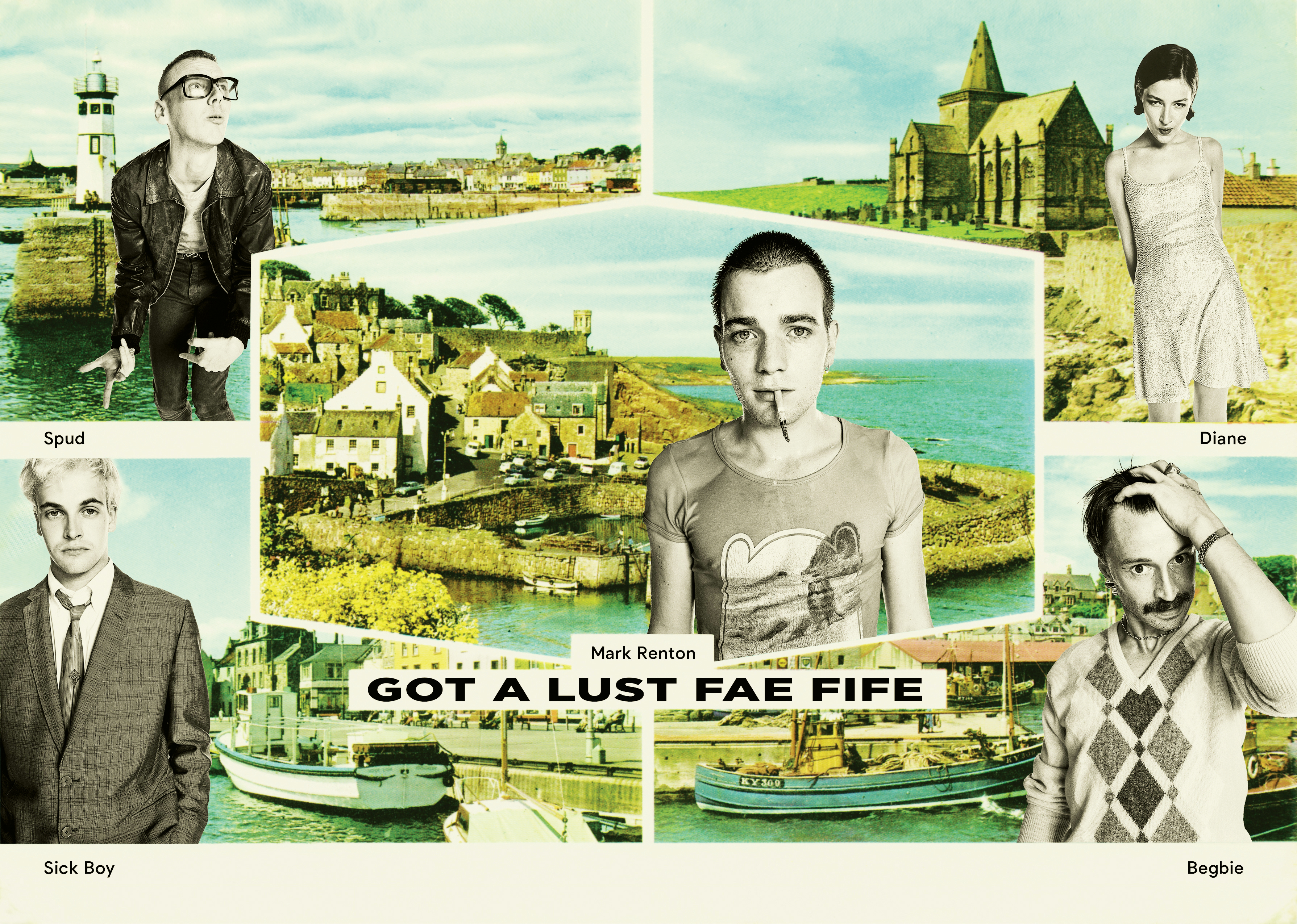
Phill Jupitus – collage on vintage postcard, A3 giclee
Image: Phill Jupitus
Phill Jupitus started out as a freelance cartoonist in 1983 for various underground music fanzines, going on to work as a poet, bank messenger, tour manager, press officer, graphic designer, stand-up comedian, script writer, singer, broadcaster, DJ, voiceover artist, football columnist, pop video director, presenter and actor. In 1996 he became team captain on a BBC Two pop quiz.
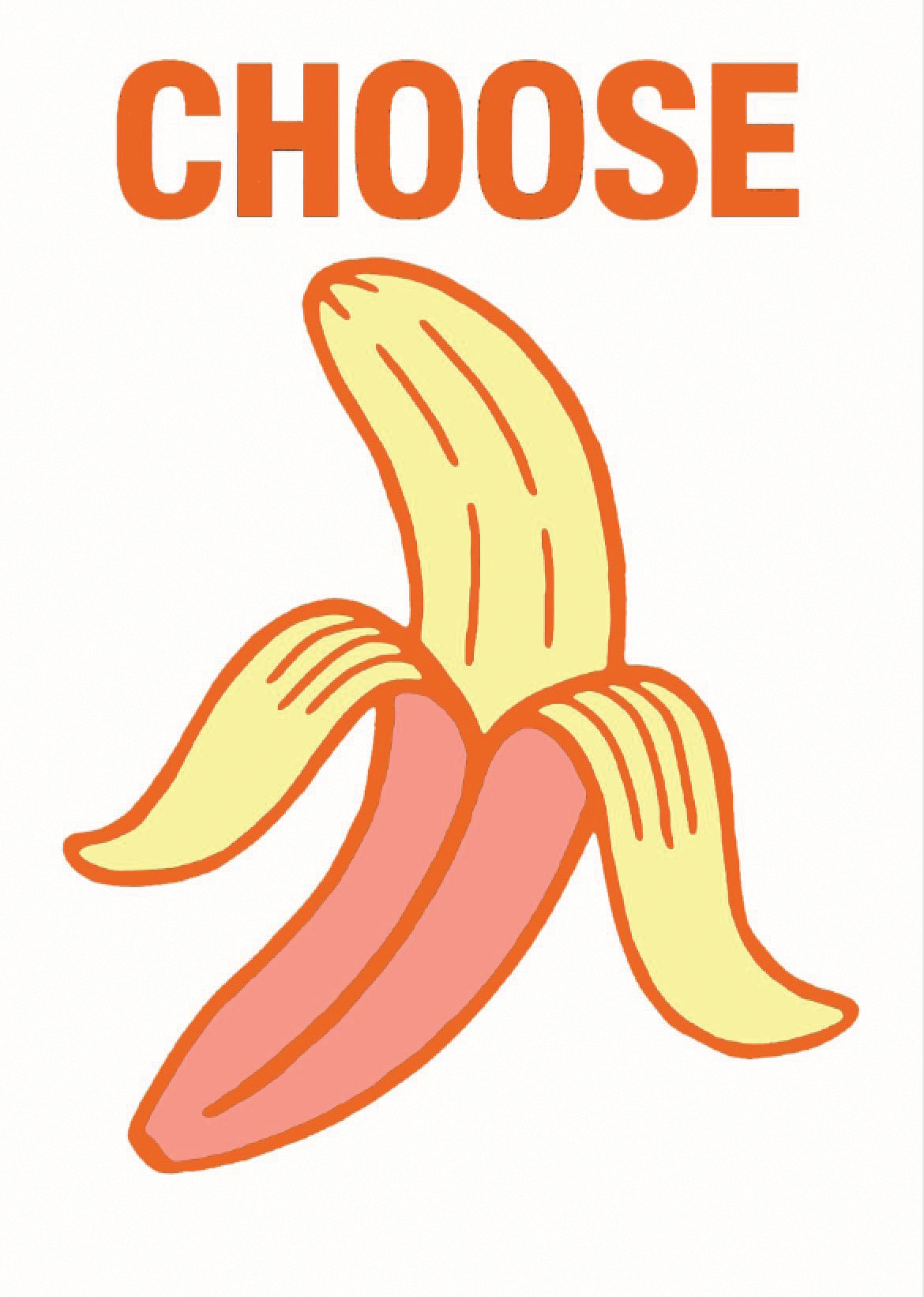
Shuby – Bananaspotting, A3 3 colour risograph
Image: Shuby
Shuby began as a street artist in 2007. Her work turns the everyday into vibrant, subversive joy. Her signature banana is a cheeky ‘Up Yours!’ to the patriarchy. In 1996 she was “signing on, doing courses, painting and decorating, getting up for Neighbours at one in the afternoon”.
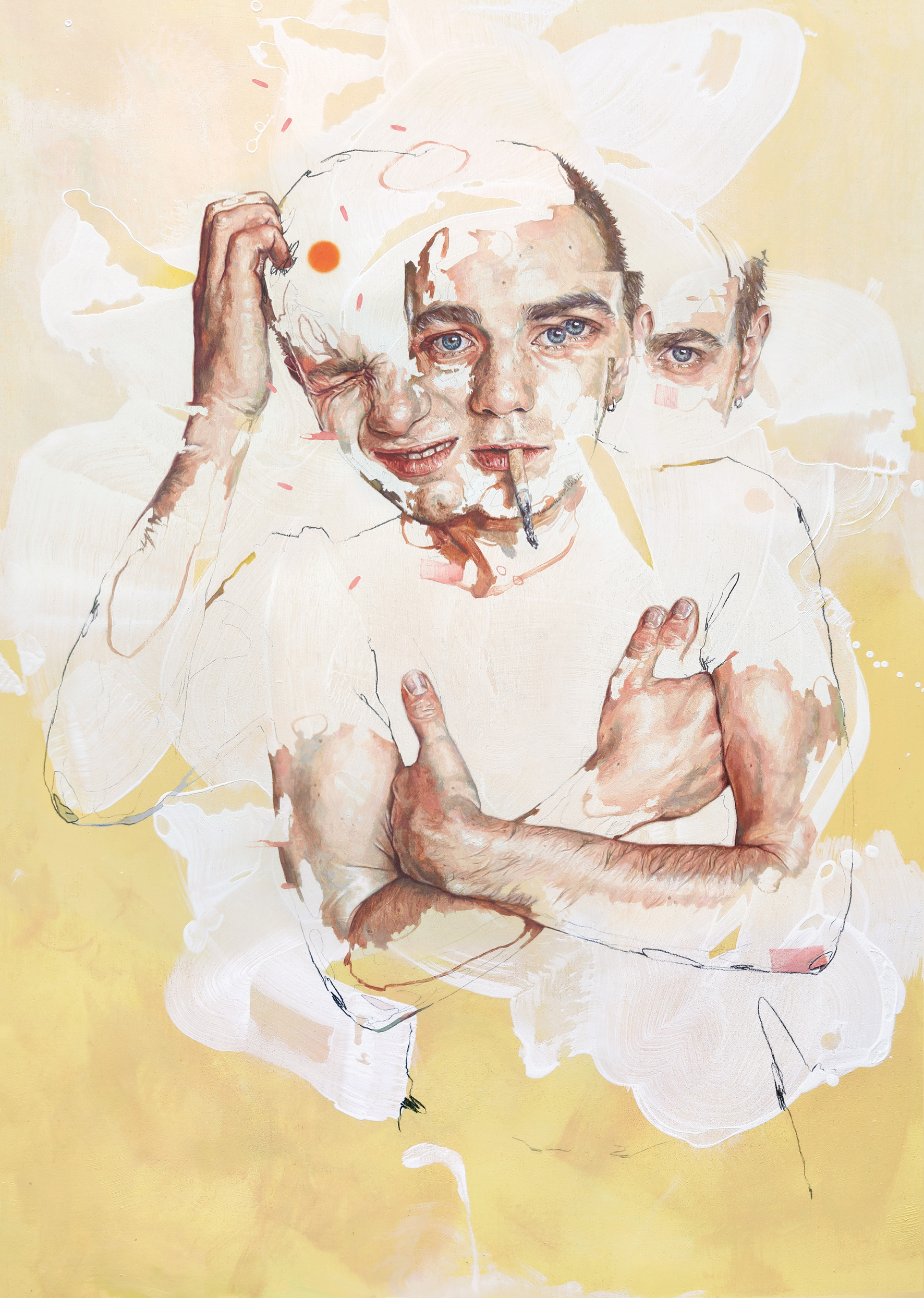
Lucy Pass – Come alive, 35’
Image: Lucy Pass
Pass is a self-taught figurative artist based in Cheltenham. Her work combines representational and abstract elements in an attempt to give physical shape to things that lie deep within us and to piece together what it is to be human. Her dynamic, fragmented portraits are a conversation between chaos and clarity; beauty and unease. She was awarded first prize in both The British Art Prize in 2023 and The Guildford House Open in 2024.
“And in 1996, I was 10 so, while I was aware of the soundtrack, I was completely clueless as to the on-screen world of Trainspotting… which is probably just as well really!”
Chris Ashworth, Untitled
Image: Chris Ashworth
Ashworth has gained a worldwide reputation for pushing the boundaries between graphic design and subculture aesthetics for bands and brands including Ray Gun magazine, Nike, New Order, Michael Stipe (REM) and Gavin Rossdale (Bush) as well as exhibiting alongside Banksy and Shepard Fairey. His book Disorder: Swiss Grit Vol II, is published by Thames & Hudson.
In 1996 he was designing the music and style magazine Blah Blah Blah in Shoreditch, London for MTV and Ray Gun Publishing.
Advertising helps fund Big Issue’s mission to end poverty
Bench Allen, Buntàta Donn
Image: Bench Allen
Allen focuses on hand-pulled screenprint editions drawing inspiration from natural history and pop culture. He combines bold hand-drawn imagery with layered textures and halftone, embracing the physical qualities and imperfections of the printmaking process.
“Being eight, I spent every child-of-divorce weekend in 1996 with my sister, Phoebe. We would be dropped off by our father at the £1 kids’ cinema club in the Odeon, Plymouth, 30p chocolate bar in pocket, obviously not watching Trainspotting – that would come a few years later.”
Maxine Gregson, Highs and Lows
Image: Maxine Gregson
Gregson is a contemporary artist and printmaker. Her work is an intricate blend of photo collage, graphical elements, grids, and typography. Drawing inspiration from music lyrics, literature, and vintage photography.
“1996 was a great year for me – I’d just started my dream design job at Malcolm Garrett’s studio in Shoreditch. I remember seeing the Trainspotting posters everywhere for the first time, cycling down Kingsland Road to work.”
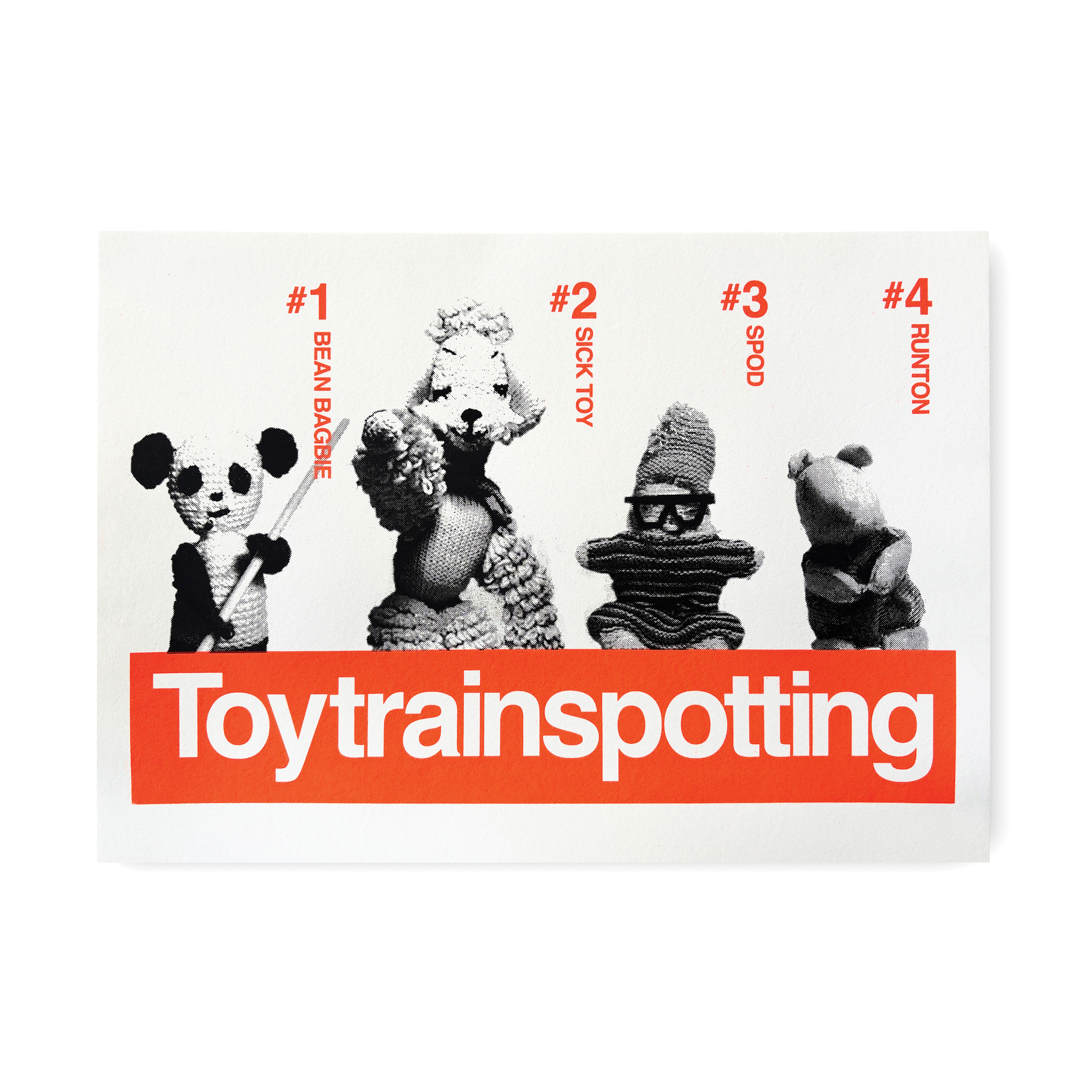
Adam + Joe, Toytrainspotting
Image: Adam + Joe
The first thing Joe Cornish and Adam Buxton made for their new TV show in 1996 was a parody of Trainspotting. Instead of the characters in the original poster, the Adam & Joe Show version featured cuddly toys.
“We thought it would be funny to do a movie as grotty and gritty and cool with cuddly toys,” says Cornish.
Advertising helps fund Big Issue’s mission to end poverty
“Instead of shooting heroin, they were shooting up Sherbert Dip Dabs. We made the shitty toilet out of cardboard.”
Back then, he says, “Adam and I had always been desperately foraging around to find some sort of a foothold in film or TV, so to get this opportunity to make this, even though it was an ultra-low-budget late night TV show, the fact that we genuinely made it all ourselves was very exciting.”
In the intervening decades, Cornish and Buxton’s careers have flourished. Cornish has written films including Ant-Man and The Adventures of Tintin, as well as directing 2011’s Attack the Block. But it was the era of Trainspotting where it all took off.
“I wasn’t taking heroin, I was smoking a lot of weed and living in a flat in Exmouth Market,” Cornish says.
“In the mid ’90s you were tame if you were just smoking weed. Everyone else seemed to be snorting coke and taking smack and driving cars into lampposts and staying up all night at various clubs.
“We were extremely tame compared to what was going on around us, I think.”
Advertising helps fund Big Issue’s mission to end poverty
He says the ‘death of monoculture’ has made parody harder than before.
“It was easier to parody stuff because everybody knew what you were parodying. Everybody knew the detail of the thing you were taking the piss out of,” Cornish says.
“In the mid-1990s everybody was talking about that movie, and everybody was having all the same discussions about pop culture”.
Adam and Joe’s contribution to the exhibition will see 100 prints priced at £60 a pop, with 100% of the money going to Big Issue
“It would seem very greedy and churlish to make any money off it,” Cornish says. “All we did, really, is send a pretty low-resolution file to Blam. And then he did a fantastic job blowing it up.
“I think we were maybe the first people to parody Trainspotting. So thanks to that dubious honour, [Blam has] allowed us – or invited us – to join the exhibition.
“It was the first thing that broke through for us,” he adds. “We were sort of riding on the coattails of that movie’s success.
Advertising helps fund Big Issue’s mission to end poverty
“It was exciting to be a mollusc, or a carbuncle, on the arse of a much bigger cultural phenomenon.”
Trainspotters #T30 is showing from 21 February to 14 March at Atom Gallery, Green Lanes, London
Buy from your local Big Issue vendor every week – and always take the magazine. It’s how vendors earn with dignity and how we fund our work to end poverty.