“I was obsessed with the Second World War,” he recalls. “Every detail of it, all the war films. All the toys back in the ’70s when I was a kid were military, were guns.”
Growing up in the North East – a region with one of the highest armed forces recruitment levels in the country – the army was a regular presence at his school. Many of his schoolmates’ parents fought in the 1982 Falklands War.
“The army are enormously, disproportionately Geordies,” Olusoga says. “The army was always at my school. So I held a British Army SLR, which was then the standard rifle of the army, when I was about nine.”
Read more:
How did that feel? “It felt exactly what I feel like now, which is, they are alluring objects, but they’re frightening. I remember being frightened.”
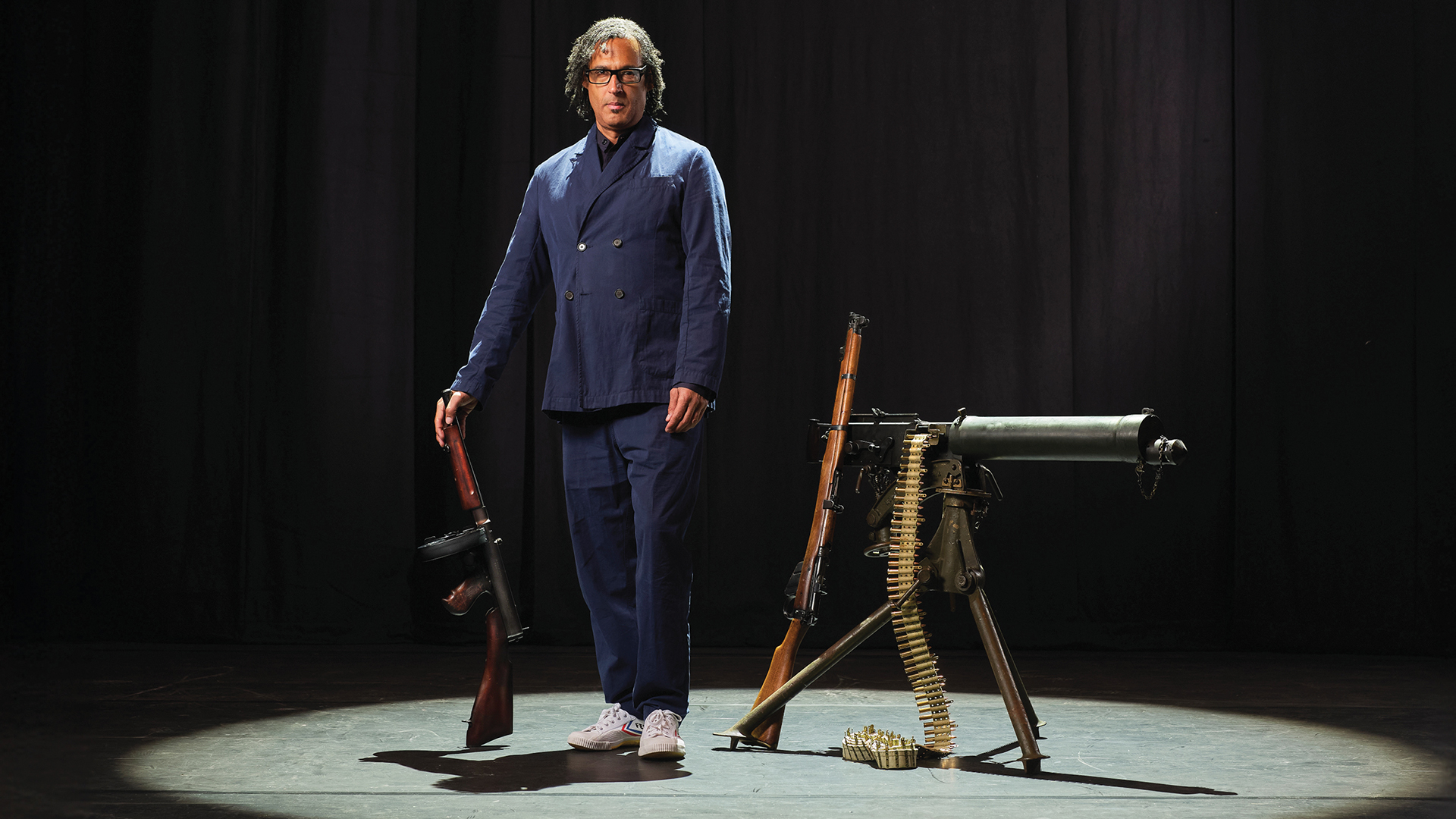
It’s that ambivalence – glamour and horror, fascination and recoil – that A Gun Through Time explores. The show traces the social history of the firearms that changed the world: the Thompson submachine gun, which transformed from a World War I “wonder weapon” to the notorious Tommy Gun of prohibition-era America; the Maxim gun, used by colonists to brutally subdue African territories before causing unimaginable devastation on the Western Front; and the Lee-Enfield rifle, the soldier’s companion in both world wars, as familiar to our great-grandparents “as a smartphone is to us”.
Advertising helps fund Big Issue’s mission to end poverty
That last point is Olusoga’s central thesis. British adults are, by international standards, extraordinarily estranged from firearms. In the UK, there are around 5.03 guns per 100 people. The US has about 120.5. At his show, Olusoga asks his audience how many have ever held a gun. Only about a third say yes.
This isn’t, he emphasises, a bad thing. Approximately 130 people are killed with guns every day in the United States, compared to 28 per year in the United Kingdom.
But our estrangement from these dangerous weapons is not something we can take for granted. It is, Olusoga believes, about to change.
“What made me want to do this tour was because I do think we need to think about our relationship with the army, the armed forces and with weapons, because the world is changing,” he says.
“And, depressingly, I think I was more right than I realised – the world is getting more dangerous at a rate faster than I imagined.”
It’s hard to argue with that. At time of writing, the United States is raining missiles down on Iran. In Sudan, a civil war that has killed hundreds of thousands and created the world’s largest displacement crisis grinds on. After four years, Russia’s brutal campaign in Ukraine shows no sign of abating. Indeed, Maxim guns are still in use there today.
Advertising helps fund Big Issue’s mission to end poverty
“A lot of these guns were put into storage. And when Ukraine faced – as it has been facing for four years now – an existential war, these old machines, stored wrapped away in oily rags, were brought out,” he says. “And so you get this surreal phenomenon where kids who were born in the 21st century are defending their homeland with a gun invented in the 19th century.”
Here in Britain, politicians are discussing rearmament and a potential expansion of the military. Last year, Keir Starmer pledged to spend 2.6% of GDP on defence by 2027, and 3% by the end of the next parliament in 2034, later promising to accelerate this commitment.
For Olusoga, it is this context that makes a re-examination of our relationship with guns so vital. “One of the reasons I think now is the time to understand our ancestors and think about their lives is because I think the next 30, 50 years are going to be more like their lives – more like the period before 1945 than the period we’ve just lived through,” he says.
“We may be going back to an age of invasions and annexations, of borders changing… In some ways this is a return to normal service. I don’t mean that to be flippant. It doesn’t make any of it less frightening, but it does make it more like most of history than the period from 1945 to about 2014.”
In February, Donald Trump was grandstanding about annexing Greenland, the autonomous territory of a NATO member. Earlier this year, Stephen Miller, deputy White House chief of staff for policy, told journalists that the world is not “governed by international niceties”. It is “governed by strength”.
It’s this sort of threat that raises questions, Olusoga says. “Are we independent? Have we relied too much on our allies? One ally in particular?”
Advertising helps fund Big Issue’s mission to end poverty
There’s a phrase, he continues, that you learn in the first term of classical history. It’s from Thucydides’ account of the Peloponnesian War – the Melian dialogue: “The strong do what they can. The weak must suffer what they must.”
The idea is that raw power dictates outcomes. Justice, morality and fairness are mere window dressing.
“I find it chilling that politicians are quoting the Melian dialogue as if it is some sort of iron law of the universe, rather than something to learn from and improve upon,” Olusoga says.
And yet, Olusoga is not without hope. We know, he says, how to build a more peaceful world – through international organisations, international law, international courts. “Everything that’s being attacked now is the stuff that we put in place after the Second World War to prevent it happening again.”
It is thanks to many of these institutions – as well as the extraordinary luck of being born in a country with relative stability and gun control laws – that you probably still haven’t fired a gun.
Even as these safeguards are under threat, there is something in human nature itself that gives Olusoga pause for optimism.
Advertising helps fund Big Issue’s mission to end poverty
“If you study history, one thing that you can’t help noticing is how incredibly inventive we are. There have been so many things that should have done us in that we managed to think our way out of. We are incredibly adaptable and inventive. For all of our terrible characteristics, our propensity to violence, our seeming love of chaos – we are just astonishingly creative.”
David Olusoga’s A Gun Through Time tour starts on 14 April
Do you have a story to tell or opinions to share about this? Get in touch and tell us more.
Change a vendor’s life.
Buy from your local Big Issue vendor every week – and always take the magazine. It’s how vendors earn with dignity and move forward.
You can also support online:
Subscribe to the magazine or support our work with a monthly gift. Your support helps vendors earn, learn and thrive while strengthening our frontline services.
Advertising helps fund Big Issue’s mission to end poverty
Thank you for standing with Big Issue vendors.