Orwell 2+2=5 director Raoul Peck: ‘There will be another world after Trump’
Filmmaker Raoul Peck’s new documentary depicts an almost overwhelming cavalcade of horror
by:
27 Mar 2026
Share
“The opinion that art should have nothing to do with politics is itself a political attitude.” So wrote George Orwell in his 1946 essay, Why I Write. Two years later, Orwell completed 1984 – considered by many to be his masterpiece. A novel of such power that it changed the very language we use. Seven months later, Orwell died in London aged just 46.
War Is Peace. Freedom Is Slavery. Ignorance Is Strength. Orwell created a fine line in doublespeak in 1984. When the Party wished to change history, rethink facts or update truths, it would simply decree it. Hence 2+2=5. If they say it’s true, then true it is.
In an era of totalitarianism, post-truth and social media and AI joining forces to create fast-spreading fictions, it is little wonder that Orwell’s provocations are back in vogue. Filmmaker Raoul Peck’s new documentary depicts an almost overwhelming cavalcade of horror. Present and historical. All the while, Damian Lewis calmly narrates quotations from Orwell’s essays, novels and letters. Seeing it together is compelling and terrifying.
“Totalitarianism demands the continual alteration of the past and in the long run probably requires a disbelief in the concept of objective truth,” intones the Wolf Hall star, after we hear Vladimir Putin saying how Russia wanted to demilitarise and de-Nazify Ukraine.
Next up, we hear Donald J Trump discuss the 6 January 2021 attack on the Capitol Building in Washington: “They were peaceful people. They were great people. The crowd was unbelievable. And I mention the word love. The love in the air, I’ve never seen anything like it,” said the outgoing president about the people who were charged with trying to change the election result through violence. He would be voted back in less than four years later.
Advertising helps fund Big Issue’s mission to end poverty
Advertisement
War in Gaza, ICE killing residents of Minneapolis, the military junta in Myanmar led by General Min Aung Hlaing, the Snowden papers, Putin’s invasion of Ukraine, the money spent on Elon Musk’s SpaceX, the death of young Syrian boy Alan Kurdi on a Turkish beach in 2015, The Handmaid’s Tale being banned in Republican states, political oppression by Yoweri Museveni in Uganda, the murder of George Floyd in 2020. The film is a lot to take in.
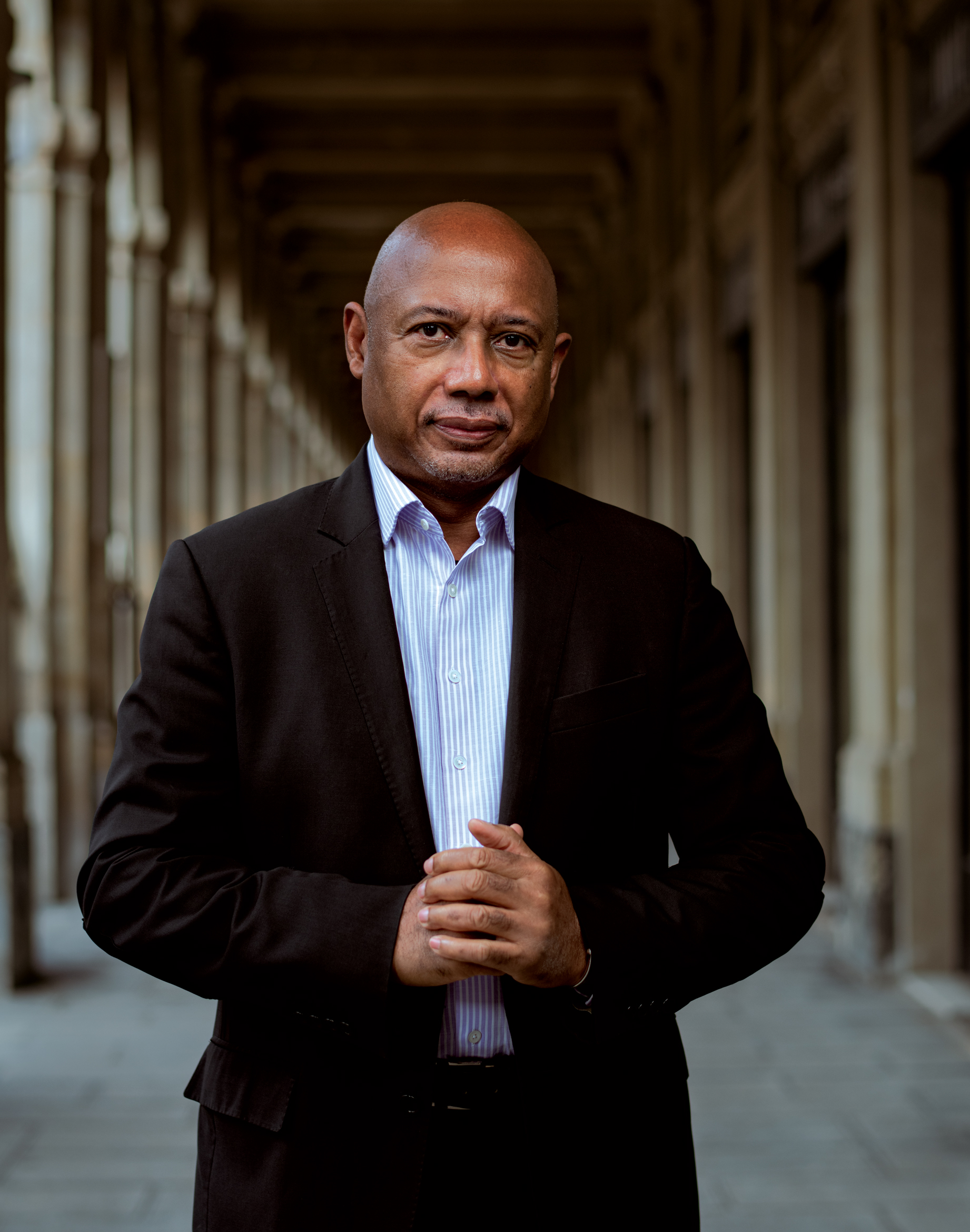
Raoul Peck. Image: Matthew Avignone
“I know people have a lot to chew but that’s the idea,” says Peck, the Haitian filmmaker whose 2016 documentary on James Baldwin, I Am Not Your Negro, was nominated for an Oscar. “I try to give as many layers as possible and as much nuance and complexity. Because we are living a complex world.
“Unfortunately, people have been used to easy solutions or easy explanations – that’s why we have the rise of populist regimes. Because they don’t care.
“They just give you easy answers. ‘Let’s throw all the immigrants out and it will be fine. All healthcare problems, school problems will be solved etc.’ I try to do the contrary. I nourish you with lots of food for thought.”
Is collecting so much of what feels wrong with the world and what we can feel powerless to change in one place a kind of evidence-gathering, as part of the drive to figure out forms of resistance?
“There is too much noise. And every type of noise. So the least we could do is try to map the whole thing again in a way that is clear and understandable, confront people with their own reality and connect the dots with what happened before,” says Peck.
Advertising helps fund Big Issue’s mission to end poverty
“If you can’t explain how we got here, it’s difficult to have an analysis to see how we can get out of it. So part of my job is to explain the whole scenario.”
While Trump is perhaps the most brazen example of the political doublespeak Orwell: 2+2=5 highlights, filmmaker Peck was keen to rise above the noise and paint a bigger picture.
“We didn’t want to make Trump the centre of the film. There will be another world after Trump. But he is the craziest example. Nobody thought it would happen in America. But the rise of fascism has been everywhere in the last 40 years, and nobody seems to know the right way to fight it.
“So for me the film was already important before the caricatural example of Trump. Orwell had given us the toolbox. It’s very clear and easy to understand: the renouncement of reality, the invention of alternative facts, the attack on universities, the justice system, books and knowledge, rewriting history, cult of personality.
“That’s the toolbox Orwell described. It’s something we always have to keep an eye out for. Because if there are no checks or balances, power will go there. And we let our guard down.”
Advertising helps fund Big Issue’s mission to end poverty
If Peck uses Orwell’s words to illuminate how the world got to where it is now, how history is repeating, and how global conflicts and a return to totalitarianism has come about, does he also find hope or a framework for change in Orwell’s writing?
“I tend to not use those terms,” he says.
“Because for me it’s already a position of not doing something. If you follow the logic of the question, and I say I see hope, maybe you just go and eat your breakfast, move on, watch another film, forget about it. And then you don’t react, individually or collectively.
“And if I say there is no hope? Well, that’s even worse.”