How much will innovations really change the traditional Christmas?
by:
24 Dec 2025
Image: Tim Mossholder from Pexels
Share
Doctor Whoisn’t on this Christmas, but it doesn’t mean we’re not time travelling. Believe it or not, 2040 is only 15 short years away. While we might think of Christmas as an unchanging beacon, the festive season could be transformed.
We’ve been speaking to experts about how different Christmas 2040 might be across food, TV and shopping – the three things which make Christmas what it is.
Of course, predictions don’t always come true. We may yet change these shadows, by an altered life
Food
Food prices have soared. Climate change is ravaging the Earth. Our ability to get food on supermarket shelves and dinner plates is stretched. And that’s just 2025. What will it be like by Christmas dinner of 2040?
One optimistic view comes from Derek Stewart. “Potentially the celementine at the bottom of someone’s stocking could be grown in the UK within 15 years,” he says. “It’s a flight of fancy, but if someone wanted to dedicate their time to it, the technology is there to do it.”
Stewart is the director of the Advanced Plant Growth Centre at the James Hutton Institute. This role means he’s got a front-row seat to the future of food and what he sees coming down the tracks amounts to a fruit and veg revolution. His vision of Christmas future spans crispier parsnips, colourful carrots and heavy-hitting meat alternatives.
Advertising helps fund Big Issue’s mission to end poverty
Advertisement
Along with better ways to get the energy to grow crops on UK shores – wind turbines, geothermal energy, anaerobic digestion – part of the reason is what Stewart calls “speed breeding”. By giving produce the absolutely ideal conditions, it means they can get through breeding cycles five times faster than normal, “which means we can get to a new variety much faster. Now that variety could be a different colour, it could be tastier, could be smaller, could have a longer shelf life.”
Scientists have already made potatoes which cook faster – softening the cell walls so water can get in to expand the starch faster. Potatoes tend to excel at one thing – whether that’s mashing, roasting, or baking – but struggle to do well across disciplines. What if you could buy potatoes specially bred for air fryers?
“I suspect what we’ll find is there may actually be ones that are much better suited for the more intense, confined cooking arrangement of an air fryer. That wouldn’t take a lot of work to do, to be honest,” says Stewart.
Beyond the veg on our tables, the meaty centrepieces could change, says Helen Breewood, senior market and consumer insights manager at nonprofit think tank the Good Food Institute Europe. Vegan options are well-suited for future challenges: climate change, wars and trade battles make food production more volatile. But plant-based alternatives can be made in a less resource-intensive way. The result, says Breewood, is fake meat prices falling while the real thing gets dearer.
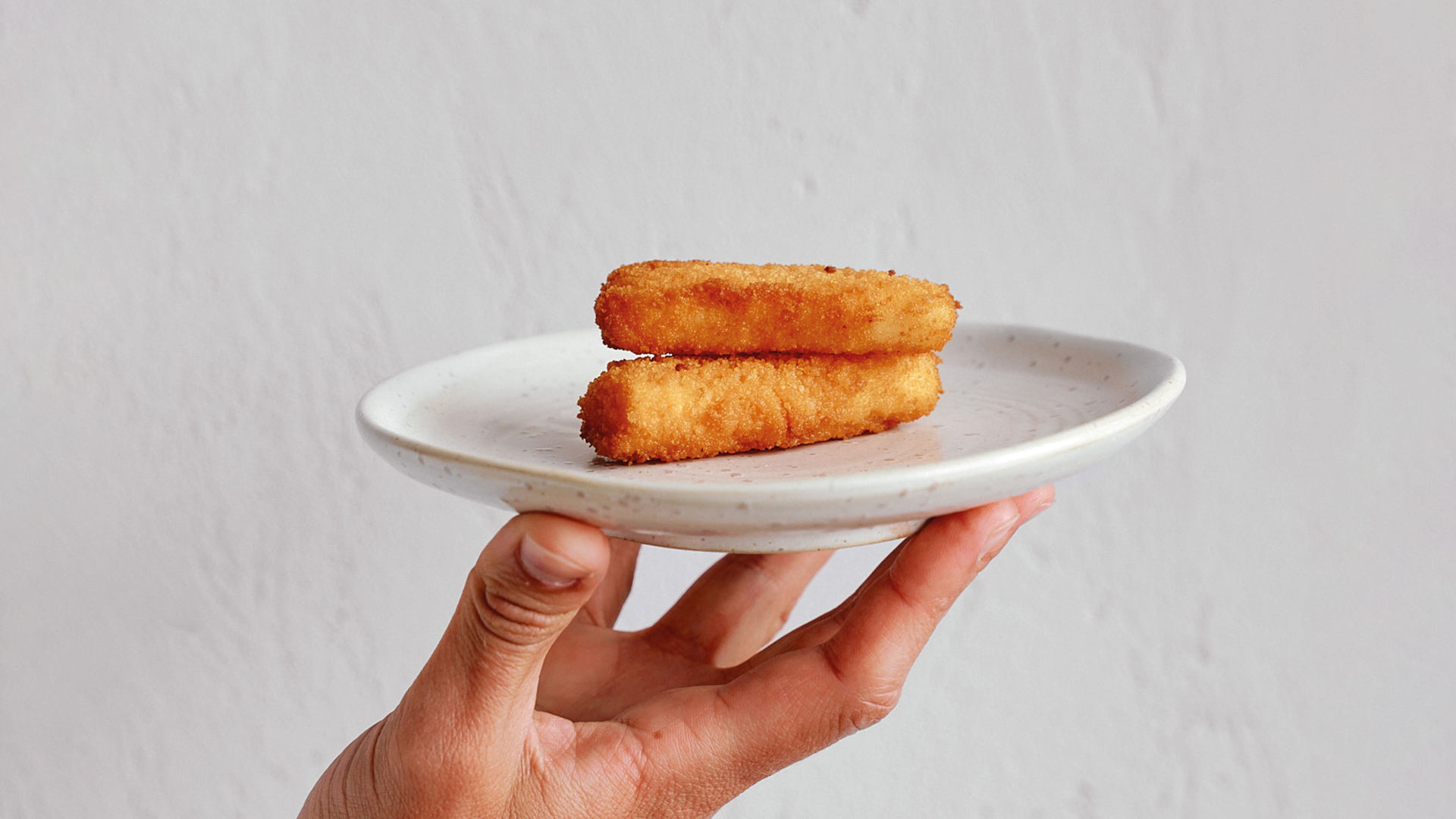
It could be a way of keeping Christmas dinner recognisable by 2040. “Cultivated meat, which aims to deliver chicken, pork, beef and seafood that is indistinguishable from the meat we eat today, can also play an important role in making sure we can eat familiar foods for decades to come. It’s made from animal cells, which are cultivated in fermentors – like those used for brewing beer – and mixed with plant ingredients to produce familiar meat products,” says Breewood.
This stretches beyond meat alternatives, too. “A future Christmas dinner could feature desserts made using precision fermentation-made eggs and milk protein, or cheeses such as Gouda, being developed by Dutch scientists,” Breewood says.
Advertising helps fund Big Issue’s mission to end poverty
Cultivated fish by Bluu Seafood. Image: Bluu Seafood
Christmas shopping
Imagine buying presents for someone you fundamentally don’t care about. This year, the easiest thing to do is most likely to flick through a gift guide or go to ChatGPT for some ideas, then get Amazon to whizz it over They might like it, they might not. Who cares? Job done.
But by 2040, it may be even easier to pretend you’ve put thought into it.
“You’ll get totally outsourced Christmas shopping, with technology and a friendly little AI,” predicts Jo Causon, CEO of the Institute of Customer Service.
Imagine: in the run up to the festive period, an AI companion could remind you of gifts which need buying for certain people. At first, you’d tell it what you think those people like, but after time it’d figure it out. It’d know what you’ve bought them before – and perhaps what they already own. You could pick from a list of options, and it would go off and automatically buy them for you.
Not only would it be great for reluctant shoppers and elderly relatives less able to get to shops, but it could also result in fewer unwanted gifts. “You could argue that actually there will be less waste because of that,” says Causon.
Now imagine someone you actually like and want to spend time and care choosing a present for. The flipside of handing everything over to a clever computer is a real desire for experience and connection. “We have gone through a period of buying stuff and we have bought more and more stuff,” says Causon. But even now, we are seeing a change as people put more care into what they’re buying. “I think there has been a shift, a genuine shift,” Causon adds, driven by more than just the cost of living crisis. This will translate into a boost for Christmas markets and spending a day enjoying all the things around shopping – eating, drinking, being around people. “I think they will become more about the experience and I think they will become more about artisans,” Causon adds.
Advertising helps fund Big Issue’s mission to end poverty
Here, technology could play a role in making Christmas shopping feel more personalised and careful. You might be able to virtually smell a perfume before you buy it. Giving gifts based around causes – say Water Aid – could be made more appealing with AI able to generate personalised videos updating donors on what their money has gone towards.
One big casualty, however, could be the Boxing Day sales. Already, says Causon, she is noticing more retailers choosing not to open the day after Christmas. “You’ve seen that more recently, and it’s a good thing, because , the poor people that have to man those stores are getting up at four o’clock or often, if they’re coming into London, on Christmas night, to work just so I can buy a pair of shoes that have got a 20% discount. That’s not really what Christmas is about, is it?”
Causon adds, “Maybe we’ll get to the point where we think, let’s just have two days where we literally don’t spend cash.”
Dad’s in the living room watching EastEndersplayed out by World War Two generals. In fact, the whole family has spent all year watching hyper-personalised brain-rot, AI-generated actors bringing life to plots perfectly based on their browsing history. But Christmas will be different.
By 2040, 71% of us will be watching television entirely on streaming services according to DCMS research, but 1.5 million, largely an older rural demographic, will still be clinging to the terrestrial remote. Yet as our TV viewing habits become more fragmented, and telly provides less of a shared experience –Celebrity Traitors notwithstanding – Christmas is set to stand strong.
Advertising helps fund Big Issue’s mission to end poverty
“There is a human need – people want community, togetherness and comfort on Christmas Day,” says Alex Gibson, an associate director at media consultancy agency MTM.
Much of what audiences love about Christmas telly is well-suited to communal experiences. Shows about family – think Gavin & Stacey – are Christmas through and through, while viewers are drawn to iconic, British characters. Ritual and tradition is something we come back to. It’s hard to replace that with AI.
“There’s very few points in the calendar where people feel the need to find that shared moment at a certain time of year,” says Gibson. “Audiences still crowd around those big, shared experiences.”
The big hitters are still popular. Back in 2016, the highest-rated Christmas Day TV show was The Queen’s Speech, pulling in 7.7 million. Its sequel, The King’s Speech, was still watched by 6.8 million last year after hitting 10.72 million for its opening episode. Since 2016, the only other Christmas show to hit eight figures has been Gavin & Stacey – with 12.3 million loyal subjects tuning in last year and 11.6 million in 2019.
By 2040, there will be more interactivity. Immersive options might allow sports fans to watch the Boxing Day Ashes test match from square leg or silly mid-off, should they choose.
The type of choose-your-own adventure drama, as trialled by Netflix’s Black Mirror episode Bandersnatch, should also have found its feet. Michael McIntyre will probably have an interactive quiz show for us all to join in after lunch.
Advertising helps fund Big Issue’s mission to end poverty
Buy from your local Big Issue vendor every week – or support online with a vendor support kit or a subscription – and help people work their way out of poverty with dignity.
Advertising helps fund Big Issue’s mission to end poverty