The impact economy: How fair systems build stronger economies
Kate Dohaney, CEO of giffgaff, argues that fair systems, accessible connectivity and community-led innovation are central to building a stronger and more inclusive UK economy
by: Kate Dohaney, CEO at giffgaff
16 Mar 2026
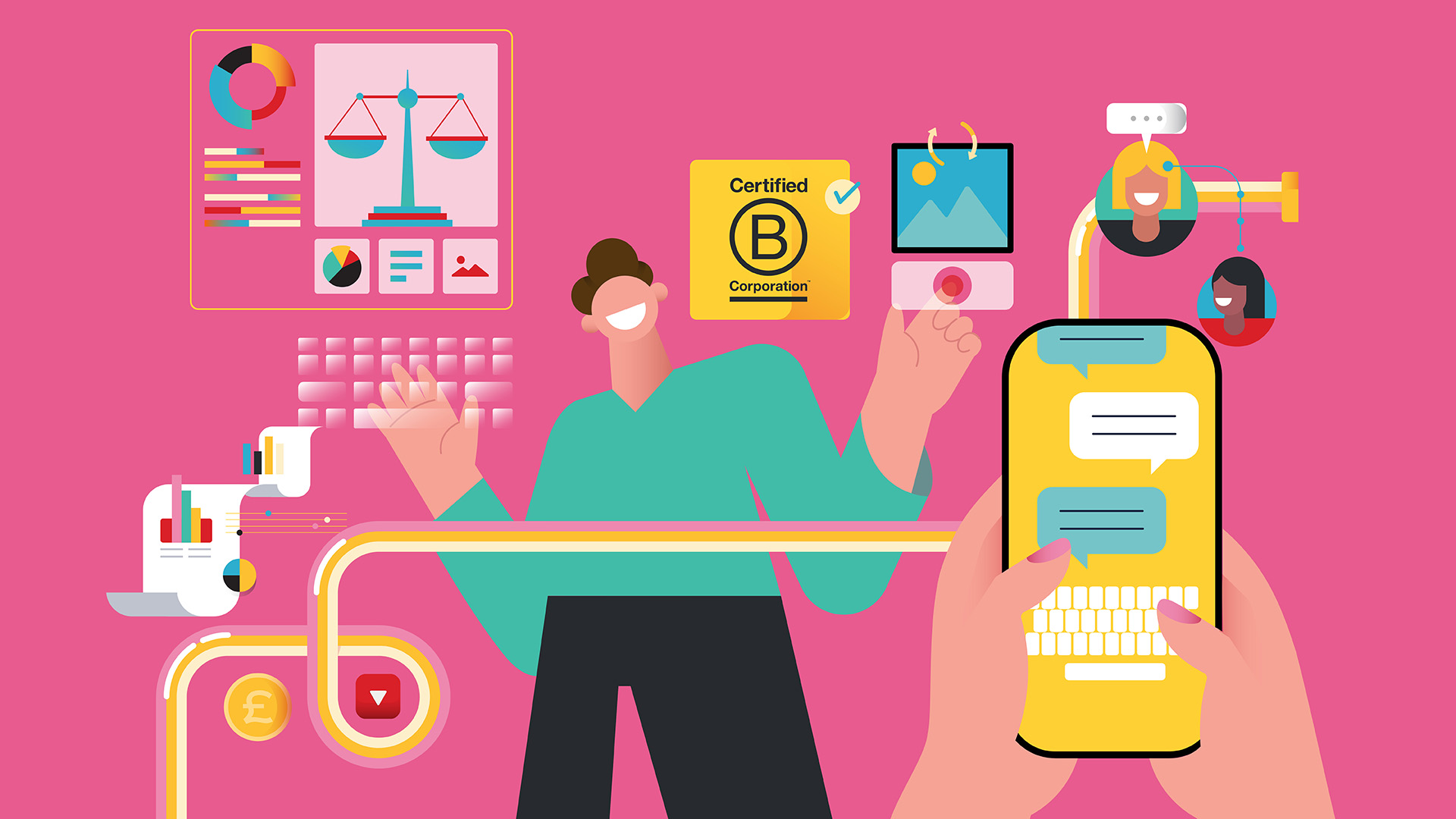
Illustration: FERNANDO VOLKEN TOGNI
Advertorial from giffgaff
Share
The “impact economy” is often treated as a niche. A corner of the market focused on doing good rather than creating economic value.
But that perception is increasingly out of date.
Research from New Philanthropy Capital estimates that the UK’s impact economy — spanning impact-led businesses, credit unions, universities, housing associations, community interest companies and charities — contributes hundreds of billions of pounds annually to the economy and employs millions of people. Far from sitting on the periphery, it is becoming a meaningful and growing part of how economic value is created.
That matters because the pressures facing the UK today — including rising living costs, widening inequality and the accelerating climate transition — cannot be addressed by any single sector acting alone. They require scale, collaboration and long-term thinking. They also require businesses that recognise their role in shaping systems that work better for the people who rely on them.
That is one of the reasons I was drawn to giffgaff.
From the beginning, giffgaff challenged how the mobile market worked. It introduced a member-powered model that gives real influence to the people who use its services. It removed unnecessary complexity and rejected many of the industry’s traditional pricing tactics. The principle was and remains simple: treat people fairly and build the business around that idea.
Advertising helps fund Big Issue’s mission to end poverty
Advertisement
In doing so, the company demonstrated something important. Serving members well is not a moral gesture or a marketing tactic. It is a commercially sound way to build a durable business.
Today, that same mindset is shaping how we think about broadband and the broader role connectivity plays in modern economic life.
Access to reliable connectivity is no longer optional. It underpins participation in the labour market, access to education and public services, and the ability to navigate everyday life. Without it, people are increasingly excluded from the systems that shape their prospects.
At giffgaff, we focus on reducing the barriers that prevent people from getting online. That means simple, good-value connectivity: rolling monthly plans, bill certainty without mid-contract increases, and affordable refurbished phones that make it easier for more people to participate in the digital economy.
Partnerships also matter. Our collaboration with Big Issue is one example of how business can expand opportunity in practical ways. By combining devices, digital skills and community support, we are helping vendors and jobseekers strengthen their earning potential and improve access to work.
Fairness also means designing technology that works for people rather than against them. In practice, that means plain English instead of fine print, transparency instead of hidden catches and systems that help members find better value over time.
Advertising helps fund Big Issue’s mission to end poverty
Illustration: FERNANDO VOLKEN TOGNI
It also means recognising the wider responsibilities that come with operating at scale. Supporting a more circular technology economy through refurbished devices, encouraging recycling, accelerating the adoption of eSIM and investing in nature are all part of building a business that remains relevant in a changing world.
These are not side projects. They are part of how modern companies earn and maintain trust.
As a certified B Corporation, we hold ourselves to higher standards across people, planet and profit. The B Corp framework helps ensure those principles are embedded in how the business operates rather than treated as an afterthought.
One of the most distinctive aspects of giffgaff is its community. Our members act as an early warning system, an idea engine and a source of accountability. They identify problems quickly, share insights and help shape the direction of the business.
Communities like this also reveal something broader about the economy itself.
Across the UK, millions of people are building livelihoods through everyday work, freelance gigs and side businesses. It is the 99% of people finding ways to create something better for themselves and their families.
Advertising helps fund Big Issue’s mission to end poverty
But the support around them has not always kept pace. Access to tools, networks and guidance is still uneven, even though these are often the things that turn hard work into progress.
Connectivity is part of that foundation. But it is only the starting point.
Companies that sit close to people’s everyday lives have a chance to do more than simply provide a service. They can help create spaces where people share ideas, learn from one another and access tools that help them move forward. Over time, environments like this can open new paths for people working hard to build stability and independence through their own initiatives.
For us at giffgaff, the question is simple: how do we make connectivity a catalyst for people building the lives they want on their own terms?
That is where the impact economy becomes real. It is not about choosing between social value and economic value. The most resilient businesses recognise that the two strengthen one another.
As I begin this role at giffgaff, my priority is to build on the strong foundations already in place, scale what works and continue shaping a business where fairness is embedded.
Advertising helps fund Big Issue’s mission to end poverty
Because when systems work better for people, they do more than improve companies. They strengthen communities, expand possibilities and build a more resilient economy for the long term.
Buy from your local Big Issue vendor every week – and always take the magazine. It’s how vendors earn with dignity and how we fund our work to end poverty.
Advertising helps fund Big Issue’s mission to end poverty