Can we build enough reservoirs to escape the jaws of death?
The UK’s drought has wide-reaching implications – exacerbated by the demand for water from AI
by:
30 Jan 2026
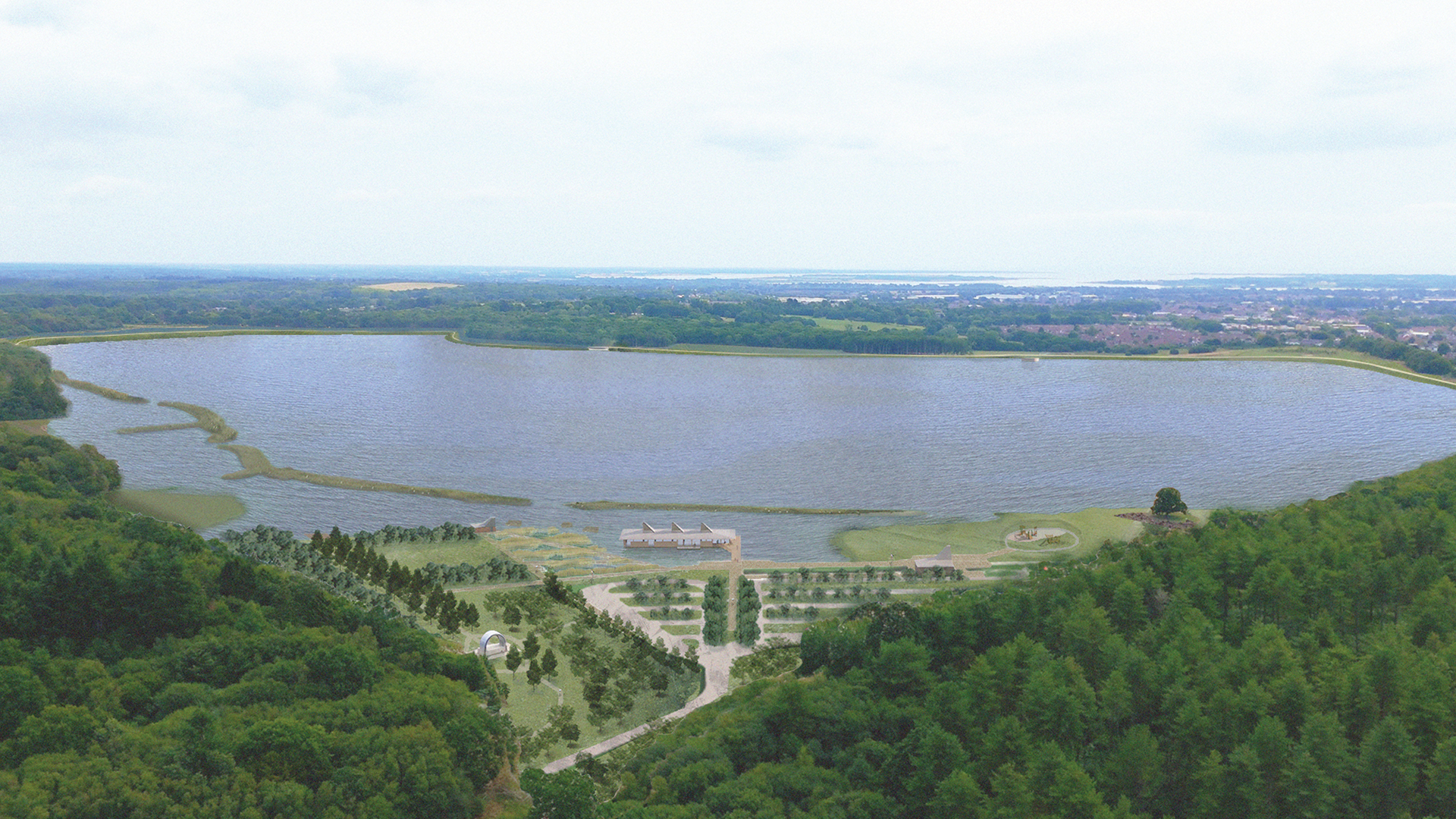
A visualisation of Havant Thicket reservoir, due for completion around 2031
Share
In 2019, attendees at a conference held by the non-profit Waterwise heard a stark warning from a man named Sir James Bevan, who at the time was the chief executive of the Environment Agency.
Bevan had been looking at the business plans produced by water companies and noticed something they all had in common. In every business plan, there was a graph with two lines snaking across it. One line showed water demand in the region served by the companies.
This line went up, as more homes and businesses crowded in. The other line showed the supply of water. Thanks to the effects of climate change, this line went down. Somewhere around 2040, the lines crossed over.
“And that, ladies and gentlemen,” Bevan said, “is the jaws of death – the point at which, unless we take action to change things, we will not have enough water to supply our needs.”
Just to be sure, Bevan told his audience: “Self-evidently, avoiding something called the jaws of death is by and large the sensible thing to do.”
Advertising helps fund Big Issue’s mission to end poverty
Advertisement
That was 2019. The UK’s situation now appears to be more dire. No new drinking water reservoir has opened since privatisation in 1992. Last year, Keir Starmer’s government ordered construction of two major reservoirs in Lincolnshire and East Anglia. It wants seven others to be built by 2050. In the meantime, supplies get more stretched.
August was the hottest since records began, with rainfall just 42% of its average. Low reservoir levels meant 20% of the Canal and River Trust network was closed. Even with the summer well in the rear-view mirror, East Anglia and parts of Wessex remain in “prolonged dry weather status”, while some areas of Sussex are still experiencing drought conditions.
The result is half-full reservoirs, with a warning from the Environment Agency that the average reservoir level is 25% lower than it should be. Bevan has warned that without action, the amount of water available in England could fall by 15% by 2050. The Environment Agency tells Big Issue: “In the face of a changing climate, securing our water resources must be a national priority.”
Stretching beyond taps, baths and hosepipes, the UK’s drought has wider implications. It throws our ability to rise to the housing crisis into doubt. And as AI data centres come into view, the demands on water grow. Positive signs are to be found near Portsmouth, where work is ongoing for the first new major UK reservoir in over 30 years. The Havant Thicket reservoir will hold up to 8.7 billion litres of water, bringing with it rejuvenated green space, a visitor centre and improved woodland.
“Excellent progress has been made on site in 2025, and we achieved several major construction milestones,” Bob Taylor, CEO of Portsmouth Water, tells Big Issue. Headway has been such, that the company are in an “excellent position” for the next phase of work, Taylor adds.
Advertising helps fund Big Issue’s mission to end poverty
A lack of water is holding houses back
The government believes that better water efficiency will help it meet its promise to build 1.5 million new homes by 2030. But developments in Lincolnshire and East Anglia are being held up because there is not enough water to supply them – with new reservoirs seen as key to getting the building going.
The ability to take water away from homes is a problem too. In Northern Ireland, developers are being told they can’t build due to a lack of wastewater capacity. The issue stretches beyond Northern Ireland. Almost 30,000 new homes – including 7,000 affordable homes – are currently blocked due to fears over a lack of wastewater capacity, a report by the Home Builders Federation (HBF) found in September.
A ‘frenzy’ of AI data centres
A Google data centre under construction at Waltham Cross. Image: Maurice Savage / Alamy
Our descent into the jaws of death is complicated by AI. A popular method for cooling the warehouses containing computers powering tools like ChatGPT is water. Data centres for AI in Scotland are already using enough water to fill 27 million bottles each year.
“It feels like there is a frenzy of construction and planning and proposed planning of data centres. Companies are piling in because they think there’s money to be made from the AI boom – or bubble – and they’re getting very significant encouragement from the government,” says Donald Campbell, director of advocacy at Foxglove, a tech justice campaign group. The number of data centres in the UK is projected to grow by 20% in the next five years.
“There doesn’t seem to be any thought for the environmental consequences,” Campbell adds.
“Are we carrying the environmental costs on behalf of tech billionaires?”
Advertising helps fund Big Issue’s mission to end poverty
It is, Campbell says, hard to hold behemoth companies to account on promises they make – while extra water demands from AI data centres could in turn place extra strain on housing. An objection from Anglian Water to plans for the largest data centre in the UK gave a hint of the fears: “Our primary concern is the ‘jaws of death’ facing potable water resources — essentially, there is no real need for sites such as data centres to be using clean, treated drinking water for cooling servers.”
As these problems intersect and the jaws grow closer, there appears to be little firm plan, says Kevin Grecksch, associate professor of water and environmental governance at the University of Oxford.
“Whether it’s AI or housing, there’s no integrated thinking happening, says Grecksch. “I think this is one of the biggest mistakes.”
Reservoirs will take time to build. Consumer solutions focus on using less water. Leakage will be targeted. AI data centres will be pushed towards less water-guzzling cooling methods. But some reach for more radical answers.
“As the UK seeks to expand housing supply, we need more of the infrastructure required to build viable and properly resourced communities,” says Mathew Lawrence, director of the Common Wealth think tank.
“Taking back control of our water to invest in the infrastructure we need should be a critical part of this mission.”
Advertising helps fund Big Issue’s mission to end poverty
Buy from your local Big Issue vendor every week – and always take the magazine. It’s how vendors earn with dignity and how we fund our work to end poverty.