Numbers have since dropped after tighter visa rules and higher salary thresholds – but with knock-on effects for the NHS and social care.
“Even the most committed Brexiteer would have to admit that Brexit has been an abject failure on the terms Leave set itself on migration,” said George Newth, lecturer in politics at the University of Bath.
“It was based on a false premise of being able to control something that was outside of any government’s control to a certain extent, external migration and workflows.”
Brexit has helped entrench a harder political tone around borders, normalising narratives associated with the far-right.
“The whole right-wing discourse around stopping the boats and stronger borders is now very much part of political conversation across the spectrum,” he added.
2. Leave: “Take back control of our laws”
The 2018 Withdrawal Act ended EU law supremacy and converted EU rules into domestic “retained EU law”. Parliament can now amend or repeal them.
Advertising helps fund Big Issue’s mission to end poverty
In practice, most remain. Around 6,925 EU-derived laws are still on the statute book as of January 2026. Keeping them is more practical than replacing them.
Brexit was always more an emotive argument than a practical one, Newth said. “This idea of ‘taking back control’ is a Pandora’s box, really. Because where does that end?”
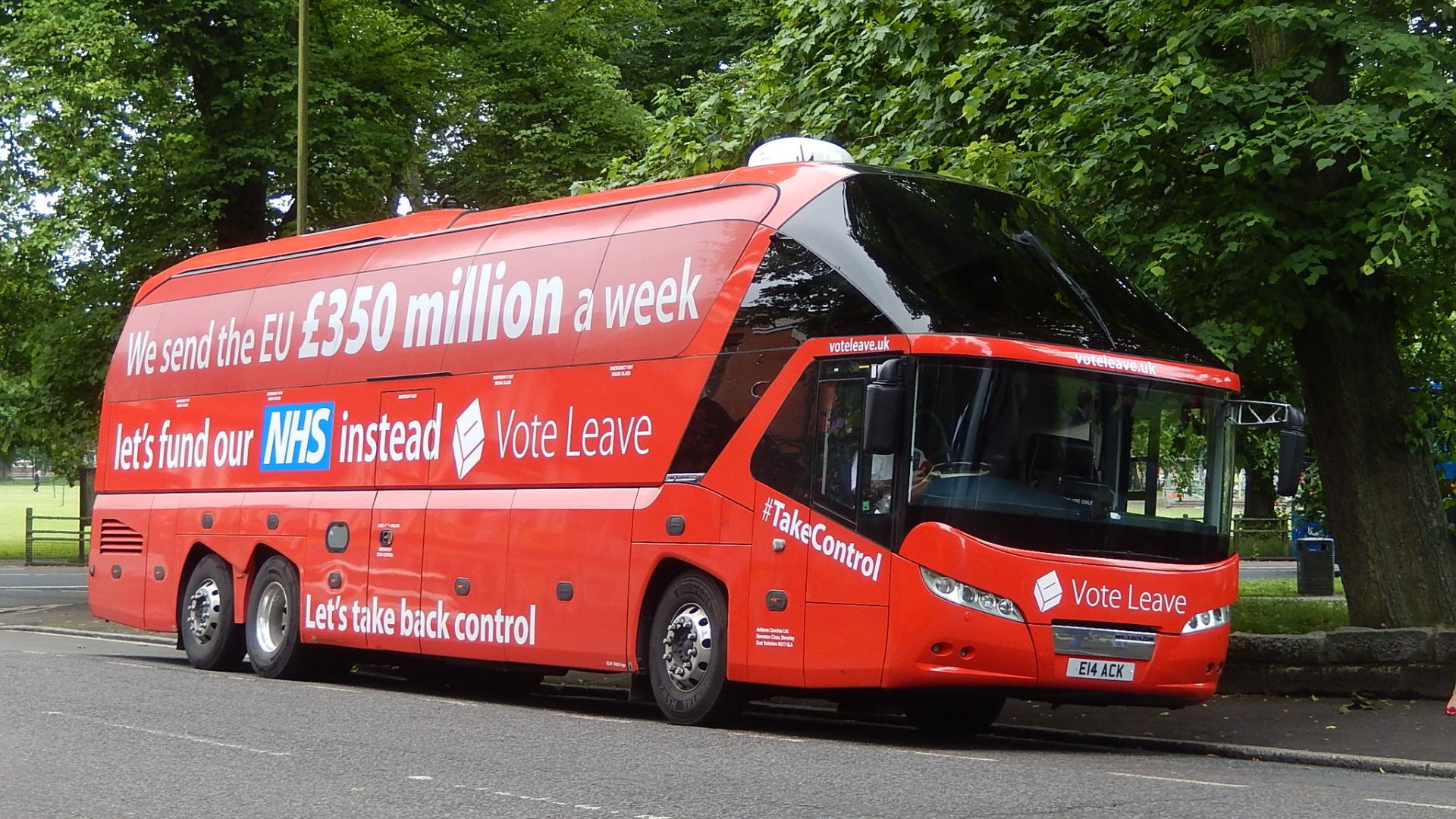
3. Leave: Stop handing over £350 million a week to Brussels and give it to our NHS instead
We all remember the big red bus, plastered with the Leave campaign’s claim that “we send the EU £350 million a week”.
“Let’s fund our NHS instead,” the coach declared.
This figure was false; according to the UK Statistics Authority it represented a “clear misuse of official statistics.”
It was more like £250 million a week – but we also got money back from the EU.
Advertising helps fund Big Issue’s mission to end poverty
“In any case, the impact on the economy from changes to trade after leaving the EU is likely to be far bigger than savings from the UK’s membership fee,” Full Fact found.
The politicians pledging to redirect EU money into the health service were often the very same politicians that stripped out vast amounts of funding during austerity, said Newth.
“The bigger lie was that any of that money was going to go back into the NHS. It was kind of a big distraction technique, really… politicians such as Michael Gove saying ‘let’s spend this on our NHS instead’. Well, how about not cutting that funding from the NHS in the first place?”
The NHS budget has increased since Brexit – but this is not funding that has been rediverted from the EU.
4. Leave: “Protect British fisheries”
Leave promised to quit the Common Fisheries Policy (CFP), become an “independent coastal state”, and “take back control” of UK waters.
Under the CFP, quotas for shared stocks were divided between member states according to decades-old catch records. Many British fishermen argued this meant EU boats hauled in far more fish from UK waters than UK boats did from theirs.
Advertising helps fund Big Issue’s mission to end poverty
More than nine in 10 fishermen were reported to back Leave in 2016.
On paper, Leave succeeded. Under the Trade and Cooperation Agreement, the UK formally left the CFP. The deal phased in a transfer of around 25% of the value of the EU’s fishing quotas in UK waters to the UK fleet between 2021 and 2026. But that’s a modest gain compared to the 80% the industry wanted. And new paperwork, health certificates and border checks hit shellfish and fresh exports especially hard.
5. Leave: “The Irish border would be unchanged”
“The situation [at the Irish border] would be absolutely unchanged,” Boris Johnson said in 2016.
But it has changed. When the UK left the EU’s customs union and single market; the Republic of Ireland didn’t. But a hard border on the island of Ireland risked breaching the Good Friday Agreement, key to the end of the Troubles.
The solution was the Northern Ireland Protocol, later revised as the Windsor Framework. Instead of checks on the Irish land border, checks moved to the Irish Sea. Northern Ireland continues to follow some EU goods rules to keep the border invisible. 56% of Northern Irish voters voted Remain. Some studies show that support for a united Ireland has surged since the Brexit vote.
6. Remain: “It will hurt the economy”
The economy didn’t collapse overnight (that drama came later under Liz Truss).
Advertising helps fund Big Issue’s mission to end poverty
But most independent analysis finds lasting damage. The Centre for European Reform estimates GDP is 6–8% lower than it would have been without Brexit with business investment 12–18% lower. The Office for Budget Responsibility projects a long-run GDP hit of around 4%.
7. Remain: Trade will suffer
The EU is still the UK’s largest trading partner. In 2024, exports to the bloc were £358bn (41% of the total) and imports £454bn (51%).
Tariffs were avoided under the Trade and Cooperation Agreement, but non-tariff barriers remain. Government data show goods exports to the EU in 2024 were 18% below 2019 levels in real terms.
8. Leave: Wages will rise
Most economists, including the OBR, find no clear Brexit-wide wage dividend. Recent pay growth has been driven more by inflation and post-pandemic shortages than structural gains.
Banseka Kayembe, founder of Naked Politics, says the promised dividend never arrived.
“Many Brexit campaigners… claimed that restricting immigration from the EU would reduce the amount of workers, which in turn would drive up wages for UK workers. A decade on, we haven’t seen that play out,” said Keyembe.
Advertising helps fund Big Issue’s mission to end poverty
“Wage growth has been squeezed mostly by high levels of inflation, the introduction of AI automation and weak productivity. There’s been no magic gains from restricting people’s movement from the EU.”
9. Leave: The Union will be stronger
“If we vote to leave, then I think the union will be stronger,” Boris Johnson argued in 2016.
Instead, Brexit galvanised campaigners for an independent Scotland. Scotland voted 62% Remain and put independence back up the news agenda. A YouGov poll from last November showed the Scottish public remains split on independence with 49% backing it and 51% against.
In Northern Ireland, post-Brexit arrangements destabilised power-sharing; Northern Ireland had no devolved government for several years as disputes rolled on.
10. Leave: “Leaving the EU lets the UK do big trade deals around the world”
Vote Leave suggested that outside the EU, the UK could strike free trade agreements with countries like the United States and Australia, compensating for increased friction with Europe.
The UK can now negotiate its own agreements. But progress has been gradual, and the economic gains modest. These are mostly “rollover” deals, that the UK enjoyed anyway as an EU member.
Advertising helps fund Big Issue’s mission to end poverty
Recent turbulence under Donald Trump – including renewed tariff threats – has shown that negotiating alone is very different from acting as a 27-nation bloc with the economic weight of the EU behind it.
However, among the first wave of tariffs Trump slapped on other nations, the UK managed to negotiate a 10% tariff which was among the lowest. But both the UK and other European nations have still faced the threat of higher tariffs over opposition to Trump’s plans for Greenland.
Do you have a story to tell or opinions to share about this? Get in touch and tell us more.
Change a vendor’s life this winter.
Buy from your local Big Issue vendor every week – and always take the magazine. It’s how vendors earn with dignity and how we fund our work to end poverty.
You can also support online with a vendor support kit or a magazine subscription. Thank you for standing with Big Issue vendors.
Advertising helps fund Big Issue’s mission to end poverty