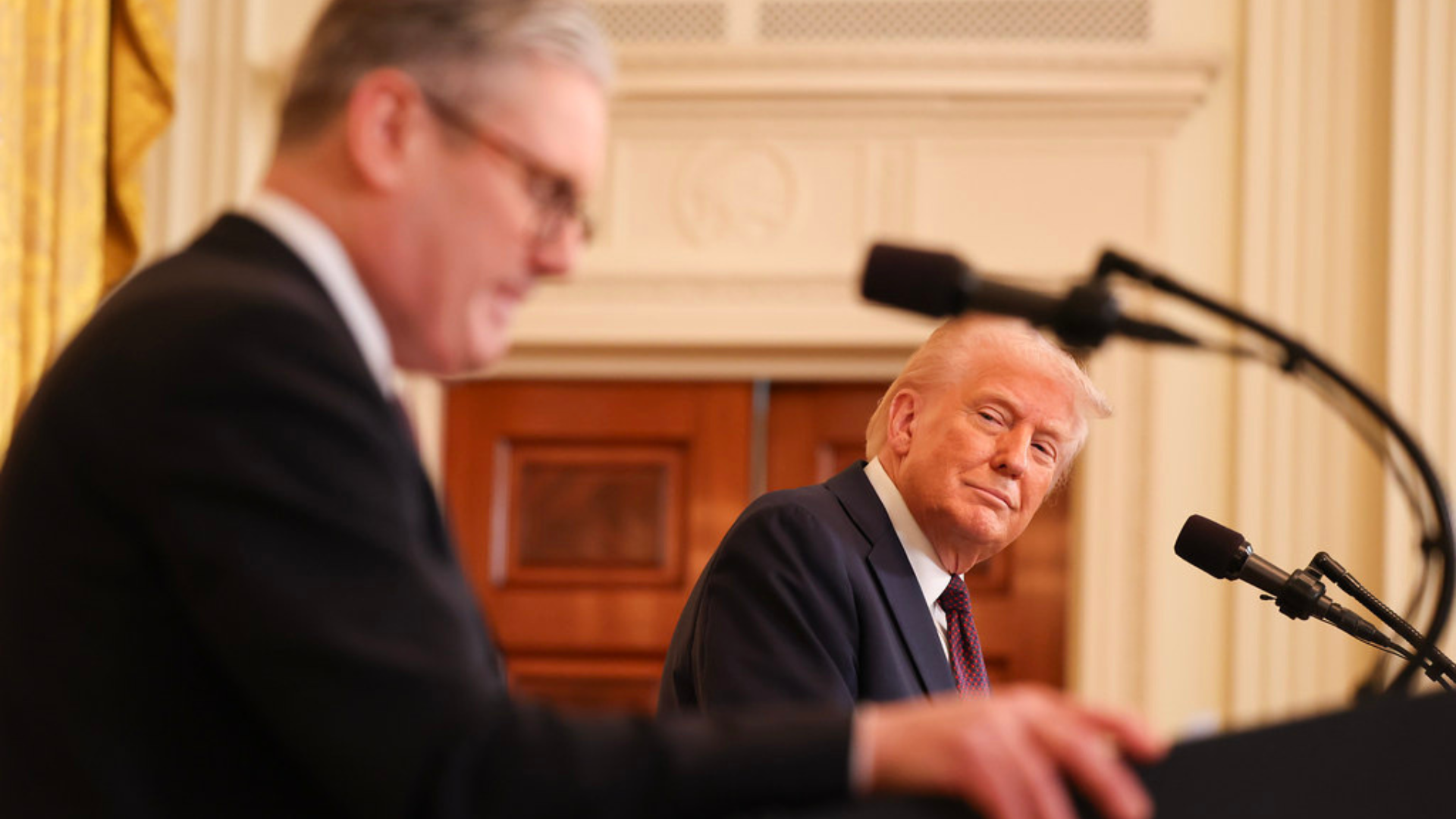
While the legal merits of Trump’s claim will now be tested in court, media analysts argue that the lawsuit’s wider significance lies less in whether it succeeds and more in what it reveals about how political pressure is exerted on public-service media.
Des Freedman, professor of media and communications at Goldsmiths, University of London, said the scale of the lawsuit should be understood as part of a broader pattern in Trump’s relationship with journalism.
“A lawsuit instigated by the US president and talking of billions of dollars in damages is designed precisely – indeed overwhelmingly – to pressure the media and to chill speech that is critical of his administration and his person,” he told Big Issue.
Freedman added that the likelihood of Trump securing the damages he is seeking is not the central issue.
“It seems highly unlikely that a lawsuit heard in Florida, where there is no evidence that a single person actually watched the Panorama in question, will award Trump the billions he wants,” he explained. “But it is simply a part of his war on any media outlet that dares to offer even the gentlest criticism.”
Trump has previously brought high-profile legal actions against major US media organisations, several of which have ended in multi-million dollar settlements. Press freedom groups argue that such cases demonstrate how litigation can function as a form of leverage even when the legal arguments are contested.
Advertising helps fund Big Issue’s mission to end poverty
In a statement published last week, the UK Anti-SLAPP Coalition – a working group championing freedom of expression and anti-corruption – said Trump’s threat against the BBC should not be treated in isolation, pointing to what it described as a long record of legal action used to intimidate or silence critical reporting.
Influence without a paper trail
The lawsuit has reignited debate in the UK about political pressure on the BBC, particularly following a turbulent period for the corporation that has included senior resignations, parliamentary scrutiny and renewed questions about governance and editorial standards.
Politicians across parties have warned that the perception of political influence alone can damage trust in the broadcaster. Yet clear evidence of direct interference in editorial decision-making is rarely available.
According to Freedman, this absence of proof is characteristic of how influence operates.
“Public broadcasters are often the first to feel external pressure because of the numerous links – in relation to funding, regulation or the appointments process – between the government and the individual media organisation,” he said.
Those links, he added, do not require explicit instructions to shape behaviour. Instead, pressure is often exerted through legal risk, reputational threat and institutional uncertainty – forces that are felt internally but rarely visible to audiences.
Advertising helps fund Big Issue’s mission to end poverty
“Public media often operate on quite fragile ground and have to negotiate between representing the interests of their audiences – in the case of the BBC, its licence fee payers – and the strategic interests of the administrations that set the terms of reference for the media,” Freedman said.
This structural vulnerability helps explain why political pressure on the BBC is frequently discussed but rarely demonstrable. There are no leaked memos or recorded phone calls. What the public sees instead are outcomes: apologies, leadership changes, defensive statements and heightened caution.
Jurisdiction, cost and uncertainty
One aspect of Trump’s lawsuit that has drawn attention from campaigners is where it has been filed. The case is being heard in Florida, despite the Panorama episode not being broadcast in the United States, and with questions over how many American viewers could access it.
While the BBC is expected to challenge jurisdiction, press freedom groups argue that the process of litigation itself can exert pressure regardless of the outcome. Even unsuccessful cases can expose organisations to prolonged uncertainty, significant legal costs and the risk of extensive disclosure demands.
The UK Anti-SLAPP Coalition has highlighted the escalation of Trump’s demands – from an initial threat of at least $1bn to a filed claim of $10bn – as particularly striking given that the BBC had already apologised for the edit and withdrawn the programme before legal action was taken.
Campaigners argue that the absence of any clear justification for the scale of damages sought reinforces concerns that the lawsuit is intended to send a message rather than secure legal redress.
Advertising helps fund Big Issue’s mission to end poverty
‘A signal to the rich and powerful’
Similar concerns have been raised by international press freedom organisations, which warn that cases of this scale can shape behaviour far beyond the courtroom.
Clothilde Redfern, executive director of Reporters Shield, said the filing of a multi-billion dollar lawsuit by a political leader sends a broader signal about how the legal system can be used against journalism.
“When a political figure files a lawsuit of this scale, it indicates that it’s OK for the rich and powerful to waste the court’s time on intimidating and silencing journalism,” Redfern told Big Issue.
Redfern said the use of so-called SLAPP suits – Strategic Lawsuits Against Public Participation – has been growing steadily in recent years, with cases designed less to succeed legally than to deter scrutiny and investigative reporting.
“In this case the BBC did make an editing error, they apologised and the program is no longer available,” she said. “I don’t believe this lawsuit is born out of a genuine need for redress. It’s just the latest move in a well documented strategy to discredit the press in general.”
Signs of a chilling effect
While the BBC has insisted it will defend itself, critics say the impact of Trump’s legal threat may already be visible beyond the Panorama case itself.
Advertising helps fund Big Issue’s mission to end poverty
The UK Anti-SLAPP Coalition has pointed to reports that a recent Reith Lecture by the Dutch economist Rutger Bregman was edited to remove a line describing Trump as “the most openly corrupt president in American history”.
Bregman later said the sentence had been approved through the BBC’s editorial process and delivered to a live audience, but was removed from the broadcast version following a decision taken “from the highest levels” of the corporation. He described the change as “self-censorship driven by fear”.
The BBC has not publicly linked that decision to Trump’s lawsuit, but campaigners argue the episode illustrates how legal threats can influence editorial decisions without any court ruling.
“These kinds of threats don’t just target one programme or one journalist,” the coalition wrote, warning they can encourage organisations to avoid potential liability by steering away from contentious subjects altogether.
Charter review and public trust
The lawsuit has coincided with the launch of the government’s review of the BBC’s royal charter, which will examine how the broadcaster is funded, governed and regulated beyond the current charter’s expiry in 2027.
Lisa Nandy, the culture secretary, has said the BBC “must remain fiercely independent, accountable and be able to command public trust”, while acknowledging concerns about political appointments to its board and the perception of influence.
Advertising helps fund Big Issue’s mission to end poverty
The BBC receives around £3.8bn a year in licence fee revenue, alongside other income streams. Critics argue that the public nature of its funding makes it particularly vulnerable to political pressure – but also makes it harder for the corporation to quietly settle legal claims.
Freedman said that dynamic places additional responsibility on the BBC to resist intimidation.
“The BBC can’t afford to bow down to Trump if it’s to retain journalistic legitimacy, given that its whole ethos is about ‘fearless’ and independent reporting,” he said. “Licence fee payers will expect the corporation to vigorously defend itself, not least as a warning to authoritarian figures everywhere who are determined to curb speech and weaken opposition.”
As the legal process unfolds, US courts will determine whether Trump’s claims have any basis under defamation law. But for critics of political interference in public institutions, the lawsuit has already highlighted something harder to adjudicate: how power is exercised through law, cost and timing – and why the influence that follows is often felt long before it can ever be proven.
Do you have a story to tell or opinions to share about this? Get in touch and tell us more.
Change a vendor’s life this Christmas.
Advertising helps fund Big Issue’s mission to end poverty
Buy from your local Big Issue vendor every week – or support online with a vendor support kit or a subscription – and help people work their way out of poverty with dignity.