Politics on ice: Greenland casts shadow over US vs Denmark ice hockey clash at Winter Olympics
As US–Denmark tensions over Greenland continue, experts explain why the US vs Denmark Winter Olympics hockey clash could carry political significance.
by:
14 Feb 2026
11 of Denmark’s ice hockey team have played in North America’s National Hockey League, including Lars Eller. Eller was the first person from Denmark to win the Stanley Cup in 2018, playing for the Wasington Capitals. Credit: Wikimedia Commons
Share
Following weeks of tension over Greenland, US secretary of state Marco Rubio and Danish prime minister Mette Frederiksen are expected to meet at the Munich Security Conference this weekend.
They won’t be the only American and Danish delegations crossing paths: on Valentine’s Day no less, the US vs Denmark face off in a men’s preliminary-round ice hockey match at the Winter Olympics.
For Timothy D. Sisk, professor of international and comparative politics at the University of Denver’s Josef Korbel School, the timing of the fixture is inseparable from the current diplomatic climate.
“Oh, it’s politically significant,” Sisk tells Big Issue.
“It reminds everyone that this is an international conflict that shouldn’t be. These are NATO members. This particular international dispute didn’t need to happen.”
Read more:
Advertising helps fund Big Issue’s mission to end poverty
As of May 2025, Denmark was ranked 8th in the International Ice Hockey Federation (IIHF), while the United States appears in the top spot. The US’s first Olympic match of this year’s game against Latvia resulted in a 5-1 win, whilst Denmark’s first game against Germany ended in a 1-3 loss.
Historically, the Danish team has beaten the US just twice in the history of the IIHF, once in 2003 and once in 2010. But we’ve already seen an unexpected win on the ice at this year’s Games, when Slovakia (ranked 9th) beat reigning Olympic champions Finland 4–1 on 11 February.
“These things matter when they’re upsets,” Sisk nods. “Which is what happened in the Slovakia-Finland match. It was an upset. And so if there’s an upset where the Danish team prevails over the US team, this will become highly symbolic.”
Sisk compares the upcoming match to the long-running US-Mexico football rivalry.
“Really, the most interesting analogy that I could see is the long history of US-Mexico football rivalry, where you have a punitive underdog. It’s an opportunity for Mexico to assert its rightful equality, or to assert its national identity against a much more dominant foe.
“I think the US vs Denmark match will be particularly politically symbolic if Denmark wins.”
Advertising helps fund Big Issue’s mission to end poverty
The match takes place amidst a Winter Olympics already marked by geopolitical tension.
The games have seen Ukraine’s skeleton athlete Vladyslav Heraskevych barred from competing after continuing to wear a helmet displaying images of athletes killed since Russia’s invasion of Ukraine. Meanwhile, two members of the US freeski team (Hunter Hess and Chris Lillis) have publicly criticised recent US immigration policies, and American figure skater Amber Glenn said ahead of her gold-medal performance that LGBTQ+ Americans were facing “a particularly difficult moment” at home.
Debate has also resurfaced around participation rules. Russia invaded Ukraine in February 2022, just days before the Winter Paralympics were due to begin in Beijing. The country was banned from international sport for breaching the Olympic Truce. Russian athletes have since competed under “Individual Neutral Athlete” status; at this year’s Games, 13 Russians and seven Belarusians are participating under that designation and were excluded from the opening ceremony.
Ukaleq Slettemark and Sondre Slettemark, siblings from Greenland, are competing in the biathlon under the Danish flag. Greenland does not have its own recognised national Olympic committee, meaning its athletes must represent Denmark. While they cannot use the Greenland flag on their racing suits, they have incorporated a design inspired by it into their kit.
For Jörg Krieger, an associate professor at the Department of Public Health at Aarhus University, Denmark, the flags themselves at the Olympics are a political statement.
“I wrote a book last year where I discussed national flags and national symbolism at the Olympics in general,” he tells Big Issue. “And I think the only way forward for sports organisations, particularly the IOC, is to say, ‘Okay, well, either we drop that political symbolism altogether, because a political flag is a political symbol, and if you say sport and politics have nothing to do with each other, you cannot use the political symbol.’ Or you have to admit that politics does play a role. But the way it is, as it is, is quite hypocritical.”
Advertising helps fund Big Issue’s mission to end poverty
Israel’s participation in Milano-Cortina has similarly prompted protest, with critics drawing parallels over the enforcement of the Olympic Truce during the ongoing conflict in Gaza.
“The Russians are not allowed to be there, and Israel is allowed to be there,” Krieger points out. “So there’s definitely something happening here where there is favouritism towards certain countries. And of course, others will argue against that and say, well, there are different cases, but I think that it appears selective in certain instances.”
A brief history of sport diplomacy
Sports diplomacy has often been used for ‘soft power purposes’ by powerful countries, including the US and the Soviets, Sisk explains.
“The most interesting cases come from 1948, when the Soviet football team did a series of four friendly matches in the UK. This was right after the war, and among those observing it was none other than George Orwell.
“Orwell wrote a really interesting essay on the sporting spirit in which he blamed the fans, and particularly nationalistic fans, for what today we would call the psychological process of displacement.”
The process involves fans ‘displacing’ their own national identities and interpreting the athletes wearing their national symbols.
Advertising helps fund Big Issue’s mission to end poverty
”Orwell tells us that the fans displace their own virtue onto the pitch such that they see in their own teams, their own kind of identities and national identities. But Orwell reminds us what is running or jumping or kicking a ball or slapping a puck actually have to do with the virtue of a country or the virtue of a people? It’s a sporting event. It’s supposed to be about play and physical recreation and fun.
“So that’s why Orwell called these kinds of events a war minus the shooting. Sometimes he called it mimic warfare.”
Like war, there have been instances where tensions between competing teams have manifested in the arena. Krieger points to an infamous water polo game from 70 years ago.
“I would highlight the match between Hungary and the Soviet Union,” he says.
“That was just weeks after the Soviets had suppressed a revolution in Hungary against the communist superpower, and then those two nations met in the semifinal of the water polo. And water polo is quite a brutal sport. It’s called the blood in the water because eyewitnesses said the water was red and bloody.”
Hungary won 4-0, defeating the USSR in the semi-final match at the Melbourne Olympics.
Advertising helps fund Big Issue’s mission to end poverty
“It’s still different to the US vs Denmark game this year”, Krieger clarifies, “but it’s an example of where you have a sort of superpower and a smaller nation involved.”
Sisk points to another 1956 match as a comparison for the upcoming ice hockey game.
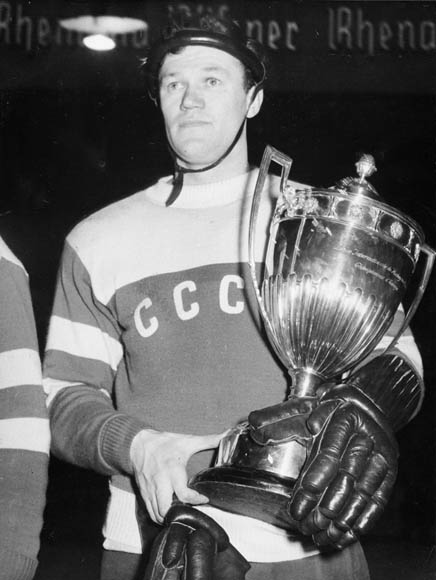
Vsevolod Bobrov with the Soviet Team in the 1956 Olympic Ice Hockey Tournament. Wikimedia Commons
“We go back to the appearance of the Soviets in Olympic hockey in 1956, where they won the gold medal in ice hockey on their Olympic debut,” he explains. “For me, it’s the most interesting one in terms of a small, seemingly weaker country taking on a global powerhouse and winning.
“And then in 1980, there was the so-called ‘Miracle on Ice’ when a US team made up primarily of amateur players defeated the heavily favoured Soviet team. The Soviets had effectively professionalised amateur sport, so many of the Soviet players could be considered professional athletes. That one was an upset.”
In December 2025, 45-years after their historic win, the team was awarded the Congressional Gold Medal by president Donald Trump, the highest honour given to American civilians by Congress.
“Hockey has been politicised,” Sisk adds. “Some of those athletes [from the team] we’re seeing onstage with President Trump during the campaign, at political rallies and things. So some athletes choose to become involved in the political arena.”
Advertising helps fund Big Issue’s mission to end poverty
Sportswashing
The US is headed into what the White House has described as a “decade of sport”. Later this year, the FIFA World Cup will be hosted across 16 cities, 11 of them in the United States.
In 2028, Los Angeles will host the Summer Olympics. Salt Lake City, Utah, then follows with the winter games in 2034. The US is also expected to stage the Women’s FIFA World Cup and the Rugby World Cup in 2031.
“This leaning into the decade of sport and whatnot really goes back to how this administration sees sport as a way to project power nationally, to project a so-called soft power in a really hard world,” Sisk explains.
Both Sisk and Krieger suggest sportswashing is at play with the US’s increased hosting of major sporting events. The concept is when a country uses a sports event to ‘wash itself clean’ of a negative reputation. In the last decade, Saudi Arabia has been widely accused of sportswashing, particularly in light of its human rights record.
“Sportswashing is done by all types of regimes, but it’s perfectly favoured by autocratic regimes,” Sisk explains. “This is not anything new, and certainly not anything new for far-right regimes.
“All eyes are on the FIFA World Cup in June, no doubt about that. There are so many dimensions to the politicisation and symbolism of the FIFA World Cup, though I’m not sure it’s actually going to be pulled off because of these threats and boycotts.”
Advertising helps fund Big Issue’s mission to end poverty
Last month, the former FIFA president, Sepp Blatter, suggested that he supported fans boycotting the World Cup matches in the US after he tweeted, “I think Mark Pieth [a Swiss anti-corruption lawyer who said fans should stay away from the US] is right to question this World Cup,” to his 1.3 million followers on X.
“There is huge concern about the role of ICE [Immigration and Customs Enforcement] at the World Cup,” Sisk adds. “There is this fear of potential detention, which is an incredible fear to face, if you’re an athlete or a fan coming to watch a match. This is a real violation of the role of sport seeking to be neutral.“
Is it just a game?
Krieger sees the US vs Denmark ice hockey match as much more politically insignificant than Sisk, and cites his experience interviewing Cold War hockey players.
“I’m doing an oral history project where I visit a lot of Danish Olympians who were athletes in Cold War times,” he says.
“All the history we teach and we learn is about ‘the tensions’. And there were the Russians, and there were the Americans, but they were just athletes to them. It was just about performing. It didn’t matter whether they were playing the Soviets, Norwegians or Americans; they wanted to win.
“The sporting competition for them was about the sport. It wasn’t about politics. And my feeling is that this has not changed much.”
Advertising helps fund Big Issue’s mission to end poverty
Will Krieger still be watching the match, though?
“I will absolutely watch this. Because I think there’s a study there to see what the Danish media, television media refer to during the game, because they might be more political than they usually are.”
And Sisk?
“I will be watching it delayed, and probably won’t jump up early. I will watch as much of the Winter Olympics as I possibly can,” he says. “It’s interesting to think about that particular match, as there’ll be an interpretation of symbolism, whether the athletes want it or not. But what will be very interesting, too, is how the athletes themselves behave.
“I think what we’re going to see is extremely good behaviour on the part of the athletes. I do think the match could contribute to, at least among the populations in Denmark and in the US, a kind of understanding that ‘We’re old friends. This little thing over Greenland was a big mistake.’”
The United States plays Denmark at 20:10 GMT on Saturday, 14 February –watch live on BBC iPlayer
Advertising helps fund Big Issue’s mission to end poverty
Buy from your local Big Issue vendor every week – and always take the magazine. It’s how vendors earn with dignity and how we fund our work to end poverty.