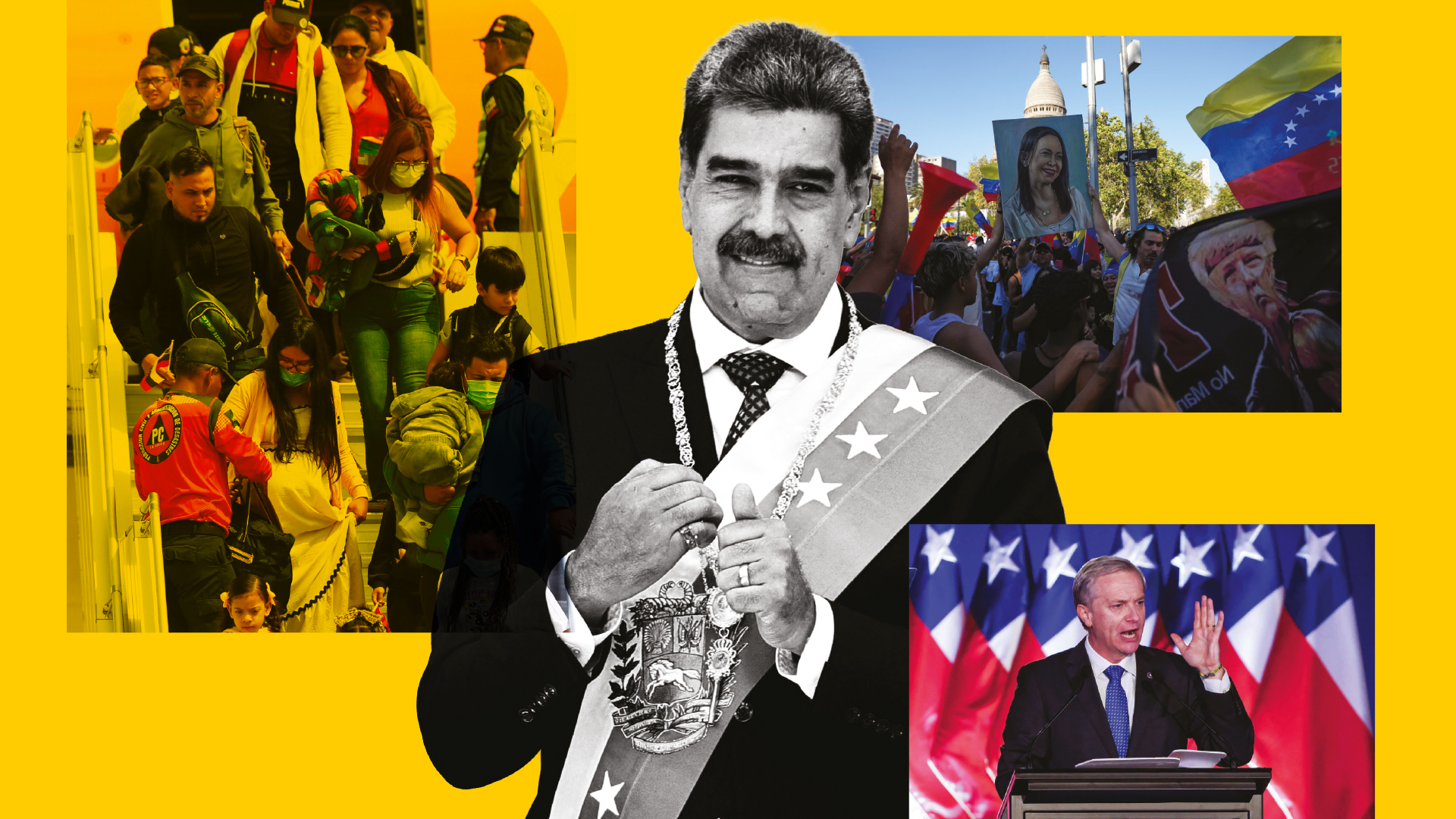
Maduro’s rule has been marked by hyperinflation, a 75% reduction in GDP and widespread political repression. These conditions have led to massive migration – primarily to other South American countries. Currently, Venezuela’s neighbour Colombia hosts close to three million Venezuelans; Peru has around 1.7 million, followed by roughly half a million each in Brazil and Chile, among many others.
Following the rigged July 2024 elections in Venezuela, migration from the country surged. According to R4V, an inter-agency platform, between May and August 2025 the number of Venezuelans moving from Colombia to Ecuador increased by 77%, compared to the same period the previous year. Similarly, the increase of Venezuelans moving from Ecuador towards Peru increased by 17%. These migratory flows have not been without political consequences.
Initially, many Latin American nations coordinated their response to the Venezuelan migratory crisis. Governments came together in Ecuador to sign the Quito Declaration in 2018, which committed them to ensuring the safe and regular migration of Venezuelan citizens.
However, with public backlash to rising immigration, this cooperative spirit soon began to unravel. Chile, Ecuador and Peru introduced visa restrictions in 2019, making it much harder for ordinary Venezuelans to enter their countries legally. In a recent study, I found that these restrictive measures, instead of deterring migrants, drove migratory flows underground, with significant costs both for migrants and host countries.
As is currently the case in the UK and Europe, rising immigration, linked to a rise in the perception of criminal activities, often associated – rightly or wrongly – with migrants themselves, has fuelled the rise of far-right political leaders across the region. The parallel expansion of drug cartels’ activities across South American nations and the spread of the Tren de Aragua, a Venezuelan criminal outfit, have led to the widespread perception that Venezuelan migrants are the cause of the increase in criminality.
These heightened security concerns have led to the recent election in Chile of José Antonio Kast, a far-right politician who ran on a security-focused platform promising the mass expulsion of Venezuelan migrants residing irregularly in the country.
Advertising helps fund Big Issue’s mission to end poverty
Whether mass deportations are feasible remains unclear. Chile will need the cooperation not only of Venezuela but also of other host nations – such as Colombia and Peru – that will both have presidential elections in 2026 and no clear incentives to cooperate. Meanwhile, the dangerously volatile situation in Venezuela, coupled with the shift in migrants’ preference away from migrating to the United States (at least for the time being), presents a double challenge that governments across South America cannot simply wish away.
So where is Venezuela heading in 2026? Following Trump’s intervention on 3 January, three scenarios seem possible.
One: a continuation of the status quo. Trump’s abduction of Maduro has so far led to no shifts in the current power structure. Delcy Rodríguez, Maduro’s vice-president, was swiftly recognised as the successor, with the rest of the regime’s key figures keeping their positions. If this situation solidifies and oil production does not increase, as Trump suggests it will, a continuous stream of Venezuelans leaving their country seems inevitable.
Two: regime change could take place, leading to the gradual re-establishment of democratic and state institutions, such as the national assembly, the judiciary and the military. Opposition leader and Nobel-prize winner María Corina Machado and the rightfully elected president, Edmundo González, could return to lead the country out of its current mess. This best case – and very unlikely – scenario would see many Venezuelan migrants come back to help reconstruct their nation.
Three: the worst-case scenario. Maduro’s abduction leads to a power struggle that could bring instability and internal conflict. While the current Venezuelan opposition and analysts have downplayed the risk of a ‘Libya-style scenario’, it would be wrong to dismiss it outright. This would see Venezuelan migration skyrocket, leading to further regional instability.
Except for the second scenario, the losers are always Venezuelans. Instead of exploiting Maduro’s absence to push for democratic reform, the US de facto act of war has been wasted on a cinematographic abduction with little to show for it.
Advertising helps fund Big Issue’s mission to end poverty
What can governments in the region do? Chile’s president-elect’s promises of mass deportations are clearly not policy, but theatre. A pragmatic approach would look different: establish both safe and legal migratory routes and regularisation pathways, and conduct contingency planning for all three scenarios. Millions of Venezuelans have already voted with their feet. The question is whether Latin American democracies will recognise this reality, or be consumed by it.
Dr Omar Hammoud Gallego is assistant professor in public policy at the School of Government and International Affairs, Durham University.
Do you have a story to tell or opinions to share about this? Get in touch and tell us more.
Change a vendor’s life this winter.
Buy from your local Big Issue vendor every week – and always take the magazine. It’s how vendors earn with dignity and how we fund our work to end poverty.
You can also support online with a vendor support kit or a magazine subscription. Thank you for standing with Big Issue vendors.
Advertising helps fund Big Issue’s mission to end poverty