How Big Issue came up from the streets, 35 years on: ‘It was the most chaotic, beautiful madness’
From uncertain beginnings, Big Issue went on sell hundreds of thousands of magazines a week and change countless lives
by:
18 Sep 2026
Share
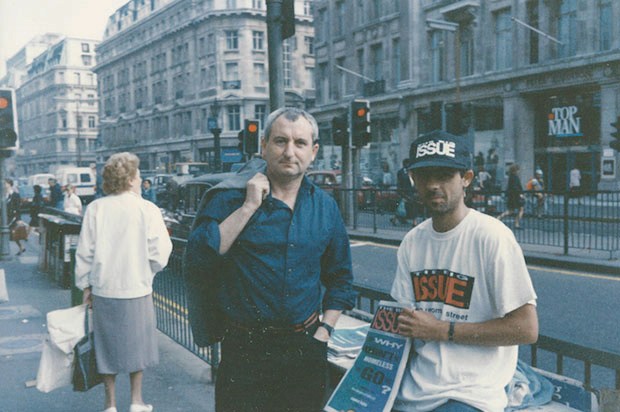
It’s 11 September 1991. At the 265-year-old St Martin-in-the-Fields church, something new is being born. Here, on the corner of Trafalgar Square, John Bird and Gordon Roddick are preparing to launch their pioneering new social enterprise, the Big Issue. The BBC, ITV and more are on their way, all curious to hear more about this so-called ‘street paper’, an American idea designed to shake up the streets of London. For them, it’s a golden opportunity to sell their idea to an audience of millions. But there’s just one problem – they haven’t got any vendors.
“Well, it was a bit chaotic,” Bird concedes, 35 years later. He’s gathered with a small group of old colleagues – old friends – to reminisce about the formation of Big Issue for the Radio 4 show The Reunion. This is just one of many amusing scrapes he chooses to share with the show’s half a million listeners, unfiltered as ever.
“We’d been around to all the places where the homeless were sleeping, and many, many of them had said: ‘Oh, we’ll come along for the launch’… and then five of them rolled up. We had a lot of press because Anita Roddick [Gordon’s wife, the CEO of The Body Shop] was all over it. So they were coming along and, as we only had five vendors, we had to kind of dress them up differently. I remember a cameraman saying to me, ‘I think I saw this bloke down the Charing Cross Road!’”
Veteran broadcaster Kirsty Wark is tasked with the tricky job of hosting The Reunion, fighting to keep order as the many voices in the room compete to tell their own version of the story.
She asks Pete Bird, John’s brother and Big Issue’s first vendor distribution lead, what he remembers about the launch. “I wasn’t invited. I was too busy selling magazines,” he tells her.
“You were there!” John shoots back.
Advertising helps fund Big Issue’s mission to end poverty
Advertisement
“Was I?” Pete retorts, “I’m not in the photograph.”
“Nor am I,” chips in Phil Ryan, the first deputy editor, “You were doing the papers and I was doing… other things.”
So how did these two unlikely friends – Roddick, a multimillionaire businessman, and Bird, an ex-offender and ex-rough sleeper turned printer – come to start a business together?
Keep reading the journalism that powers our mission
Register free to continue and learn more about the stories, campaigns and the support we provide, helping people facing poverty across the UK.
“I met him when I was 21,” John remembers. “I was hiding from the police in Edinburgh and I met him in a pub. We had an argument about noses – because we both had big, broken noses – and it bonded us. We became mates. I didn’t see him for 20 years, and he’d morphed into a multimillionaire. As soon as I realised there was this geezer with a shedload of money, I approached him. And eventually, he said to me, would you take the chance of doing a street paper in London, because he’d seen a street paper in New York. And I said, eventually, yes.”
Did Roddick know how this street paper would work? Did he have a clear vision?
“Well, he didn’t have much of an idea. All he knew was that there were people selling papers on the streets, and it was a crime-prevention programme, which was brilliant. As an ex-rough sleeper and an ex-offender myself, I thought this is exactly what we need to be doing for the homeless.”
Advertising helps fund Big Issue’s mission to end poverty
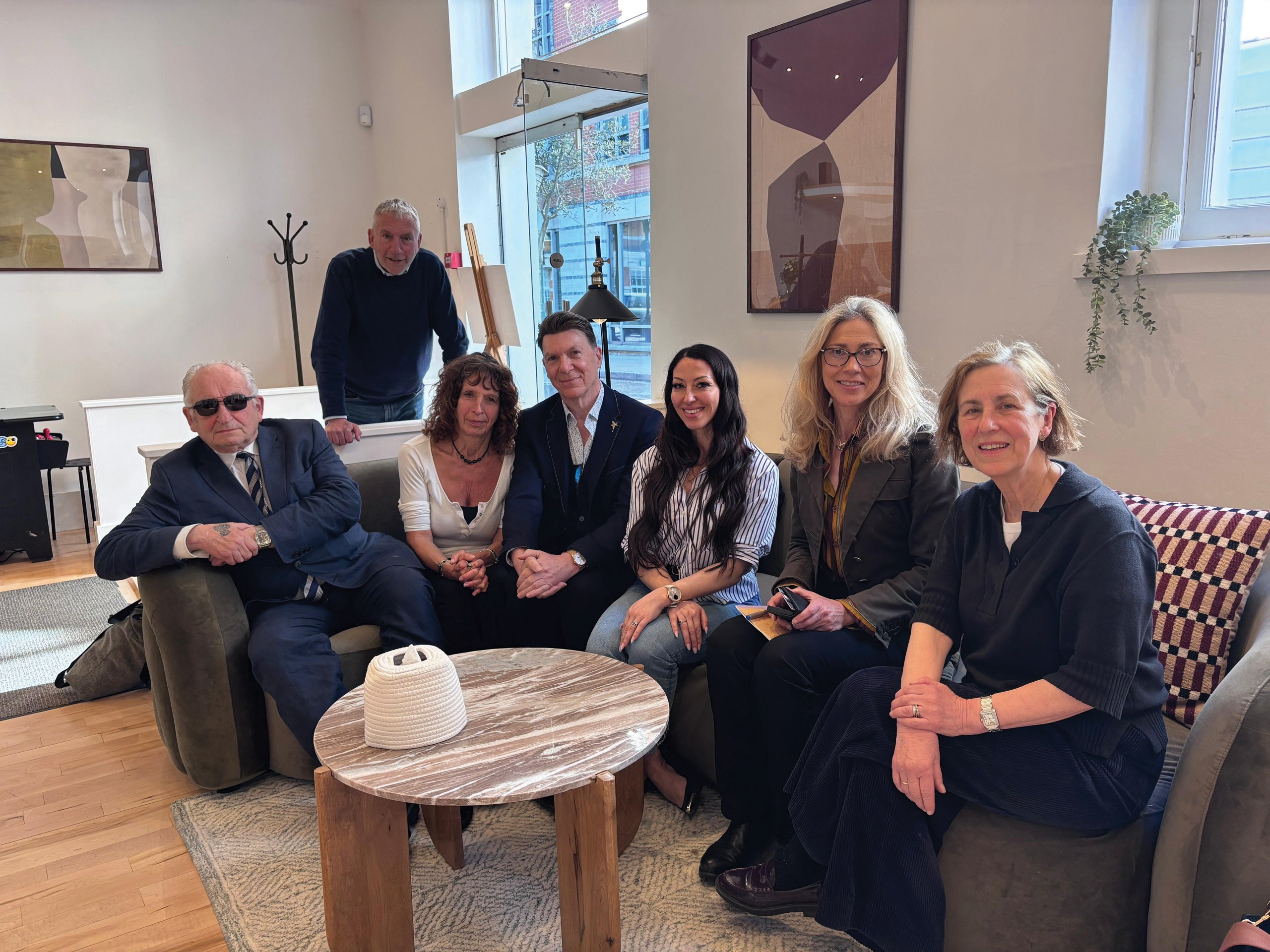
(From left) John Bird, Pete Bird, Lucie Russell, Phil Ryan, Sabrina Cohen-Hatton, Lucy Johnston and Kirsty Wark, on the day of recording The Reunion
In 1991, there were more than 6,000 people sleeping rough in the capital. In the West End of London, in Lincoln’s Inn Fields, and in the huge encampment on the South Bank known as ‘Cardboard City’ – now the site of the BFI Imax – homelessness was rife. Thousands were sleeping along the Strand; on Aldwych. It puts today’s levels of rough sleeping into stark perspective (4,793 rough sleepers were counted in the whole of England in the autumn of last year).
Into this chaos the Big Issue was born, conceived as a new kind of medicine for this epidemic – a “business solution to a social crisis”, as Lucie Russell, the first CEO of the Big Issue Foundation, puts it. Vendors would buy their magazines at cost price and sell them to make a profit, working to earn a legitimate income. A hand up, not a handout.
“We weren’t, and aren’t, a charity,” John insists. “I don’t want to give somebody something for nothing. I want to give people an opportunity to change their lives. This is what Gordon Roddick and I stood by. And we’ve never changed that trajectory.”
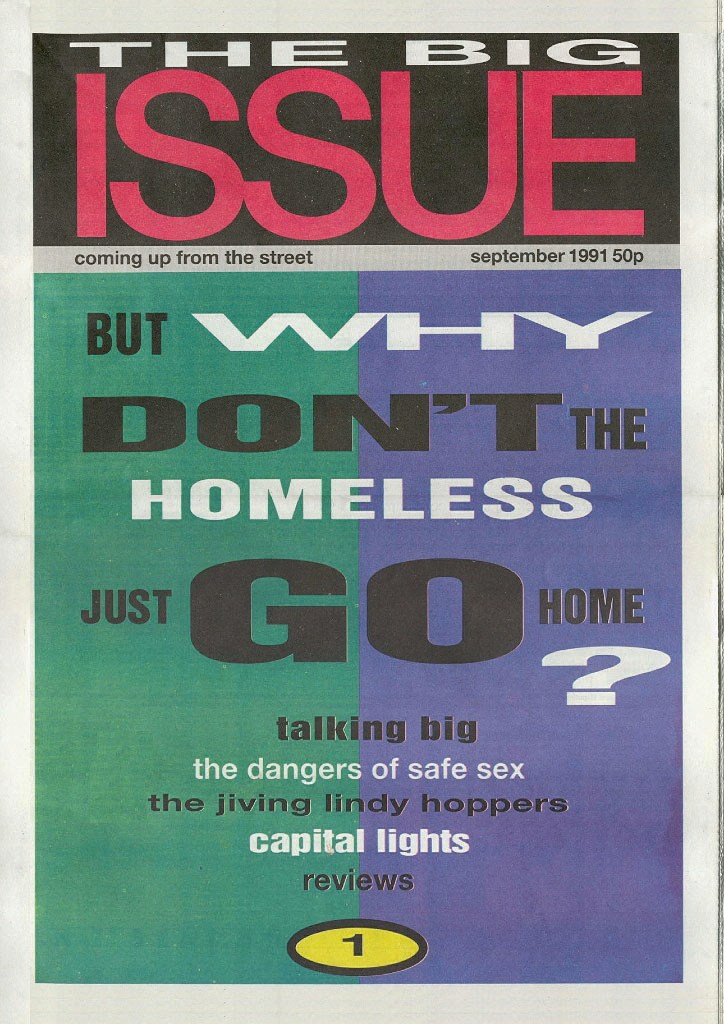
The first edition of Big Issue
How did rough sleepers themselves react to this idea? “Very cynically,” according to Ryan. Selling the model in hostels and shelters was no easy task. He remembers turning up with John Bird’s son Paddy in tow, hoping the presence of a teenager might soften some of the hostility.
“A lot of the rough sleepers didn’t like us, because the first thing they asked is, ‘What you gonna give us?’ And we said, ‘We’re not gonna give you anything. You’re gonna give us some money.’ It was a difficult one.”
And so, we reach September 1991, with just five vendors having to swap outfits between TV appearances to create the illusion of a wider take-up. The Big Issue seemed destined for failure before it had even begun, John recalls: “The next day we had no vendors. The next day we had no vendors. And it went on for about a week.
Advertising helps fund Big Issue’s mission to end poverty
“Then suddenly one guy called Ray Gray, who was one of our favourite vendors, came and said, ‘I’d like to buy another 50 papers’. And lo and behold, behind him came a whole phalanx of people. So it took about a week or two, but we went from 10 vendors to 20 to 50, to 100 to 500 vendors.”
“Suddenly they all got on board,” Russell remembers. “We had a vendors’ meeting one day. There were hundreds of people in this place in Chester Square.
“Me and Pete were in the van at the end of it. And John said, ‘Right go and get your Big Issues’, and they ended up chasing the van down the road! They were desperate for the magazines.”
So now they had vendors. But what about a magazine for them to sell? Lucy Johnston, later associate editor of Big Issue and a senior reporter for The Observer and the Express, was one of the Big Issue’s first writers. “It was totally chaotic. There were sometimes 20 people in an office that had two desks. We’d be sitting on the floor. We’d have to share one computer. We actually would say, do you think we’re going to get this magazine out?!”
Stories would come from unusual places, Ryan remembers. “My friends used to ask me, what’s this John Bird like? I said, he’s a bit like Rabbit out of Winnie the Pooh. He always turns up with 65 other people you weren’t expecting. So we had lots of volunteers turning up and giving us stories. We put the magazine together in a slightly shambolic way at first, but it looked good enough to sell.”
Advertising helps fund Big Issue’s mission to end poverty
Lucie Russell started as a volunteer. “I said to John after a while, ‘I’m going to give up my other job. How long do you think the Big Issue is going to last? Will it last until Christmas?’ And he said, ‘I don’t know’. But, however many years later, we’re still here.”
Jeopardy was never far from the door. “We were all spending Body Shop money,” John says, “and we were getting through it at a very, very fast rate. In June 1992, Gordon Roddick said to us, I’m not giving you any more money. You’ve got three months, and if you don’t sort it out, then I’m going to pull the plug. That was a terminal moment in the history of the Big Issue.”
The key to fending off this peril? Big Issue had begun to establish a foothold in contemporary culture. Journalists like Johnston were getting access to major celebrities, household names who helped raise the magazine’s profile. “It took off, it felt like people wanted to be part of it,” Johnston remembers.
Image: Chris Barham / ANL / Shutterstock
“We got Oasis and Irvine Welsh. We had this celebrity questionnaire and we would interview Ruby Wax, Eddie Izzard, Spike Milligan… you felt like you were part of something cool. Celebrities wanted to be seen to be doing something that was useful and helpful. And that really helped with our credibility.”
Celebrity interviews were only part of the story. The Big Issue was also building a reputation for hard-hitting, trailblazing journalism.
“We became trusted by sources, and we broke a few stories,” Johnston says. “I’d go and stay in a crack den, I’d go out with prostitutes. We’d get stories from the streets.”
Advertising helps fund Big Issue’s mission to end poverty
BBC news anchor Sophie Raworth cut her teeth volunteering for the Big Issue in 1992. “I think the first article I ever wrote was for the Big Issue, the first thing that was ever published in my name.
“It was a great big learning process. I loved the journalism and what you were doing, having such a purpose.”
Raworth departed for the BBC in 1992. “I was sent to Manchester about a year later, and suddenly the Big Issue went to Manchester. It had an office there, a proper big office. You were no longer in the basement of a pub. It really burst out onto the scene at that stage. I remember feeling very proud of it.”
“Because of the good magazine, the public bought into it,” says Pete Bird. “So the public wanted the magazine, so gradually the vendors we got on board realised they could sell it.
“It was almost a badge of honour when you were walking along and you had bought a Big Issue. People would have it in their bags, in their hands, saying: Look, I’m socially aware.”
At its height in 1997, Big Issue topped the circulation figures for UK weekly current affairs magazines, with national sales of 280,000.
Advertising helps fund Big Issue’s mission to end poverty
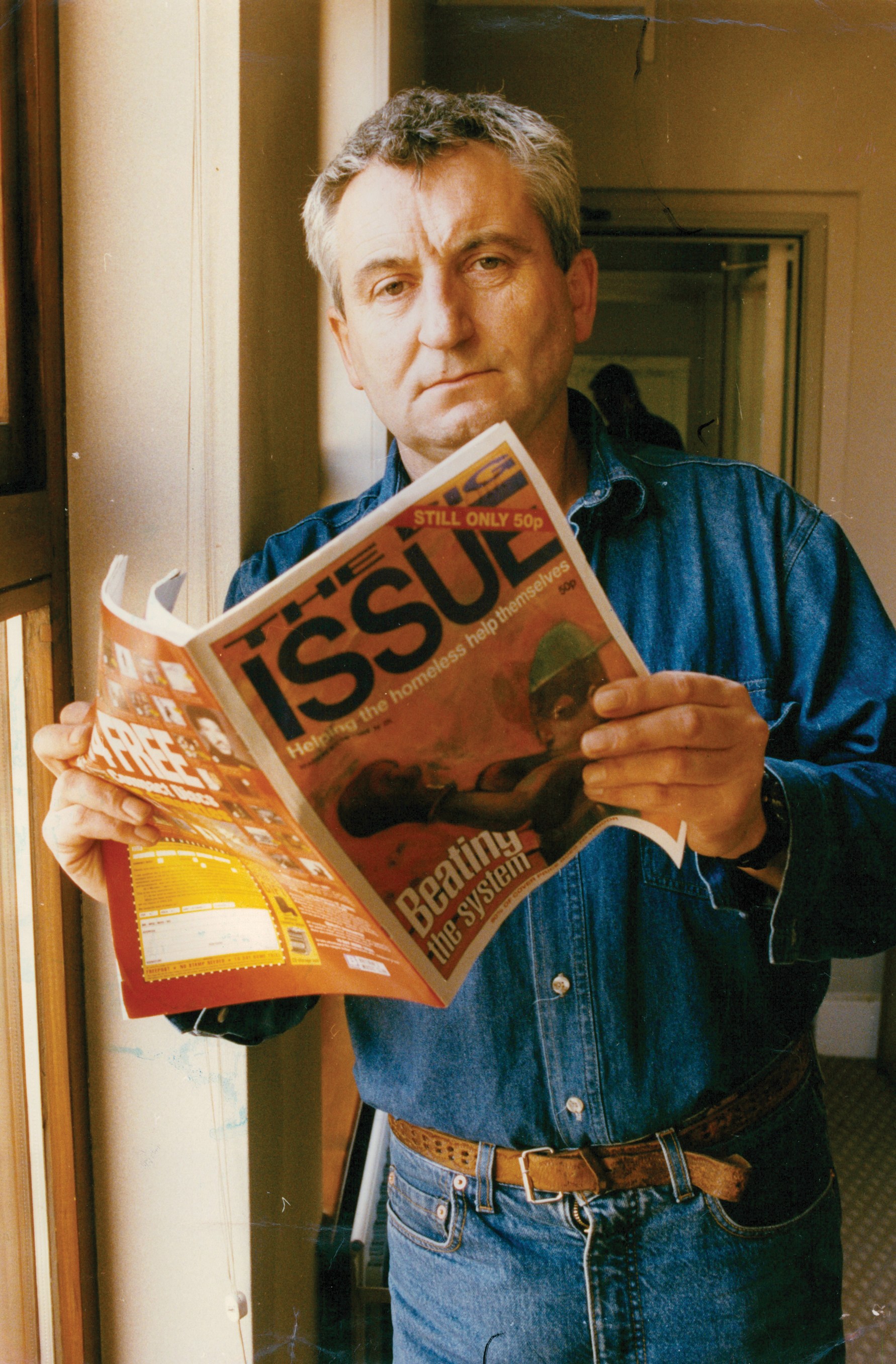
Big Issue founder John Bird with a vendor in London
But how was this filtering down to the streets, to Big Issue vendors themselves? Sabrina Cohen-Hatton, now one of the country’s leading firefighters, was feeling the impact of this publishing revolution in Newport, South Wales, where she’d started sleeping rough at the age of 15.
“I went down to the office, I got badged up and I started selling the magazine,” she remembers, “and it instantly gave me some hope.
“You’re coming from a position where you are literally sat there and treated like you’re a ghost. People walk past you like you’re not even there. You feel so lonely and isolated. You start to think that you’re worthless. So being able to stand there, buy a magazine for cost price and sell it on for a profit – it made me feel like I was working. It gave me confidence to speak to people, even when I didn’t feel like it, even when I just wanted to curl up in a ball and disappear, I knew I still had to get up and sell some magazines because I needed to eat.
“The Big Issue saw me. They saw me as I was and they met me there, and that flexibility enabled me to be really practical.
“It meant that I could earn something without it being taken away in a heartbeat. And I think that’s important to so many people. When you are rough sleeping, life is chaotic. It’s not possible to live by a set of prescriptive rules, and that’s why so many of the interventions fail.”
The word that recurs through all this – the launch, the magazine, the vendors – is chaos. It’s a description John Bird wears like a badge of honour. “It was the most chaotic, beautiful madness,” he says happily.
Advertising helps fund Big Issue’s mission to end poverty
“What I really liked, and I want to sell this idea to people – if you start off knowing exactly what you want to do, then you’re probably doing the wrong thing. Because as Bonaparte said, the most useless thing on Earth, is a battle plan. But you need it. So you need a plan, but then you go off plan.
“I wouldn’t put any money on my ability to do this again. It was chance, it was happenstance, and I kind of fell in love with the people I worked with – even though sometimes I use certain expletives to describe their characteristics.”