Why doing nothing is the biggest gamble for free TV
The debate on how to protect free TV is ongoing but failing to act risks damaging British telly, writes chair of the Future TV Taskforce Jonathan Thompson
by: Jonathan Thompson
17 Mar 2026
Existing licenses for TV are set to expire in 2034 and the government is considering whether an aerial-accessed service will be provided beyond that date. Image: Glenn Carstens Peters / Unsplash
Share
Television is changing, and so is the way it is delivered into our homes. With current broadcast licences due to expire in 2034, the government is reviewing how free-to-air television will be provided in the future. No decisions have yet been taken, but this review creates a natural point to reflect on how audiences watch TV today and how best to secure universal access for the long term.
It is important to be clear: 2034 is not a “switch-off date” selected by broadcasters. It is simply the point at which existing licences expire, meaning the government must review what comes next. The debate is about how to protect free television – not whether it should continue.
Affordability and access rightly sit at the heart of this conversation. For millions of people, free television is an essential public service, and we believe everyone should be able to access it, regardless of income or circumstance. The question for the government is not whether free TV should continue, but how it can be delivered most effectively and sustainably in the years ahead.
How are people watching TV today?
For many households, watching television via the internet is already part of everyday life. Catch-up and on-demand services now account for a significant share of viewing, and live channels are increasingly accessed through connected TVs and streaming devices.
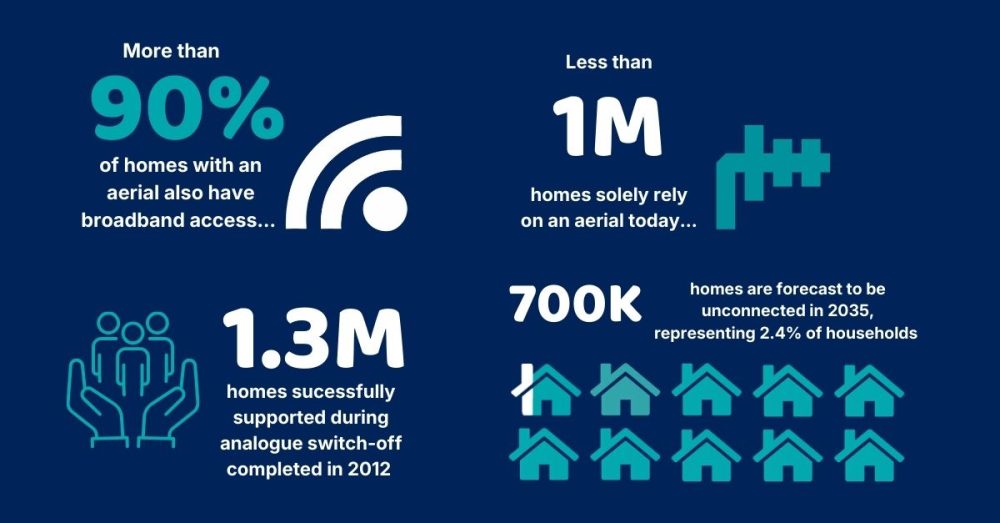
While around 10 million homes still have an aerial connected, that figure does not mean 10 million households rely solely on that aerial. Fewer than one million homes currently lack broadband and rely entirely on digital terrestrial television (DTT). The vast majority of homes with an aerial – over 90% – also have broadband access.
So, having an aerial connected does not necessarily mean it is the only way people watch. In reality, many households now combine broadcast and streaming, and live television is increasingly streamed via Wi-Fi.
Advertising helps fund Big Issue’s mission to end poverty
Advertisement
The number of homes without broadband is also shrinking quickly. Forecasts suggest that by 2035 around 700,000 homes will not have internet access, and recent trends show broadband uptake is happening faster than expected.
Image: Future TV Taskforce
Ensuring nobody is left behind
That does not mean change should happen without care. Any long-term transition must put audiences at the centre and focus on the minority who are not yet able to stream, ensuring they have the information and support required to access free streamed television.
We know support schemes work and have been done well in the past. The UK successfully supported households during the analogue-to-digital switchover between 2007 and 2012, with a targeted help scheme for older and disabled viewers. In practice, fewer households required assistance than initially expected, and the programme came in under budget.
Helping a relatively small, yet important, number of households connect is a manageable task, one that brings wider benefits beyond television, including access to healthcare services, job opportunities, consumer savings and online public services.
Moving television online does not mean losing free access. Free-to-air channels will remain free at the point of use and, for most households, there would be no additional cost – only improved functionality.
Advertising helps fund Big Issue’s mission to end poverty
Internet-delivered television offers features many viewers already value:
· The ability to pause and restart live TV
· On-demand access without needing to record programmes
· Voice search and simpler navigation
· Enhanced subtitles and audio description
· Higher definition picture quality
Advertising helps fund Big Issue’s mission to end poverty
Research also shows that traditional aerial reception is not without disruption issues. A significant proportion of aerial viewers report repeated signal issues, while internet reliability continues to improve year on year. In short, the experience becomes more flexible and accessible.
Futureproofing British content
Beyond how people watch, there is the question of how free television can remain sustainable for the long term. Delivering television through both aerial and internet infrastructure involves significant and increasing costs for broadcasters. As audiences continue to move online, policymakers must consider how to protect universal access while ensuring public service broadcasters can continue investing in British content.
Large sums spent maintaining ageing infrastructure serving a shrinking audience mean less funding available for news, drama, entertainment and factual programming made in and for the UK. The strength of British television lies not in how it is delivered, but in the content itself, and ensuring broadcasters can continue investing in that content is what ultimately protects universal access.
Planning for the future
This discussion is not about the value of free television, which is widely shared, but about whether change could happen too quickly and risk excluding poorer or more vulnerable audiences. Those concerns must be taken seriously.
Our view is that, with the right planning and support in place, it is possible to modernise delivery without undermining universality.
By acknowledging how television is already being watched today, while safeguarding access for everyone, we can futureproof universal, free access to trusted news, entertainment and world-class British storytelling for generations to come.
Advertising helps fund Big Issue’s mission to end poverty
Buy from your local Big Issue vendor every week – and always take the magazine. It’s how vendors earn with dignity and how we fund our work to end poverty.