Advertisement
Opinion

What is it that makes life worth living?

For every person who experiences profound thankfulness for being alive, there’s another who never feels it at all

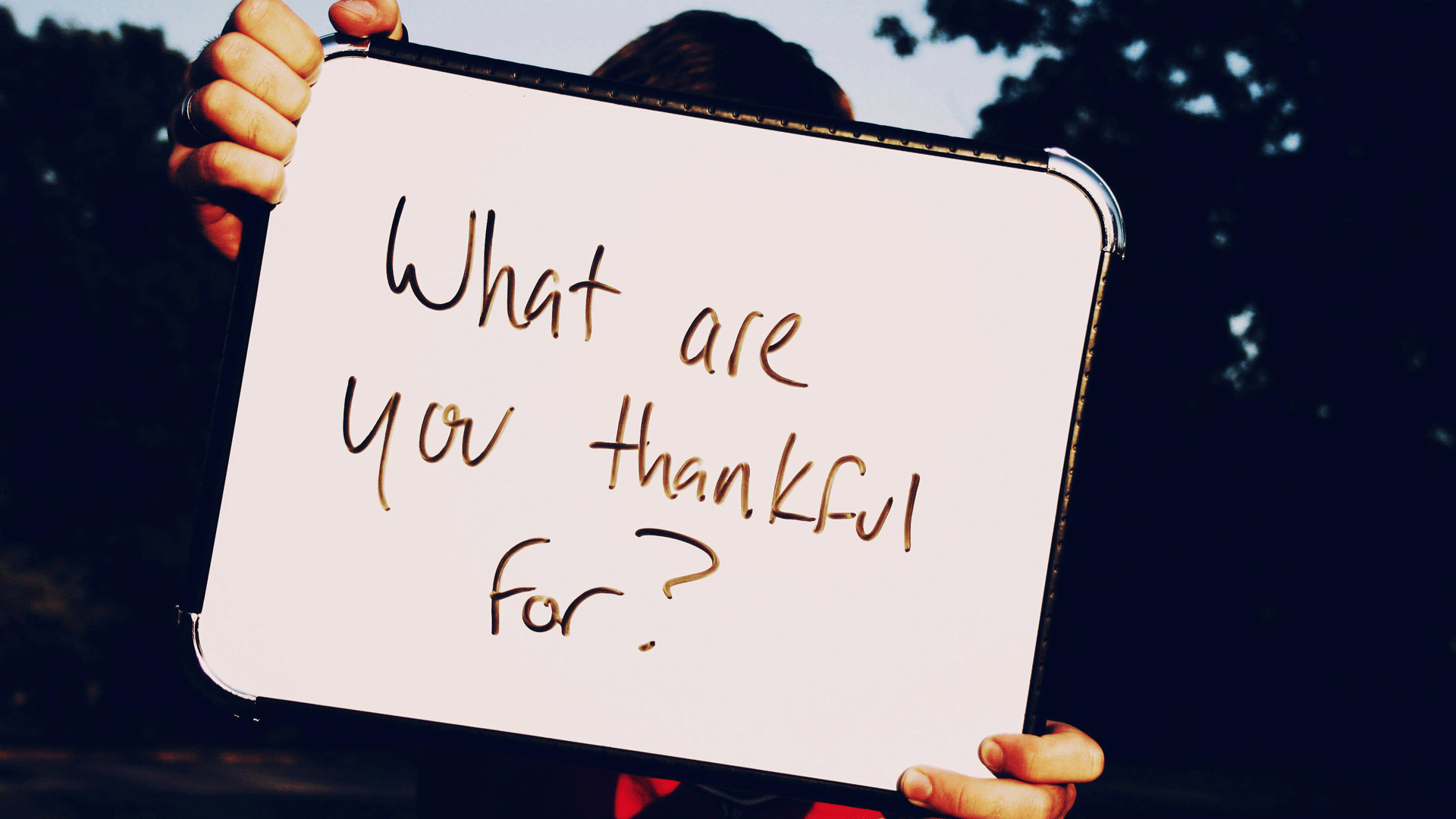
Over the last decade or so we’ve seen increasing use of hashtags like #thankful, #grateful and #blessed. Outside the online world, people are keeping gratitude journals, recording things and events for which one is thankful in one’s everyday life.

Being grateful, according to many psychological studies, contributes significantly to one’s wellbeing and indeed to one’s outlook on life. But how thankful are we really as a nation? And to whom or what are people grateful?

Recent research we conducted at the Policy Institute, King’s College London, ventures into this rarely charted territory, asking more than 2,000 Britons about their deepest emotional experiences. The findings reveal a striking portrait of a nation divided not by the usual demographics, but by something more fundamental: the capacity for profound connection, wonder and gratitude.

We found seven in 10 (68%) of the population say they’ve felt suddenly and deeply thankful to be alive at some point in their lives, with one in seven (14%) reportedly experiencing such feelings on a daily basis. Yet for every person who experiences this profound thankfulness with such regularity, there’s another who never feels it: a further one in seven (15%) say this just isn’t something they ever feel. These represent fundamentally different ways of experiencing existence itself.

Read more:

Conducted in association with the Existential Gratitude and Spirituality project hosted at King’s College London and the University of St Andrews, the study also tackles a curious philosophical puzzle that has occupied theologians and philosophers: In an increasingly non-religious world, what does it mean to be grateful for existence? Can you feel deeply thankful for your life or others in it if you don’t believe there’s any divine giver of life like God to thank?
Advertising helps fund Big Issue’s mission to end poverty
Advertisement

The answer, according to the public, is yes. While belief in God certainly increases the likelihood of feeling grateful – and provides a clear recipient for that gratitude – a majority of the public believe you don’t need faith in a higher power to feel thankful for life.

Among those who feel thankful, it is to nature (34%) that they are most likely to direct this sentiment, with people also slightly more likely to feel this way towards other people (31%) or their own inner selves (31%) than towards God (28%). This suggests that existential gratitude is more fundamental than its religious expressions – a deeply human response to existence that precedes theological explanation.

This connection to nature is wider than thankfulness. One in four people say they experience a profound feeling of awe or wonder at the universe or nature either daily or weekly. In today’s fast-paced culture our attention is endlessly divided and we often struggle to step back. It’s perhaps surprising, then, that for so many this sense of awe doesn’t just come through rare mountaintop moments but is in fact a regular feature of everyday life.

These feelings of wonder often relate to a sense of connection to the world beyond ourselves. One in five (22%) people report feeling connected to all people or living things at least every week, with three in five (58%) having experienced this feeling at some point in their lives. It’s a curious sensation to try to articulate – a sudden awareness of being part of something vast and interconnected – yet it appears to be a common thread in human experience.

Similarly, one in five say they feel personally guided or watched over by something or someone every week or more often, with a majority having felt this way at some point in their lives.

But, again, for every person who regularly experiences these feelings of awe, connection and guidance, there are others for whom they simply don’t register: one in eight (12%) never feel wonder at nature, a quarter (24%) never feel connected to other living things, and a third (32%) have never felt watched over or guided by anything beyond themselves.

This existential divide matters. If we never measure these dimensions of human experience, we risk designing a society optimised for economic productivity or material comfort while neglecting what actually makes life feel meaningful and worth living. Policy debates focus relentlessly on GDP growth, employment figures and consumer spending – yet rarely consider these deeper, and arguably more important, issues.

What seems clear is that these profound feelings – whether thankfulness, awe, wonder or connection – reveal something fundamental about the human condition that we rarely acknowledge or discuss. For some, they’re daily occurrences that infuse life with meaning and purpose.

For others, they’re entirely absent. By bringing these hidden dimensions of experience into view, this research challenges us to think more seriously about what kind of society we want to build – one that nurtures wonder and connection, or one that merely measures prosperity while remaining blind to whether life actually feels worth living.

Dr King-Ho Leung is a lecturer in theology, philosophy and the arts at King’s College London.Professor Bobby Duffy is director of the Policy Institute at King’s College London.

Do you have a story to tell or opinions to share about this? Get in touch and tell us more

Change a vendor’s life this winter.

Buy from your local Big Issue vendor every week – and always take the magazine. It’s how vendors earn with dignity and how we fund our work to end poverty.

You can also support online with a vendor support kit or a magazine subscription. Thank you for standing with Big Issue vendors.

Advertising helps fund Big Issue’s mission to end poverty

GIVE A GIFT THAT CHANGES A VENDOR'S LIFE THIS WINTER 🎁

For £36.99, help a vendor stay warm, earn an extra £520, and build a better future.
Grant, vendor

Recommended for you

Read All
In this moment of geopolitical sword-dancing, words matter more than ever
Paul McNamee

In this moment of geopolitical sword-dancing, words matter more than ever

Only investment at the next budget will turn Scottish housing rights into housing reality
Margaret-Ann Brünjes

Only investment at the next budget will turn Scottish housing rights into housing reality

I'm a survivor of female genital mutilation. We must get serious about ending this practice
Valerie Lolomari

I'm a survivor of female genital mutilation. We must get serious about ending this practice

It's a critical moment for millions of Brits living in fuel poverty in desperately cold homes this winter
A house in the snow
Simon Francis

It's a critical moment for millions of Brits living in fuel poverty in desperately cold homes this winter

Most Popular

Read All
Renters pay their landlords' buy-to-let mortgages, so they should get a share of the profits
Renters: A mortgage lender's window advertising buy-to-let products
1.

Renters pay their landlords' buy-to-let mortgages, so they should get a share of the profits

Exclusive: Disabled people are 'set up to fail' by the DWP in target-driven disability benefits system, whistleblowers reveal
Pound coins on a piece of paper with disability living allowancve
2.

Exclusive: Disabled people are 'set up to fail' by the DWP in target-driven disability benefits system, whistleblowers reveal

Cost of living payments: Where to get help in 2025 now the scheme is over
next dwp cost of living payment 2023
3.

Cost of living payments: Where to get help in 2025 now the scheme is over

Citroën Ami: the tiny electric vehicle driving change with The Big Issue
4.

Citroën Ami: the tiny electric vehicle driving change with The Big Issue