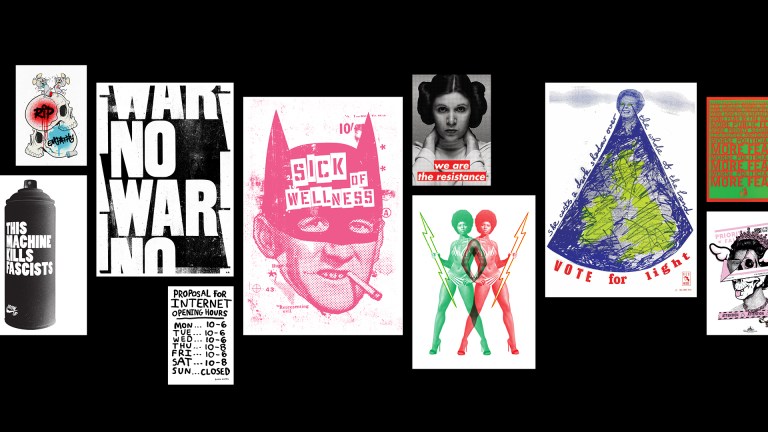
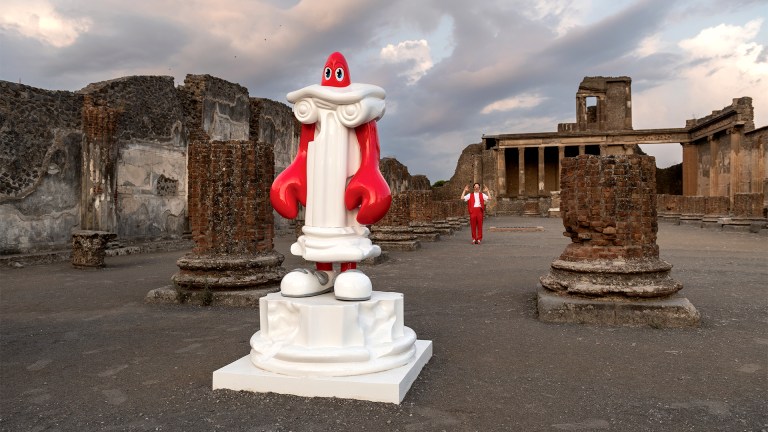
10Foot: Yeah totally, Peter Linebaugh was the protege of EP Thompson, author of The Making of the English Working Class, so his primary lens was class. They co-authored a book about the Tyburn Tree, which is near modern day Marble Arch, where people were hanged. He went on to write The London Hanged, which Ian Bone thrust into my hand and said, “You MUST read this”. That copy has been so many places with me that it’s now bound in gaffer tape. He also taught at the Attica Correctional Facility in New York and other federal penitentiaries. AND he writes in a way that is so readable.
M & J: The book talks about the hydra as a term used by elites to describe poor people. They were described as a writhing, many-headed monster who needed taming and, to us, this was an immediate connection to the ideas of criminalisation faced by homeless people today. It meant we went in a much different direction with the exhibition. We have got a clear answer now for all the people who ask, how is homelessness possible?
10Foot: I mean, how are all the disasters of this country possible? Homelessness, child poverty, the wealth divide, a cruel and expensive prison system, a mad media, corrupt politics. How is the comment section on a lot of Instagram more racist than an ’80s council estate? The answer is that all these things are entirely predictable, preventable and thus intentional, as I mentioned before.
Keep reading the journalism that powers our mission
Register free to continue and learn more about the stories, campaigns and the support we provide, helping people facing poverty across the UK.
M & J: Yeah, when we researched Criminal there’s records that are saying that really early in the 1600s Britain was taking ships full of the new criminal class who were already in prison and sending them to plantations. But in lots of cases they found solidarity with each other and with people who were enslaved and so that led to creation of the slave codes to divide people and so a lot of the hardening of the racial laws happened there. Homelessness becomes linked to a need to criminalise because the empire needed labourers. And then the resistance that took place led to development of ideas around racism. Where does your own piece – Faerie Newbuild – fit in?
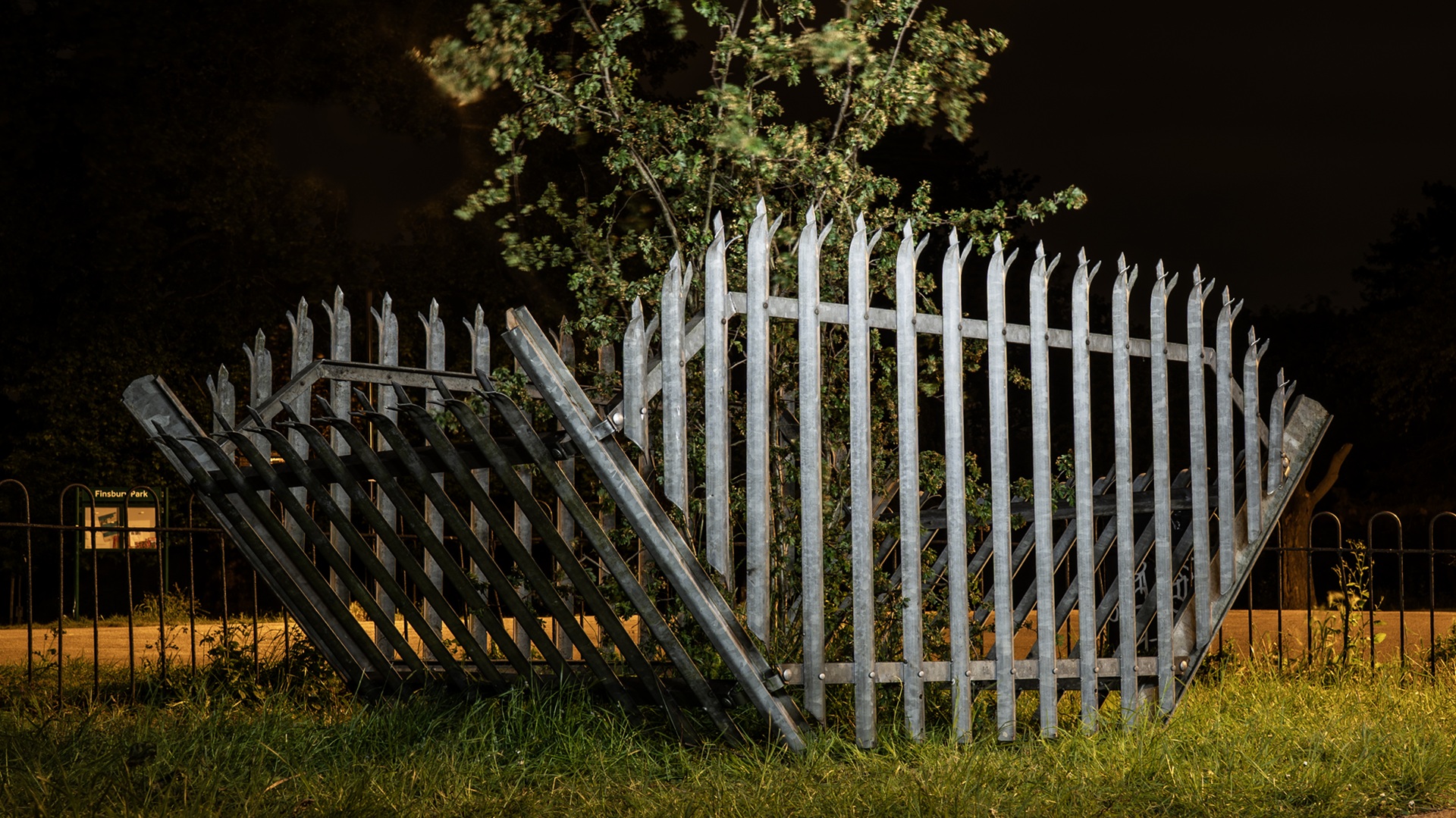
10Foot: Well it uses two forms of security fence, hawthorn and palisade railway fence, cos it feels like my life has been defined by them.
I grew up in 2000s Britain where fences were evvvvverywhere: garden fences, railways fences, barbed wire fences, electric fences. Maybe in the future some humans will define our moment as The Fence Age. And then there are the abstract fences, adults constantly shouting, ‘DO THIS!’ and ‘DON’T DO THAT!’ at children until the children have the capacity to shout the same at the subsequent generation.
So I wanted to jump fences and cut holes in them, it was impulsive but the more I learn, the more I think it was a great response.
My version of graffiti isn’t about the finished product, it’s about a kaleidoscopic transgression of law, societal norms and physical space. It’s criminal damage, something I’ve been arrested for about 60 times.
There’s a dual intention of using a hawthorn as before it was used as spiny, fast-growing security fencing, it was a tree where faeries lived according to folklore in Britain and Ireland. To touch it or bring it into the house would piss the faeries off, and if you uprooted one you’d be cursed forever, cos the faerie bush, the hawthorn, is their access to the netherworld. You should go and watch all these videos of people in Ireland talking about it; it’s well worth having a look.
And I feel like it worked. I felt proven when on the first day it opened I saw DJ Zinc, Zoë Garbett and Bas DDS standing around it because I feel like each of these people are a constituent of the cocktail; an underground music legend, the newly elected Green Party mayor of Hackney, and the all-time most prolific tube artist.
And just to namedrop one more person, haha, I remember you lot said that Jeremy Corbyn had advised you to plant it at the museum when you first moved in?
M & J: Yeah years back, he came to visit as a local MP and see what we were doing just before we moved into the building. He’s very involved locally with Finsbury Park. He knows a lot about folklore and British social history so maybe he shared the same intent as you, to make a newbuild for the good old faeries of the park.
So how did you come up with the idea for Faerie Newbuild? Was it a different process as your first ever sculpture?
Read more:
10Foot: I caught it like a ball flying at my face. I can’t explain how it ended up in my head or hands. I like stuff like that, feeling possessed, something emerging from your mind and feeling surprised; sometimes disappointed, sometimes pleased. The best graffiti writers I’ve ever known paint like this, like Fume DDS, I’ve watched him paint a train and look genuinely surprised at what has emerged in front of him. Sometimes he looks at it and he goes ‘That’s shit.’ and other times he looks at it and goes ‘That’s all right, you know, I like it’. And it’s OK for him to judge it like that, because the judgement comes from a totally separate place within himself than the instinct.
M & J: The sculpture links with your other piece at our show. It’s funny you already had it ready when we started developing the ideas for Criminal.
10Foot: Yeah Faerie Newbuild, the sculpture, interacts with Greater Villain, the print that sits inside. It features a poem from the 16th century (The law locks up the man or woman / who steals the goose from off the common / But leaves the greater villain loose / who steals the common from the goose). I made this after someone wrote this poem in Vauxhall train station, which is very good placement as that’s the train that takes you to the area of the world where enclosures first started. So, yeah, they mean more when put aside one another.
M & J: I think that brings us onto the idea of the commons, which I know you are thinking about for this Big Issue?
10Foot: Yeah, commons and enclosures of the land, humanity, and the digital realm. I’ve invited three great thinkers, Jake Hanrahan, Dorothy Spencer and Max Lennard, to write their response to each of these things.
I think I’ve personally tackled this question in the responses above: all of these ideas flow from the commons and the loss of. How about you two, how does the museum relate to commons and enclosures?
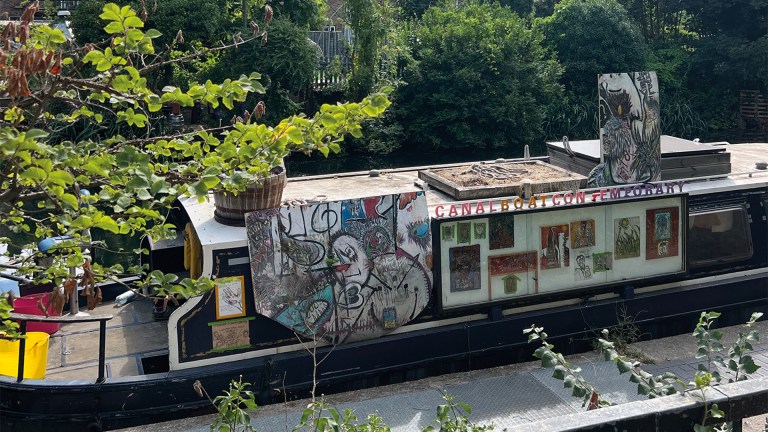
M & J: I think it links to our politics which is often less about the pondering and more about doing. It is natural that the museum has a knee-high fence in a London park that’s open 24 hours 365 days of the year, we’ve never had vandalism or theft, and the reason for that is because our entire community has a sense of ownership, so we don’t need security in the form of a spiky fence. We have many people looking out for us. So I think for us the living experience of the commons is about creating spaces where people are genuinely involved and genuinely give a shit, and people take care of each other and take care of the space.
10Foot: You have such a good way of relating to people. Everyone feels at home and equal, unlike other institutions. I actually turned down a far ‘grander’ institution to be part of this show. You know I’m such a fan of the holistic way you guys operate.
M & J: Well, thanks. So many younger kids who are your fans have been coming to the show and have joined the curator tours as well, when I was that age, I definitely wouldn’t have! It’s great to see that they came for your work but are interested, or are becoming interested, in the historical aspects.
10Foot: I hope that’s the case. I hope I can be a gateway drug to accelerate a few young people’s understandings. I hope I can make some culture that is experimental but grounded in history, like my favourite UK underground culture is. There’s far too much stuff currently that’s as deep as a puddle; gimmicky rubbish and artless art. I’d like to make something with sharp teeth that springs from how we grew up, during this bizarre moment in human history: The Fence Age.
Criminal: An Untold History of Homelessness, Resistance and Survival is FREE and is open three days a week (Thu-Sat, 12.30pm-4.30pm)
Do you have a story to tell or opinions to share about this? Get in touch and tell us more.
Change a vendor’s life.
Buy from your local Big Issue vendor every week – and always take the magazine. It’s how vendors earn with dignity and move forward.
You can also support online:
Subscribe to the magazine or support our work with a monthly gift. Your support helps vendors earn, learn and thrive while strengthening our frontline services.
Thank you for standing with Big Issue vendors.