Inside the chocolate factory spreading sweet treats – and helping autistic people find work
In the Harry Specters factory, the production lines are busy in the run-up to Christmas. It’s also helping autistic people bed into the working world
by:
15 Dec 2025
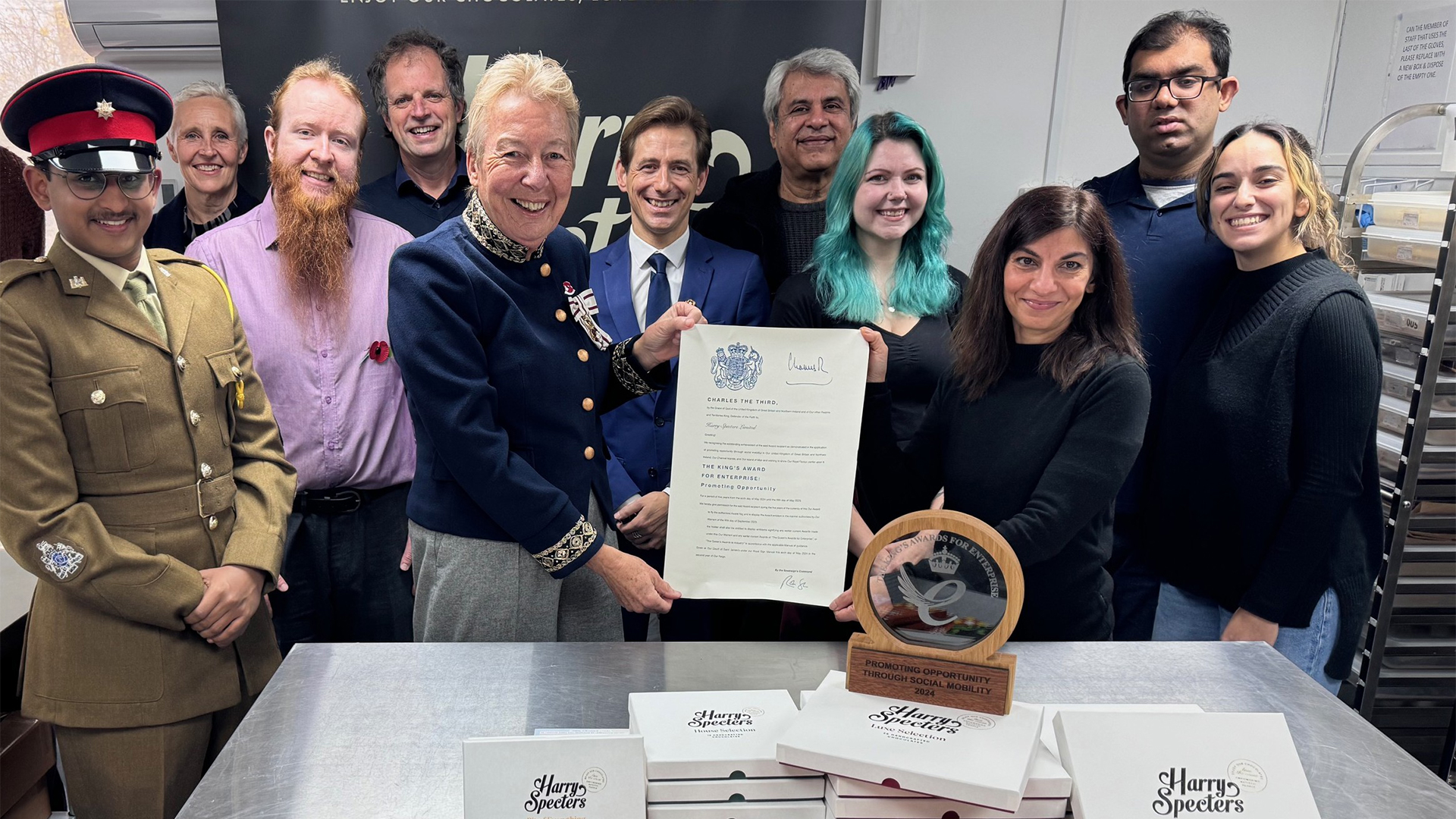
Staff at Harry Specters receiving the King’s Award
Share
As Christmas approaches, staff at the Harry Specters factory in Cambridge are making 4,000 chocolates a day.
The factory begins to ramp up at the end of October, and by November it is, as operations executive Zoey Nichols describes, “hectic.”
There is no chocolate river, sadly, but when Nichols began working at Harry Specters almost four years ago, it was unmistakably a chocolate factory: “The thing that really hit me was the smell.”
Flavours range from raspberry and elderflower, maple and pecan, and fresh mint, all the way to strawberry cheesecake, vanilla coconut and passionfruit and lemongrass. Each of the chocolates which makes its way into a box is handmade, with no artificial flavours.
Though the six-strong team behind them have won dozens of awards, the sweet treats made in the Harry Specters factory are not simply special because of how they taste. There is life beyond the box of chocolates.
Advertising helps fund Big Issue’s mission to end poverty
Advertisement
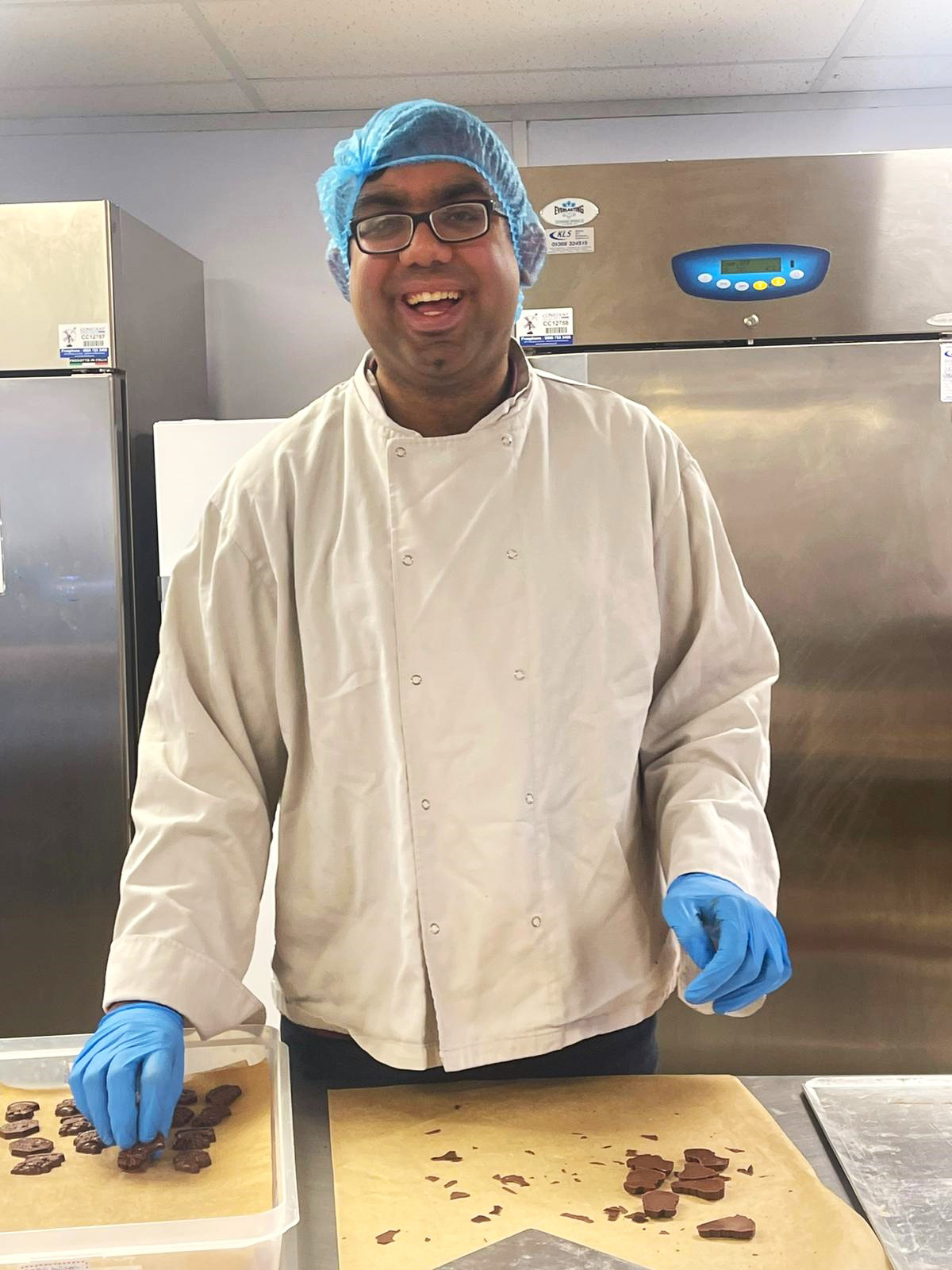
Ash Shah unmoulding chocolate shapes on the production line
Set up by Mona and Shaz Shah after they decided to create a company where the strengths of their autistic son, Ash, could shine, the business is a social enterprise which helps autistic people gain experience in the workplace. Investment from Big Issue Invest has helped Harry Specters expand their capacity to make chocolate.
Christmas is a boom time for the chocolate business. 2024 saw the size of the festive confectionery market grow by 8% to £853 million.
Yet we are not always getting what we used to. Plastic wrappers aside, tubs of Quality Street have shrunk from 600g to 550g, a Terry’s Chocolate Orange is 7.6% smaller, and tins of Cadbury Roses are 6.7% lighter. Meanwhile, prices go up. But there is demand for something bespoke. This year, Harry Specters introduced a £50 ‘Slowdown Countdown’ advent calendar, where each day’s chocolate is accompanied by a message encouraging customers to take a moment in the busy season.
Autistic people face exclusion from the workplace. While around eight in 10 non-disabled people are in employment, that figure is just three in 10 autistic people, the government’s 2024 Buckland review found. The pay gap is stark too, receiving a third less than non-disabled people. The disparity persists even with higher education – autistic graduates are twice as likely than non-disabled graduates to be unemployed 15 months after leaving university.
As Big Issue has reported, hiring practices such as the widespread use of personality tests can make getting in the door even harder.
Advertising helps fund Big Issue’s mission to end poverty
Harry Specters is not alone in trying to fix these problems. There are companies such as auticon, which has a workforce of IT consultants who are all on the autism spectrum, supported by job coaches. Specific job boards list roles suitable for autistic and neurodivergent jobseekers.
When Nichols began work, she thought that by coming in early, doing her work on time and to a good standard, she would be considered a good team player. “I quickly learned that to a lot of people, being a good team player is, ‘Are they fun and will they go out for drinks on a Friday after work?’ But by that time, I’m so socially exhausted I don’t want to go out to a noisy pub for the sake of keeping up appearances,” she says. “You just want to do really good job and to go home feeling proud of the work you’ve done.”
So for those hoping to work with Harry Specters, the recruitment process is different. There are no interviews. Instead, candidates are invited in for an informal chat and a tour of the factory, with the option to bring somebody else along.
Harry Specters advent calender
The idea is discovering people’s strengths, and tailoring them, “so that we have the best possible version of them as an individual person”.
There is a glimpse of some hard-headed business rationale, and perhaps a lesson for other employers. “People who feel happier are going to want to work harder for you,” says Nichols.
“People shouldn’t have to feel like they have to stay here forever, just because it’s a social enterprise for autistic people. We want more autistic people in the workplace everywhere.”
Advertising helps fund Big Issue’s mission to end poverty
She adds: “If we can help them to gain the confidence and skills to move on to somewhere else and thrive, that’s the dream.”
‘I often go home and lie on the floor’
Christmas in particular can be difficult for autistic people – with lots of bright lights everywhere, social interactions, busy spaces, and routines turned upside down.
Nichols says, for her, it’s noticeable. “I often go home and then I’ll lie on the floor in the dark for 30 minutes before I can do anything,” she says.
But once Christmas is done, and the chocolates are all sent out, the factory closes for a couple of weeks. “Everything’s shut down and we sleep,” she says.
Advertising helps fund Big Issue’s mission to end poverty
Change a vendor’s life this Christmas.
Buy from your local Big Issue vendor every week – or support online with a vendor support kit or a subscription – and help people work their way out of poverty with dignity.
Advertising helps fund Big Issue’s mission to end poverty