I waded through a river of raw sewage to meet the man trying to save London’s waterways
An on-the-ground investigation into sewage pollution in London reveals a crisis far worse than official data suggests
by:
29 Jan 2026
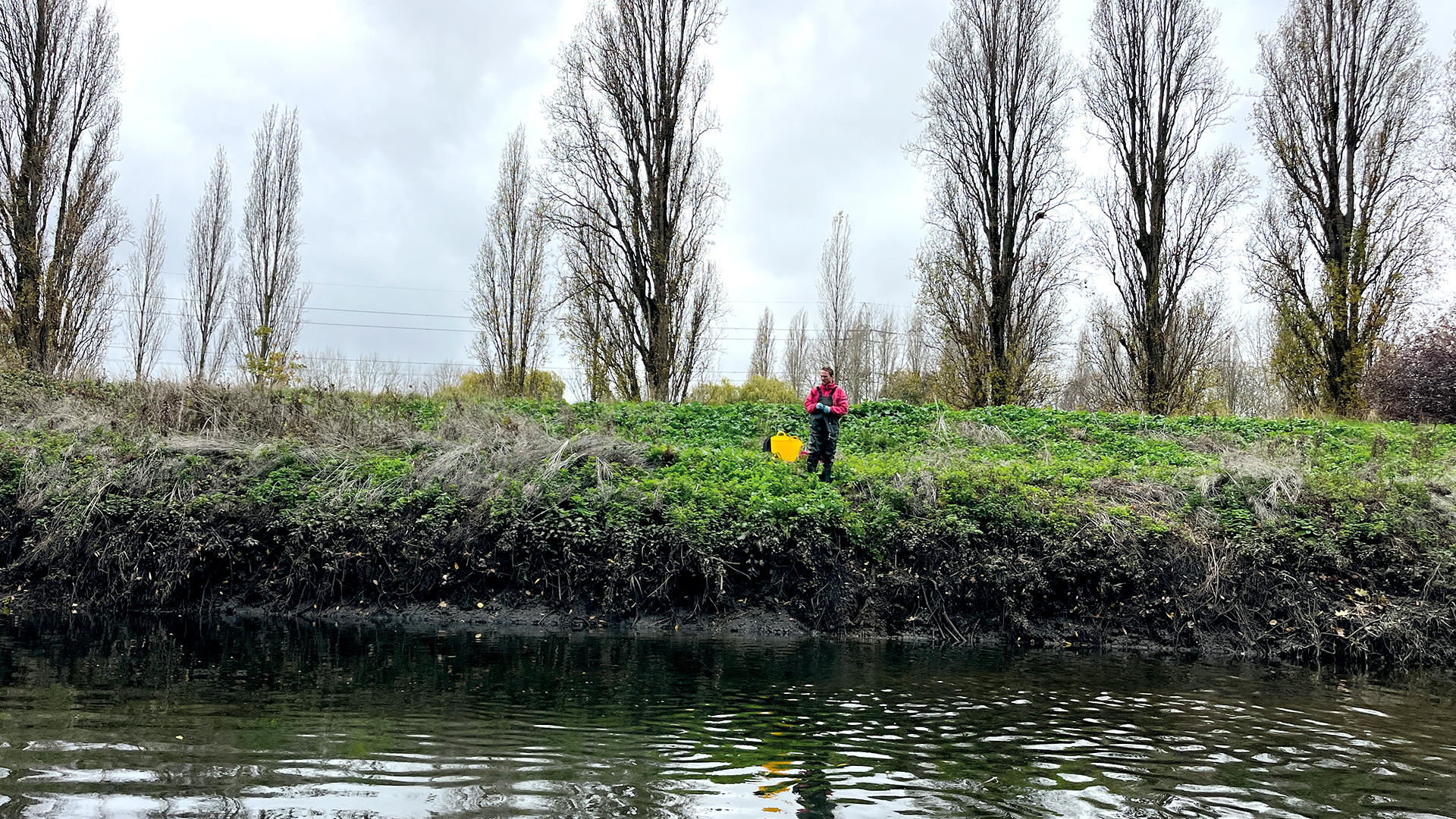
Paul Powlesland on the bank of the River Roding
Share
“Watch your step,” warns Paul Powlesland, grimacing. “This is pretty much an open sewer.”
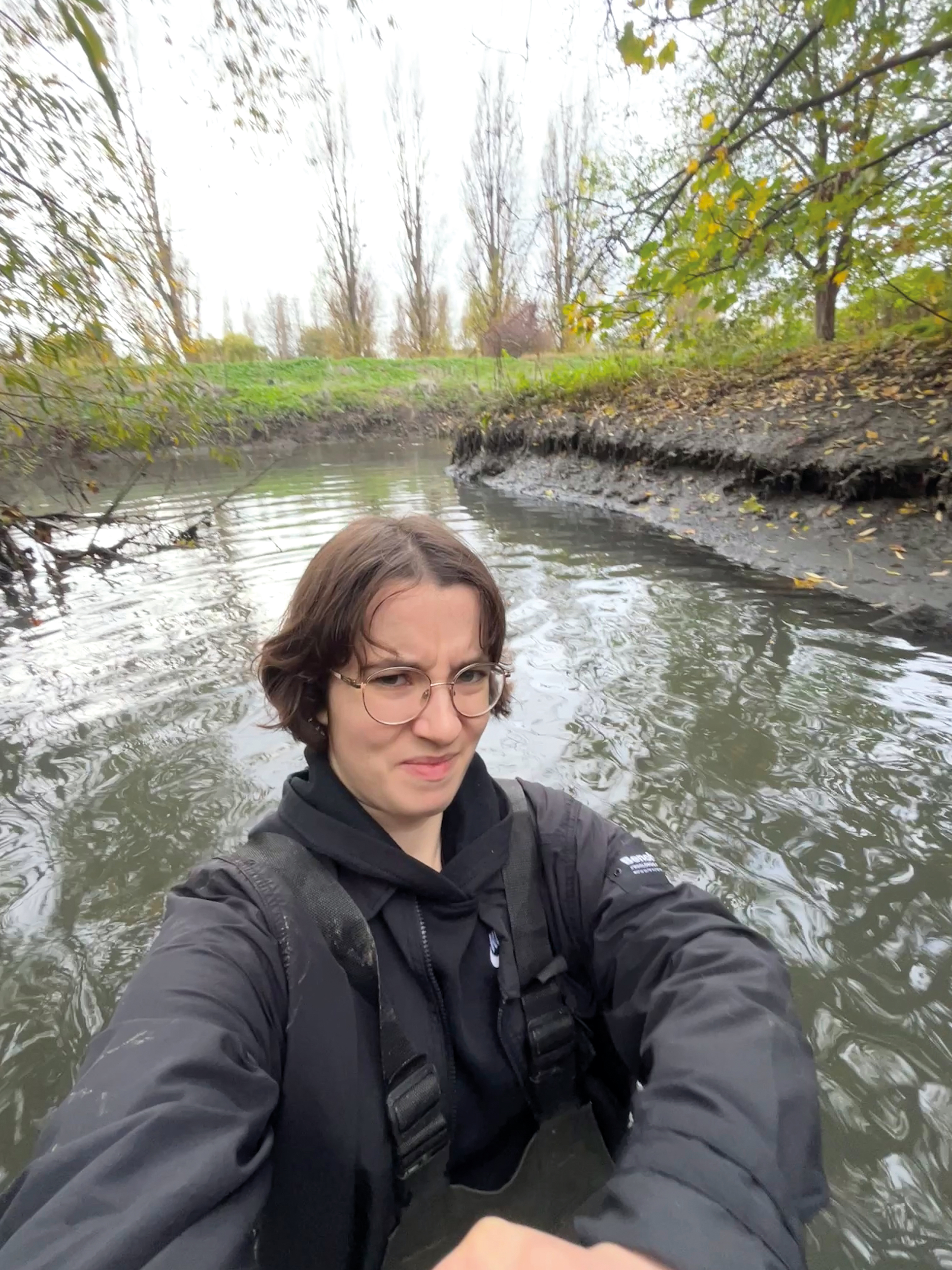
It’s a grey winter’s morning on the outskirts of Ilford, East London, and we are waist-deep in a river of shit. I know this because Powlesland – environmental lawyer and self-appointed ‘guardian’ of the River Roding – has just measured ammonia levels in this small, acrid-smelling patch of London’s third largest river.
A number 5.19 blinks on his handheld device: the effluent running from the pipe behind us contains more than 5.19 parts per million of ammonia, a compound produced by human waste. That is more than 25 times the 0.2ppm threshold that protects river life – but worse still is the quantity being released.
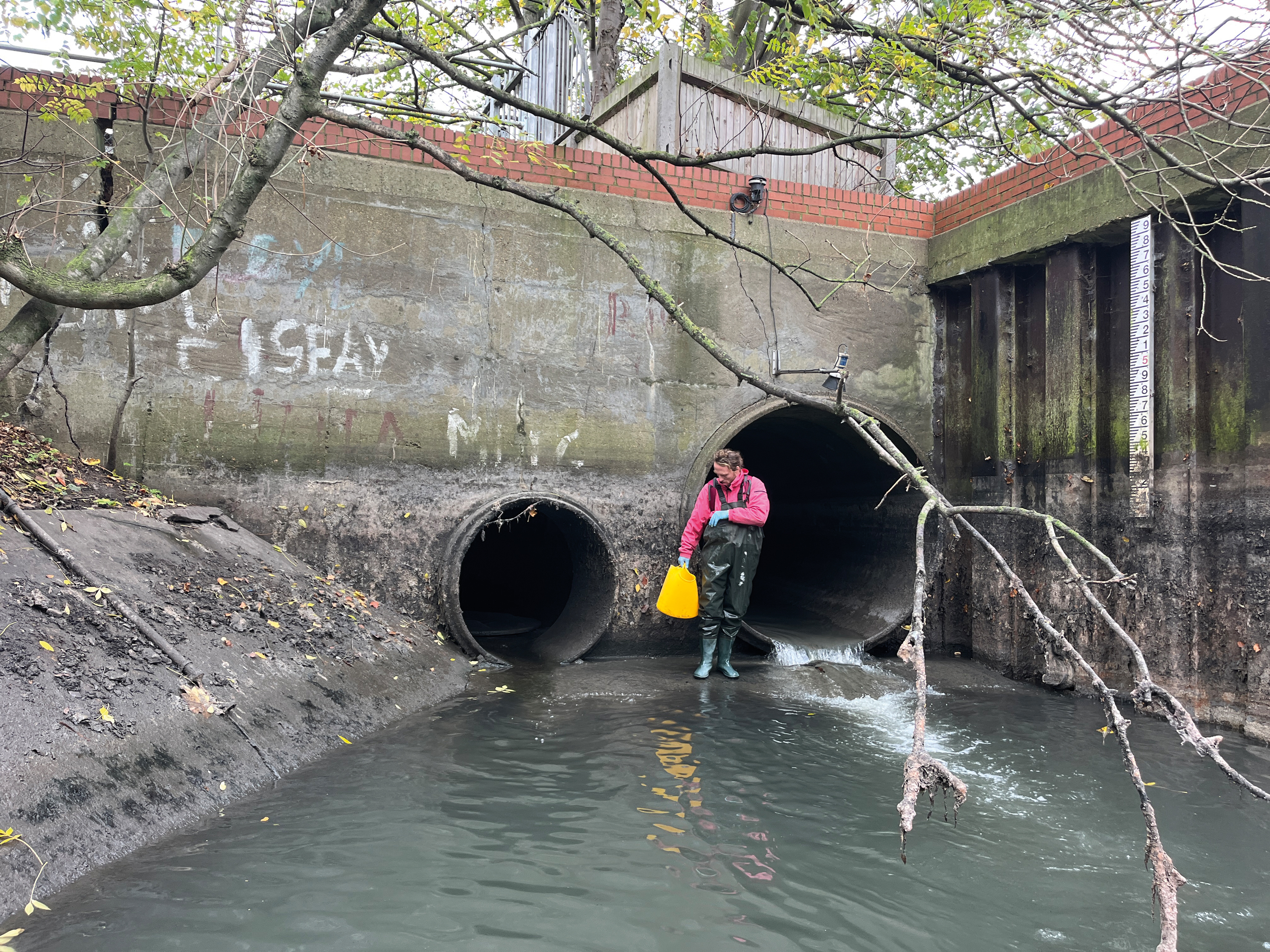
Using what he calls the “tried and tested bucket method”, Powlesland captures 10 seconds’ worth of discharge and calculates a daily flow. The pipe discharges three million litres of sewage and landfill leachate a day – over a billion litres a year.
“That is just killing the river for hundreds of metres downstream,” Powlesland says, wading back from the outfall. The grey water rises almost to the top of his rubber waders; he lifts his arms to keep them clear. “This is one of, if not the most, polluted rivers in London.”
Advertising helps fund Big Issue’s mission to end poverty
Big Issue is here to see Britain’s sewage crisis first hand. The scandal has been widely covered, but the data Powlesland is gathering reveals a problem beyond public awareness: at least a dozen unknown illegal outfalls on the Roding and its tributaries that no authority has logged, monitored or acted upon.
Across the country, he estimates, thousands of outflows could be missing from official statistics – unknown to the Environment Agency (EA) and to the water companies themselves.
“Even if water companies wanted to do the right thing,” Powlesland explains, returning to the relative safety of calf-deep water, “they do not have the data that allows them to do that. That’s what this is; that’s what I’m trying to do.”
Big Issue reporter Lottie Elton is pondering her career choices
The Roding runs through a populous part of East London. But it isn’t easy to find.
I meet Powlesland near Ilford station. We cycle through heavy traffic to a small park and duck through a fence. Suddenly, the hitherto-invisible river comes into view.
Advertising helps fund Big Issue’s mission to end poverty
This section of the Roding is unglamorous, muddy green slicked with obvious algal blooms. Just above the opposite bank, the North Circular ring road hums with traffic.
But the waterway has an understated beauty, too. In early November, there are still golden leaves on the trees; tangled green nettles cloak the banks.
The river flows gently: the water in front of us has wound its way from Essex and will meander down to meet the Thames near Barking. Though far from bucolic, the scene is a far cry from the nearby concrete and traffic of central Ilford.
“It’s hard to find, right?” Powlesland says. He has lived on the river since 2017, and moors his houseboat just downstream. “A lot of the time we turned our back to it. It’s in some ways frustrating, but that’s our job, to bring it back into people’s lives and consciousnesses.”
Only 14% of rivers and lakes in England are in good health, according to the Environment Agency. The Roding is certainly not one of them. Powlesland – an environmental barrister – was appalled by the neglect he found on the waterway: the fly-tipping and litter that choked its banks, the shine of oil and greasy chemical sheen on its surface, its inaccessibility to all but the most intrepid boaters.
In response, he founded the River Roding Trust (RRT) in 2019, funded largely by donations from local boaters. Volunteers began with litter picks, tree planting and campaigning for public access.
Advertising helps fund Big Issue’s mission to end poverty
“It needs a lot of love,” Powlesland says. “I’d never studied ecology, never studied water management or riverine ecology as such, but just started acting for the river, and slowly, over time, became what I call its guardian, which is someone who just acts in the interest of the river.”
Powlesland takes this role seriously, with an air of almost spiritual solemnity. Called for jury duty a few months ago, he swore his legal oath on a vial of water from the Roding.
“Over time, the river has kind of taught me what she needs, and what is needed from me and the other river guardians,” he says. “One of those key things is water quality.”
It was on a community litter pick that Powlesland first saw encountered raw sewage flowing directly into the river – the Winn Valley pumping station. The pollution was unknown to both the Environment Agency and Thames Water. RRT campaigned to have it fixed.
“It took quite a long time, and eventually Thames Water spent a million quid and fixed it,” says Powlesland.
“For this one outfall alone, it prevented 23 million litres of sewage a year entering the river… but we knew there were more.”
Advertising helps fund Big Issue’s mission to end poverty
Finding those unrecorded outlets has become this year’s project, and is the reason we are back on the river today. “Shall we get in?” Powlesland asks. His attire – a neon-pink waterproof jumpsuit befitting of a vigilante river activist – is making me feel nervous. My polythene ‘rain-resistant’ coat may not be sufficient protection. Luckily, Powlesland hands me some rubber waders.
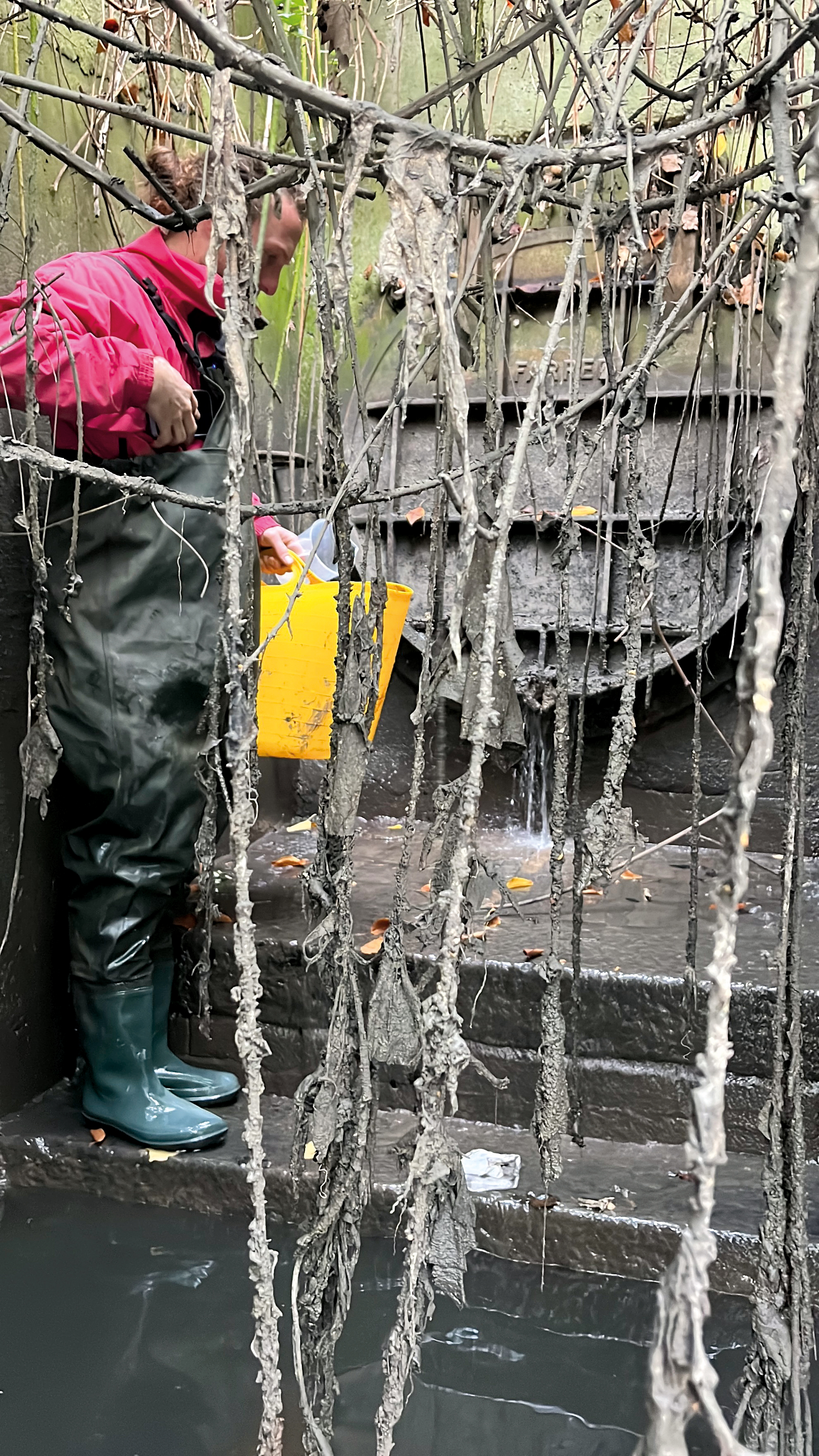
An estimated 50,000 litres of sewage leave this one outlet each day
Our first stop lies about 20 metres upstream. The outflow is nearly hidden, a concrete duct choked by dead vegetation.
Powlesland disappears inside and I follow, ducking under bramble festooned with debris. Wet wipes and sanitary pads litter the ground. A steady trickle seeps from a pipe. Powlesland estimates that around 50,000 litres a day leave this outlet.
“Obviously, looking at that water, it looks kind of clear,” he says. “So how would you know how harmful that is to the river? There are two things we need to know: the concentration of sewage, and the volume.
“If you have those two things you can times them together and work out what the rough harm on the river is. Any sewage coming out of here is illegal, it shouldn’t be happening.”
This distinction matters. Not all sewage outflows are ‘illegal’. Britain’s combined sewer system – built in the 19th century – carries rainwater and wastewater in the same pipes, and water companies are legally allowed to release overflow during heavy rain.
Advertising helps fund Big Issue’s mission to end poverty
An illegal outflow is one that releases sewage without a permit. Illegality of this kind is widespread. Water companies reported 2,487 pollution incidents in 2024, twice the Environment Agency’s limit. But Powlesland argues that even this alarming figure barely scratches the surface.
The pipe we are standing beside is not included in those statistics. It is officially a stormwater drain, meant to release only surface water. It is not monitored for sewage – and yet unpermitted sewage is present. Back on the bank, Powlesland tests the water. The device flashes 30.9ppm. That’s more than 150 times the safe limit.
“I had to use the higher range checker because it’s so bad,” he says. “That outfall, even though it might not look that bad, is really harming the river. We don’t know why sewage is coming out of this one; it’s supposed to only be surface water, but it’s clearly got sewage in it.”
Possible explanations include misconnections – homes accidentally plumbed into surface-water drains – or failures buried deep in old Victorian sewer lines. “It could be that a Victorian sewer pipe under Ilford collapsed 20 years ago,” he says. “And it then leaks into the surface water, and no one’s bothered to find it or fix it.”
This isn’t the only one. This summer alone, Powlesland found at least a dozen on the Roding. “The government, the Environment Agency, Thames Water themselves, all have no idea where the illegal sewage is coming in,” he says. “These are not only not permitted, they’re completely unknown.”
We cycle a short distance north and scale a large bank. The river reappears, green but for a huge bloom of dirty grey around the mouth of a tunnel on the opposite side. That’s where we are headed.
Advertising helps fund Big Issue’s mission to end poverty
The long tunnel takes us underneath the North Circular, past floating litter and around a submerged bit of concrete that very nearly sends me for an unplanned swim.
“This is the Cranbrook,” Powlesland explains, as we emerge into daylight, a “tributary of the river Roding.” At the other end of the tunnel, Powlesland repeats his testing process. This outflow is far larger than the one we inspected earlier. He calculates that this combined sewer overflow (CSO) releases around a billion litres of sewage and landfill leachate into the Roding each year. “It’s just disgusting,” he says.
A spokesperson for Thames Water said that they “actively encourage reports of any outfalls and will investigate them fully.”
However, unknown sources of sewage are only half the problem. Not only are there at least a dozen undocumented outflows on the river, but regulators cannot even accurately track the sewage released from the known ones.
Upriver is Cascades CSO. Unlike the hidden stormwater drains, this CSO is, at least officially, on the books. Thames Water knows it exists and has a permit to release sewage from it during periods of heavy rainfall.
But the impact is catastrophic. Testing above the outfall shows no ammonia. However, the sewage is so concentrated (testing has shown 32 ppm ammonia) that it effectively turns the river into a sewer for more than half a mile downstream.
Advertising helps fund Big Issue’s mission to end poverty
“This CSO is clearly illegal and it needs to be fixed, or temporarily stopped,” Powlesland says.
The problem is, the current system cannot accurately measure the scale of malfunction. At present, sewage pollution is quantified in “hours” of discharge – the number of hours that untreated sewage flows into rivers. In 2024, England recorded 3.6 million such hours. But that isn’t very useful, Powlesland says, because an ‘hour’ is a nebulous unit of measurement.
“You’re measuring an hour – an hour of bloody what?” he tells me. “Our current metric is completely unable to distinguish between an hour of a tiny trickle of mostly surface water and an hour of a huge torrent of shit going into the river.”
This becomes a major practical problem. Investment in upgrades is finite. Decisions about where to intervene first should be guided by the greatest harm, not simply the duration of discharge.
“There’s a limited pot to fix these, and we can’t fix them all at once,” he says. “The more I looked into it, the more I was just like, how is there not any kind of prioritisation system for this? It’s insane. It’s actually insane.”
Hundreds of billions of pounds are at stake. After years of underinvestment, greenwashing and outright denial, the privatised water companies have finally admitted that sewage is a problem – but say they need new revenue in order to fix it.
Advertising helps fund Big Issue’s mission to end poverty
In December 2024, water regulator Ofwat granted water companies permission to hike bills by an average of 36% over five years to pay for “essential upgrades” to water infrastructure.
Thames Water, struggling under a mammoth debt mountain – all accrued since privatisation – hiked its bills by 40% in April, citing its plans for massive investment.
But Powlesland’s findings present a problem. If you don’t know where the leak is, how can you fix it?
“Even if they want to do the right thing – at the moment, on most rivers they don’t have a way of actually working out where to put that money,” Powlesland says.
Powlesland monitors a stormwater outfall
Thames Water have part-funded RRT’s summer project, which has been carried out in collaboration with Thames21, another London environmental charity.
Tens of millions of pounds is the ballpark figure Powlesland gives to fixing pollution on the Roding – if you know where the outfalls are.
Advertising helps fund Big Issue’s mission to end poverty
“A key reason why this project points the way forward is the extent to which it’s critical of, but willing to work with, the water companies,” Powlesland says. “I recognise that Thames Water has criminally underinvested in the Roding. However, that has happened, and Thames say they want to do the river differently, and they have supported and worked with us.
“Not only is their support really important – a lot of these answers I couldn’t find without them because it involves going into the sewage network, but it also actually helps them. Because it allows them to concentrate their resources on the outfalls that are the most harmful. I take them at their word that they want to fix the Roding. If that doesn’t happen, of course, I will be their harshest critic.”
A Thames Water spokesperson said that “clean, safe rivers are a shared priority, and we support efforts to improve water quality. Over the next five years, we’re delivering the biggest wastewater network upgrade in 150 years, increasing treatment capacity, reducing storm discharges and introducing nutrient-reduction schemes. The newly completed Tideway Tunnel will cut typical annual discharges into the tidal Thames by 95%.”
As we return to our bikes, I ask for the bigger picture across Britain. Powlesland sighs: it’s the same.
“I’d be willing to bet that on most substantive rivers, there are going to be completely unknown illegal discharges that nobody has any idea about it. Every single river, really.
“And the flip side of that is we cannot fix the sewage problem without doing a project like the one I’ve done on Roding. We cannot fix it without doing that.”
Advertising helps fund Big Issue’s mission to end poverty
Success is possible – it just needs investment, and data. In some unassuming parts of Ilford, this has already happened. As we wheel past a Kwik Fit tyre shop and mechanic, Powlesland brakes. “This is the site of my greatest triumph,” he says. “Underneath there is the first outflow we found.”
That’s the one RRT persuaded Thames Water to fix. “The Roding is a river that’s been neglected because it runs through deprived areas. It’s not middle-class people making a fuss about it. So it has been largely abandoned,” Powlesland adds.
“But because we found it, here there was a simple problem and they fixed it and now that’s gone. That would just be spewing out raw sewage otherwise.”
Advertising helps fund Big Issue’s mission to end poverty
Buy from your local Big Issue vendor every week – and always take the magazine. It’s how vendors earn with dignity and how we fund our work to end poverty.