Revealed: Homeless people face ‘postcode lottery’ of support leaving them at risk in heatwaves
The Severe Weather Emergency Protocol (SWEP) is meant to keep homeless people safe when the weather poses a threat to life on the street. Big Issue teamed up with the Pavement magazine to investigate how councils responded to recent heatwaves
by: Jake Cudsi, Liam Geraghty
13 Jul 2026
There is a growing understanding that homeless people need protection during extreme heat but there’s no guarantee that councils will act when temperatures soar. Image:
Ray Donnelly / Unsplash
Share
A joint investigation by Big Issue and the Pavement magazine has uncovered major inconsistencies in how councils across England protect people sleeping rough during heatwaves.
Using around 40 Freedom of Information (FOI) requests sent to councils and London boroughs with some of England’s highest rough sleeping populations, the investigation found a patchwork response to the record-breaking late May heatwave.
The FOI requests asked councils whether they activated the Severe Weather Emergency Protocol (SWEP) as temperatures reached unprecedented levels.
SWEP governs how local authorities take action to support rough sleepers, usually getting them off the streets and into emergency shelters.
It’s most commonly implemented for cold weather events but councils may take action when heavy rain or high winds pose a threat to life, as well as extreme heat.
The hottest May temperature ever recorded in the UK – 35.1 degrees Celsius – was registered on 28 May 2026 at Kew Gardens in West London. Yet Richmond Borough Council, Kew’s local authority, stopped short of explicitly activating their SWEP protocols.
Advertising helps fund Big Issue’s mission to end poverty
Advertisement
FOIs revealed the borough’s outreach team undertook “additional shifts” to support those at risk, which included directing people to so-called “cool spaces” in the daytime, but didn’t offer any special emergency accommodation provision for the area’s rough sleepers.
Responding to Big Issue and the Pavement’s FOI requests, 20 out of the 33 London councils (61%) said they did activate SWEP– but the support offered varied greatly from borough to borough.
Over half (55%) of local authorities who activated SWEP said they only offered emergency accommodation to people considered “most vulnerable” and subject to strict eligibility criteria. 30% of councils did not include a special emergency accommodation offer in their SWEP response at all, instead relying on outreach teams distributing bottled water, sunscreen and directing rough sleepers to “cool spaces”.
Keep reading the journalism that powers our mission
Register free to continue and learn more about the stories, campaigns and the support we provide, helping people facing poverty across the UK.
A heatwave can be uncomfortable for most of us but if you’re living on the street then it can be a matter of life and death.
Our investigation revealed one of the main issues with SWEP in England: each local authority has its own protocol for engaging with vulnerable people, including those experiencing homelessness. There is no dedicated central funding for SWEP, which poses a problem for councils when extreme weather is more frequent and lasts longer.
The result is a strange postcode lottery effect, with differing responses and services from council to council.
London boroughs generally operate SWEP during extreme heat, with the exception of Hounslow, which said it doesn’t formally activate SWEP during the summer months.
This conspicuous exception was the norm among local authorities outside of London with the highest figures of people sleeping rough. In Cornwall, Leeds, Nottingham and Somerset SWEP was not active during the May heatwave. Brighton & Hove City Council reasoned that SWEP could not be activated as the temperature didn’t surpass the threshold of 30°C.
The only local authorities in London that we found provided emergency accommodation during a heatwave – albeit reserved solely for those deemed to be most vulnerable and contingent on numerous conditions being met – were Croydon, Haringey, Greenwich, Lambeth, Sutton, Tower Hamlets, Waltham Forest and Westminster. The remaining respondents allude to the availability of “cool spaces”, alongside outreach teams offering rough sleepers sun cream, bottled water and the option of advice.
A London Councils spokesperson said: “Boroughs work hard to help ensure the safety and wellbeing of those sleeping rough during periods of extreme heat.
“Alongside pan-London guidance produced by London Councils and the GLA, individual boroughs and their partners will respond based on local need and circumstances. This approach is locally led, flexible, and enables targeting of those most at risk.
“Boroughs receive no dedicated government funding for the additional activity prompted by severe weather, despite their ongoing service pressures and overstretched homelessness budgets.
“With climate change causing a growing frequency of severe weather incidents, there are concerns about the future sustainability of this crucial work.”
The importance of accommodation during these periods of extreme weather was made clear by Met Office deputy chief forecaster Mark Sidaway. He said there were several consecutive nights during the May heatwave where temperatures did not drop below 20°C, which is called a tropical night.
Sidaway added: “This will make it very hard for people to recover from the daytime heat, exacerbating the heat stress impacts.”
The overall picture is difficult to piece together. A jigsaw puzzle that doesn’t match up. Neighbouring authorities are activating SWEP on different days, running services for longer or shorter periods and the contents of those services differ from one place to the next. And that’s just London: local authorities in England with high numbers of people sleeping rough are failing to grasp the impact and severity of the increasingly extreme heat beating down on the UK.
Our investigation found several councils that recorded high levels of rough sleeping in the government’s annual rough sleeping count in autumn 2025 did not activate SWEP at all during the May heatwave, including the local authorities for Leeds, Cornwall, Nottingham and Somerset.
Time for action
The confusing picture comes as rising heat requires more urgent action. Not only does the heat impact rough sleepers, it also makes it harder for Big Issue vendors to earn a living. Rodney Lyall, a vendor in Bournemouth, said that the hot weather was a challenge as Big Issue handed him a Summer Support Kit to stay safe.
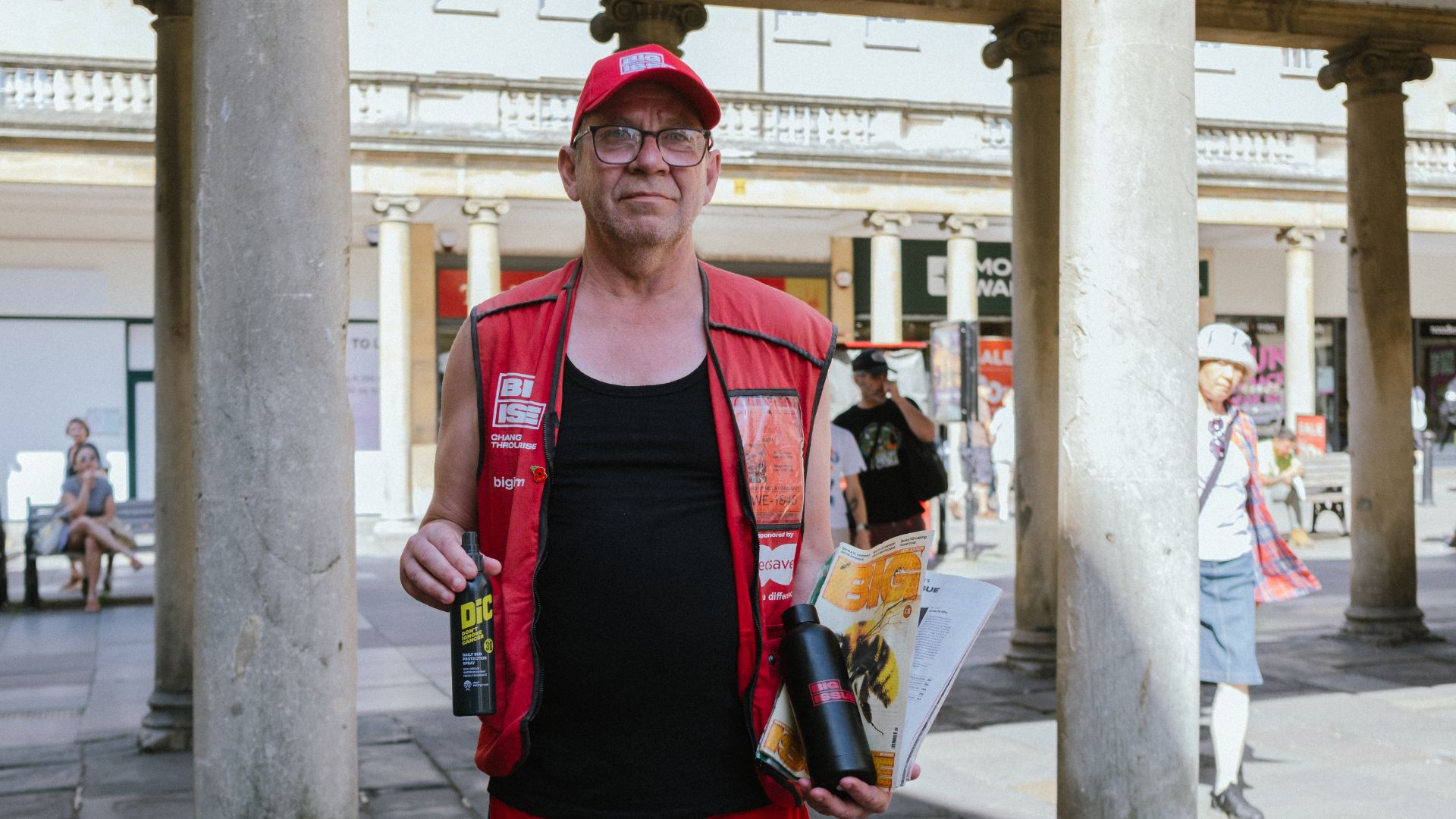
“When it’s hot like this – it’s red hot today, about 38 degrees – I can’t really sell because I’m susceptible to the sun because of my medication,” he said. “The past couple of days I haven’t sold the magazine.” Lyall described the support, which includes a cap, DIC (Don’t Ignore Cancer) sun cream and a water bottle with water as a “lifeline”.
Big Issue vendor Ian Duff pictured with a bottle of DIC (Don’t Ignore Cancer) sunscreen. Credit: Juliette Pedram
Bath-based vendor Ian Duff said he was forced off his pitch to look after his dog, Trigger, in the heat: “Now because of this heatwave, it’s really hard,” he said. “I’m only working a couple of hours a day because I have my dogs at home and I can’t leave them on their own for too long.
“It’s a bit touch and go sometimes. It’s not as easy as everyone thinks it is.”
Temperature records have been smashed since May, of course.
On 26 June, temperatures reached 37.7°C, making it the hottest day ever recorded in the UK during June. The Met Office had issued a Red Warning for Extreme Heat to people across the UK ahead of the heatwave, indicating danger to life. Government advice suggests people keep their homes cool and avoid the sun when it is strongest, while taking care to stay hydrated and “wear loose clothing made from breathable natural fabrics”.
Good advice, sure, but for many people it is hard to follow. What happens when you don’t have a home? When it’s a struggle to find shelter from the sun and when your wardrobe isn’t kitted out with light natural fabrics?
For those outside, the recorded temperature doesn’t tell the story. In June, Greenpeace used thermal cameras to record the temperature of central London’s pavements. The results showed temperatures exceeding 60c. Holborn sizzled at a surface temperature of 65c captured by the thermal camera, while central London pavements were all recorded in an unbearable window of between 50-60c.
As June’s heatwave came into full force, Matt Downie, chief executive of Crisis, called on all local authorities and London boroughs to invoke SWEP.
“Rough sleeping has always been a public health emergency, but in this intense heat lives are at imminent risk,” he said. “It reinforces the urgent need for us to end homelessness and ensure everyone has a safe, secure home.”
Later that week, Big Issue interviewed mayor of London Sadiq Khan. He said that he was “really worried” about the impact of hot weather on the “most vulnerable Londoners”.
But he declined to call a pan-London SWEP during the heatwave, instead allowing local authorities to make their own calls.
“Historically, we’ve always thought about helping rough sleepers when it’s cold, for obvious reasons, around Christmas time,” he told Big Issue. “But actually, because heatwaves are becoming a norm, the new reality, we’ve got to repivot our minds to also think about summer as well.”
He added: “There’s not agreement yet for SWEP to be turned on, but there are really good examples of councils, charities and experts working with rough sleepers during this extreme weather.”
It’s a familiar story. Museum of Homelessness’s investigation into how councils responded to protect people experiencing homelessness during extreme weather found a patchy response. The investigation, published exclusively with Big Issue, found only 53% of the councils they quizzed put in measures to respond to extreme heat between 2022 and 2024. That paled in comparison to their responses to sub-zero temperatures. There was no evidence that heavy winds and rain had sparked SWEP action.
As extreme weather becomes more frequent and lasts for longer, so grows the need for urgent action on SWEP. As does the financial burden on cash-strapped councils. But, with a record-high 4,793 people counted as sleeping rough across England in last autumn’s official count, heat will continue to pose a threat to life.