‘I went to A&E with a migraine. It was a rare brain tumour. Sometimes I feel it’s not fair’
The government has promised action to support people living with brain tumours. It was good news for people like Cal Petrie who was diagnosed with a rare, aggressive and fast-growing form of brain cancer, called pineoblastoma
by:
4 Nov 2026
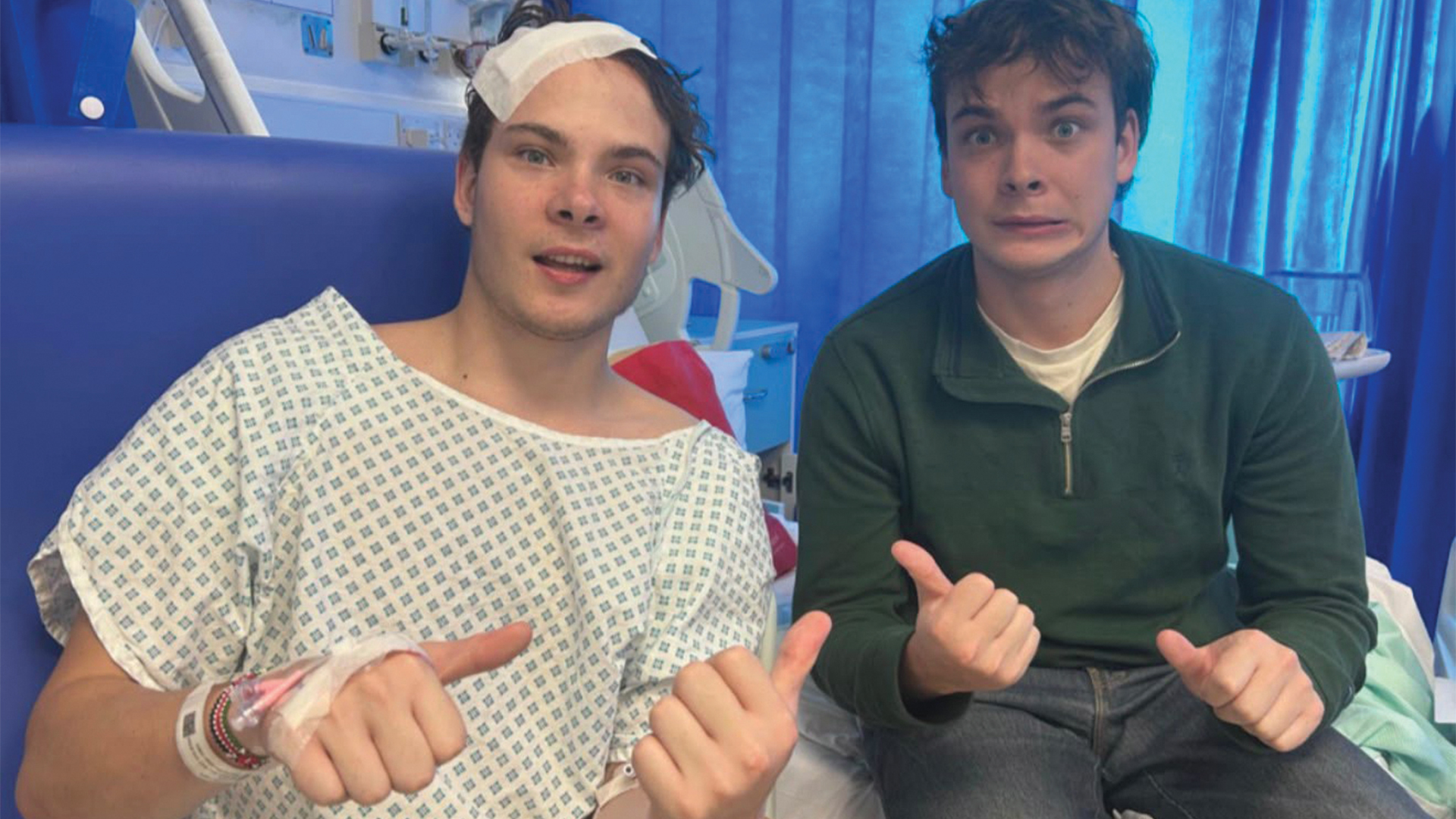
Cal Petrie (left) with his twin brother Brodie during his time in hospital. Image: Supplied
Share
This was always going to be a big year for Cal Petrie. He had moved from his parents’ house in Surrey into Central London to share a flat with his twin brother Brodie. He was enrolled on a business course and making big plans for the future. But, late last autumn, he’d begun getting headaches.
While they were initially controlled with ibuprofen, dismissed as surprisingly persistent hangovers or dehydration, they became more regular.
“One day I couldn’t look left, right, up or down,” recalls Cal. “I couldn’t move my eyes properly and if I did, it would cause a searing pain in my head.”
Finally, after returning from a family holiday in Kenya, when one headache caused by simply diving into a swimming pool did not go away, he realised he needed to get it looked at.
“You wouldn’t immediately jump to the conclusion that this is something living inside my head,” he says. “So I took more medication. But it continued long enough for us to raise questions. I would take medication with me to classes because I knew it would spike up once or twice a day.”
His father actor Alistair Petrie, a familiar and formidable screen presence, well known for roles in Sex Education, The Night Manager and Andor, takes up the story.
Advertising helps fund Big Issue’s mission to end poverty
Advertisement
“Cal’s mum and I decided we should get it checked out. It was a Saturday morning, the GP was closed, so the logical thing was to head to A&E.”
The initial response was that it was probably a migraine. But, when he was offered the option of a CT scan, “although they said they didn’t think they would find anything”, Cal immediately said yes.
“Even the walk down the corridor to the CT scan was painful. I’d have to stop every few steps to clutch my head. I could sense this wasn’t a normal headache.”
Keep reading the journalism that powers our mission
Register free to continue and learn more about the stories, campaigns and the support we provide, helping people facing poverty across the UK.
This was the beginning of a journey that is still ongoing for Cal and his family. There was fluid on his brain but, he was told, it was “probably just a very benign tumour”. He was nevertheless transferred from Chelsea and Westminster hospital to the specialist neurological department at Charing Cross.
“They put me in an ambulance and blue light me all the way through the city, and the entire time I’m sort of clutching my head and groaning,” Cal remembers. “Poor Mum, travelling with me through all this journey.”
Throughout our conversation, Cal’s concerns are constantly with his family. At 23, and still midway through a gruelling course of chemotherapy, he displays a remarkable empathy.
His treatment is scheduled to end in mid-December, bookending a traumatic and unexpected year. Meanwhile, he is advocating for more funding to research brain tumours in young people. More children and young adults under 40 die, he knows, from brain tumours than any other form of cancer – yet it is relatively under-researched.
Alistair explains what happened next. “After a lot of MRIs and investigations, the supposition was that the build-up of pressure was because this mass had blocked off the natural flow of fluid and that was causing the headaches. Then we met Arthur Dalton, who is Cal’s amazing surgeon. We were still told, given his age, that the likelihood was it was a benign tumour.”
During a two-hour procedure to drain the fluid from his brain following an incision in the top of his head, a biopsy was taken. Just in case. Standard procedure.
“Weirdly, it was all quite exciting to me,” says Cal. “It’s a world you’re completely unfamiliar with. And then I woke up feeling like myself. The headache had disappeared. I honestly felt like a million bucks. So I thought that was it.”
His father, sitting next to him, switches between pride at his son’s fortitude and a look that betrays the powerlessness a parent feels in this situation.
He admits: “I did end up apologising to Cal down the road because I kept saying to all the medical professionals, ‘This is my son, tell me everything first.’ I wanted to be the person to filter the information – I didn’t want Cal hearing all this confusing big news. But of course, Cal is 23. He is not seven. It’s that parental instinct – if I could take this from you and give it to myself, I’d do it in a heartbeat.”
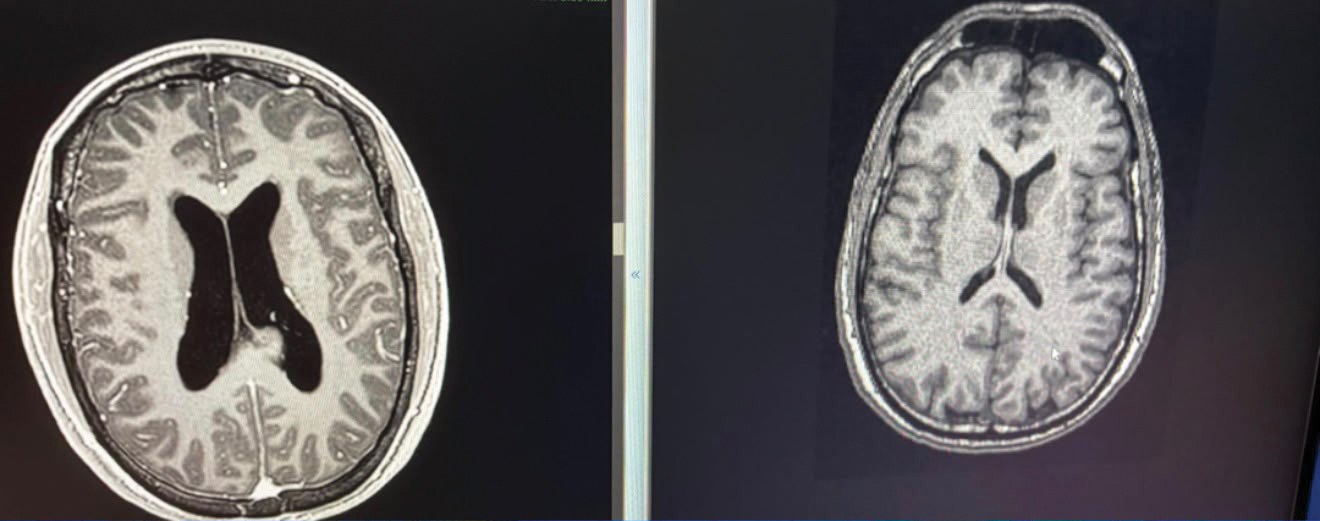
Cal Petrie’s brain scan (left) shows the build-up of fluid. Image: Supplied
Alistair set up a brains trust – getting second opinions from brain surgeon friends-of-friends. None of them felt the scans or symptoms were cause for further alarm. Sure enough, two days later Cal was discharged. But the biopsy results showed up something much more serious. And Alistair took the call they had been dreading – asking them to come in as soon as possible.
“It was the unknown that was absolutely killer,” says Cal. “Bless him, Arthur was really gracious with his words and didn’t outright say it’s cancer. He described a spectrum between benign and malignant and told me I was somewhere on that scale. There was this whole rush of information coming in. My mum recorded the whole interaction and transcribed it later to see what really was said – which was really useful. That’s where we could pick out the positive elements.
“I left weirdly unsure about whether it was cancer. I think I was trying to protect myself. I remember turning to Dad as he’s driving home, in a silent car, saying, so is it cancer? And,” he turns to his dad, “you really kindly said, you can call it whatever you want. It doesn’t really matter what it is – but whatever happens, we’ll get through it. That’s the moment I knew it would be a long road ahead.”
Operation preparation
They were grateful for the surgeon’s bedside manner (Alistair describes him as a “remarkable human’”. But they were venturing into the unknown. Cal had a rare, aggressive and fast-growing form of brain cancer called pineoblastoma, more commonly found in babies and young children. There are only around 100 people worldwide with a similar diagnosis at his age each year.
Alistair, again, looked to control what he could in an out-of-control situation.“The thing I was thinking is that my job now is to simply find the greatest surgeon the world has ever seen and do whatever we have to do to get them here. But of course, as it turned out, there he was, the very brilliant Arthur Dalton, sitting right in front of us, courtesy of the very brilliant NHS.”
A lot of questions were asked. Did he have a busy few days of surgery before Cal’s operation? Would he be well rested? As an actor, Alistair felt reassured hearing the surgeon would spend the day before Cal’s operation rehearsing the procedure. “I could relate to that,” he says. “Arthur said, ‘My job, when I go in, is to have a minimum amount of unknowns’. He had these two shopping bags full of Mixed Reality kit and asked us if we wanted to use it, to see the entirety of his brain and exactly where the tumour is. We looked at each other. Erm, not yet! But it was remarkable.
“One of his trainees programmed his own Mixed Reality software that Arthur could use to plan the operation. He’s also starting a charity we’re going to support and promote, called the HAIDN Foundation, which aims to train and build neurological capacity in less resourced healthcare systems than ours.”
The operation was to be complex and long. But the build-up was short and scary. “Cal was remarkable. Calm, somehow listening to the information coming at him,” says Alistair. “Something he said then, which he has said a lot over the past 10 months, was that every treatment is a positive step on the journey to getting better, one step closer to it all being over. What a remarkable thing to cling on to and express.”
But inside, ahead of a long day of surgery, Cal was anxious. “It was so nerve-wracking. We went to lunch by the river with my twin brother. It was such a normal thing to do but I couldn’t focus on living in the moment. I was thinking about what’s coming and the risk that I might wake up with distorted vision or blind and might have to relearn how to walk. Those things kept swirling in my head. I worried that thinking about it so much might manifest it in some weird way. But I couldn’t get it out of my mind.”
The aim, according to the surgeon, was to remove 80% of the tumour. “I looked him square in the eye and just said, Bring him back. He shook my hand and said, I’m looking forward to it,” Alistair recalls. “That made me feel settled. Wow, I thought, this is what you do. But then, of course, Cal was wheeled into the lift with this gorgeous team around him ready to go. And as soon as the lift’s doors closed, Lucy and I literally dropped to our knees.”
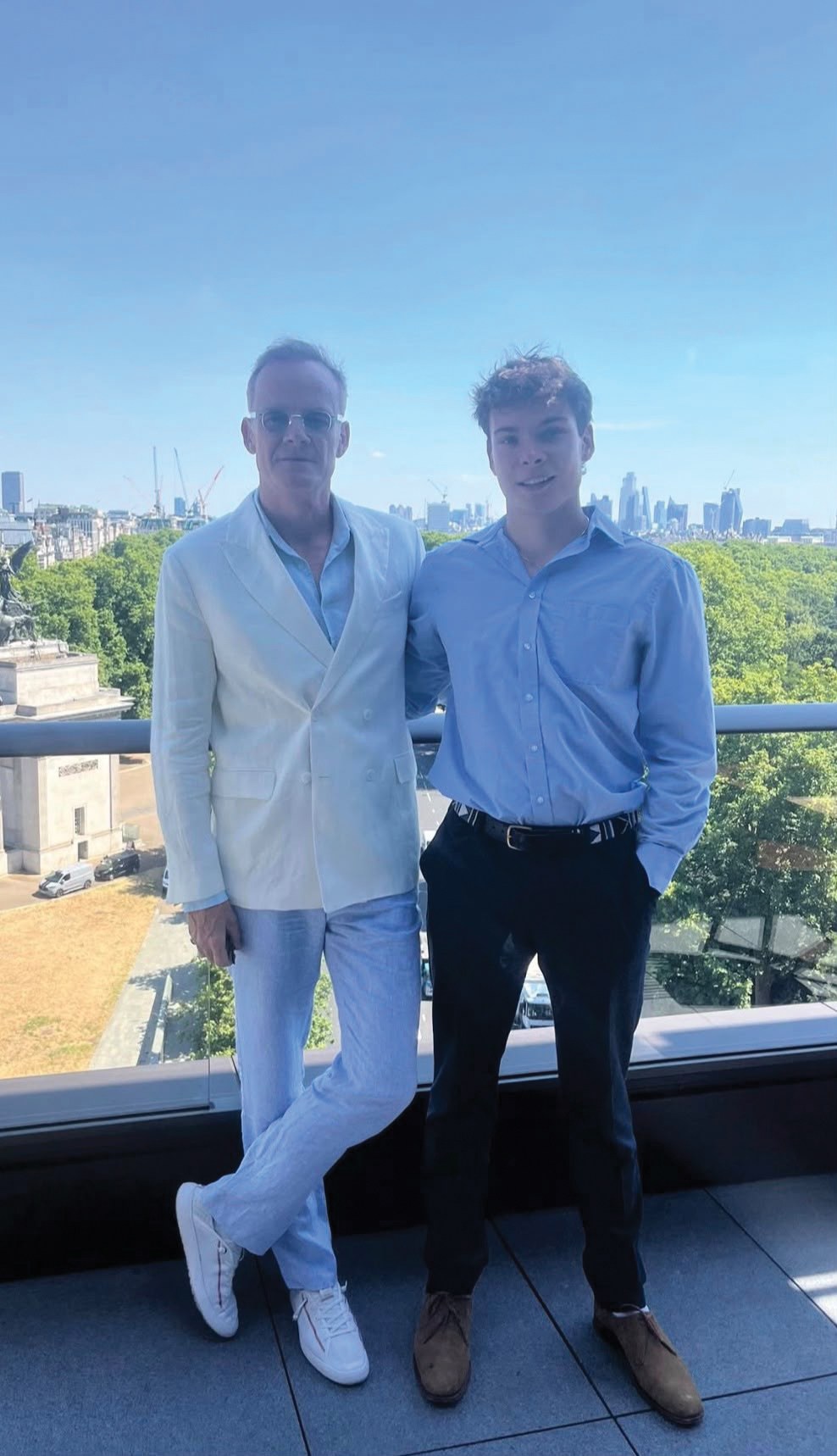
Cal Petrie with his dad Alistair. Image: Supplied
Into the unknown
If the time, for Cal, passed in the blink of an eye, for his family it was the longest day. “I get put under and wake up two seconds later, going, ‘Hey, are we done?’ But for everybody else, it was a long, cruel 13 hours while I was under the knife.”
Alistair took a call from the surgeon at 5pm. “He told me, ‘We are going slow and steady. That’s exactly how we want it. We’re just stopping for a coffee break.’”
They walked around nearby and visited the Maggie’s Centre at Charing Cross Hospital.
“We spent some time being looked after by volunteers. It’s almost like a Scandinavian lakeside pavilion, so beautifully done. An amazing charity. You can walk in and there are people who are going through treatment or related to people going through treatment.
“And it’s this beautiful hub that is so supportive. We met some extra-ordinary people.
“The next morning, when Cal came round, Arthur told us he had asked Cal how he was. And he said the first thing that came out of Cal’s mouth was, ‘No, how are you?’ Which says everything about my son. I think it rather moved him.”
Cal lost around one-third of his blood “and a bunch of spinal fluid” during surgery. But the surgeon managed to remove 98% of the tumour. “Even he described being thrilled,” recalls Alistair, though the surgeon felt unable to celebrate. Because the next stage was frightening for Cal. “I woke up and effectively my entire right side of my vision had completely shut off,” Cal says.
Alistair, who had raced home to feed the family’s dogs, adds: “He called me and I was just expecting this slightly woozy young man still coming round. But I picked up and he said, Dad, I can’t see, which broke me.”
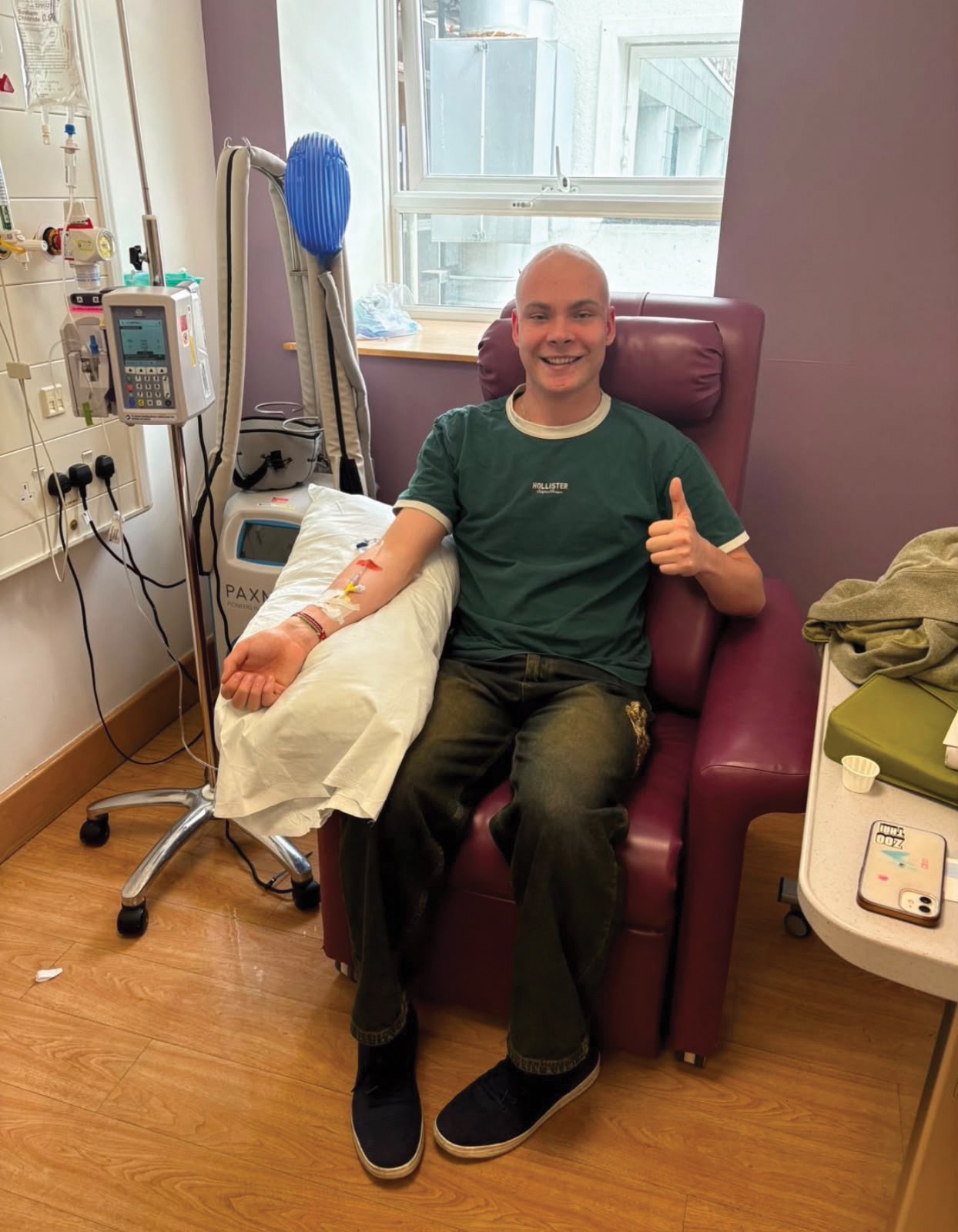
Cal Petrie lost his hair during chemotherapy and proton-beam therapy treatment. Image: Supplied
After six weeks, Cal’s sight began to improve. Because so few people of Cal’s age face this diagnosis, there is not enough data to build a specific treatment plan. So he started six weeks of proton beam therapy, five days a week, in a futuristic treatment room – “like being on the set of Star Trek” – deep beneath the hospital, so Northern Line trains don’t shake the machine. He began to lose his hair.
“It came to a point where we needed to shave the rest of it off. So my twin brother gave me a really nice mohawk, a little square on top, all the hairstyles possible. That really helped. We made light of the situation. Then it all came off – and then he did it to himself too.”
Having a twin brother is, Cal says, a huge source of strength.
“It’s like having a best friend from day one in your life,” he says. “There’s also an unspoken competitiveness between us. It was there all through school, whenever we did sport.
“But it’s a very sacred relationship. You’ve got things like twin telepathy, and there’s a theory you can feel each other’s pain – and to some extent that’s true.
“There are also moments of utter jealousy. I’m stood stagnant during this year. I can’t really do anything. Whereas he’s gone off, he’s graduated, his career is moving forward and he is starting a two-year masters course at the National Film School. So he’s doing incredibly well.
“I have moments of feeling that it’s not fair. There have been times when it has felt like my own personal lockdown. I’ve been terrified of going anywhere or getting the tube and picking up a virus when my immune system is so low. I have struggled. That’s where the loneliness kicks in.”
This week, Cal returns for his fifth of six cycles of the chemotherapy that followed the proton beam therapy. It involves 10 hours of infusions. He remains in the middle of this. But he’s determined to speak out to raise awareness of brain tumours in young adults.
“If everything goes right, the last cycle is 10 December – I’m really glad it won’t jump into 2027. But if it does, that’s another bridge we will cross.”
As Cal looks forward to the end of a year of treatment and turmoil, he is still wrestling with so many unknowns. Why this happened being the key question. Only more research will help Cal and others going through this. So he has been watching with keen interest the recent conversation around funding for research into brain cancers sparked by swimming champion Archie Goodburn’s televised appeal and meeting with Prime Minister Andy Burnham.
It’s a campaign the Petrie clan are fully behind. “This is the biggest change that we’ve seen to brain tumour research in the last two decades,” says Cal. “It’s a really big step forward. More funding means more research. And more research means more answers.”
Brain Tumour Research is the only UK charity focused on finding a cure for all types of brain tumours
According to the Brain Tumour Research charity, one in three people in the UK knows someone affected by a brain tumour. This disease can affect anyone at any age, and each year more than 12,000 people are diagnosed with a brain tumour.
The disease kills more children and adults under the age of 40 than any other cancer, yet just 1% of the national spend on cancer research was allocated to this devastating disease between 2002 and 2021.
BTR is campaigning to increase the national investment in research into brain tumours to at least £45 million a year, while fundraising to create a network of Brain Tumour Research Centres of Excellence across the UK.
Dan Knowles, CEO of Brain Tumour Research said: “Cal’s story reflects the devastating reality faced by so many families across the UK.
“We need sustained investment if we are to develop kinder, more effective treatments.”
Responding to Andy Burnham’s recent promise of more investment, he added, “The government has seized the opportunity to place research at the heart of transforming outcomes for patients.”