Can Labour’s new code help child victims of crime get justice?
At a school in east London, a Labour minister tries to get to the heart of why children can’t get the justice they need
by:
5 Feb 2026
Minister Alex Davies-Jones and children’s commissioner Rachel de Souza. Image: Ministry of Justice
Share
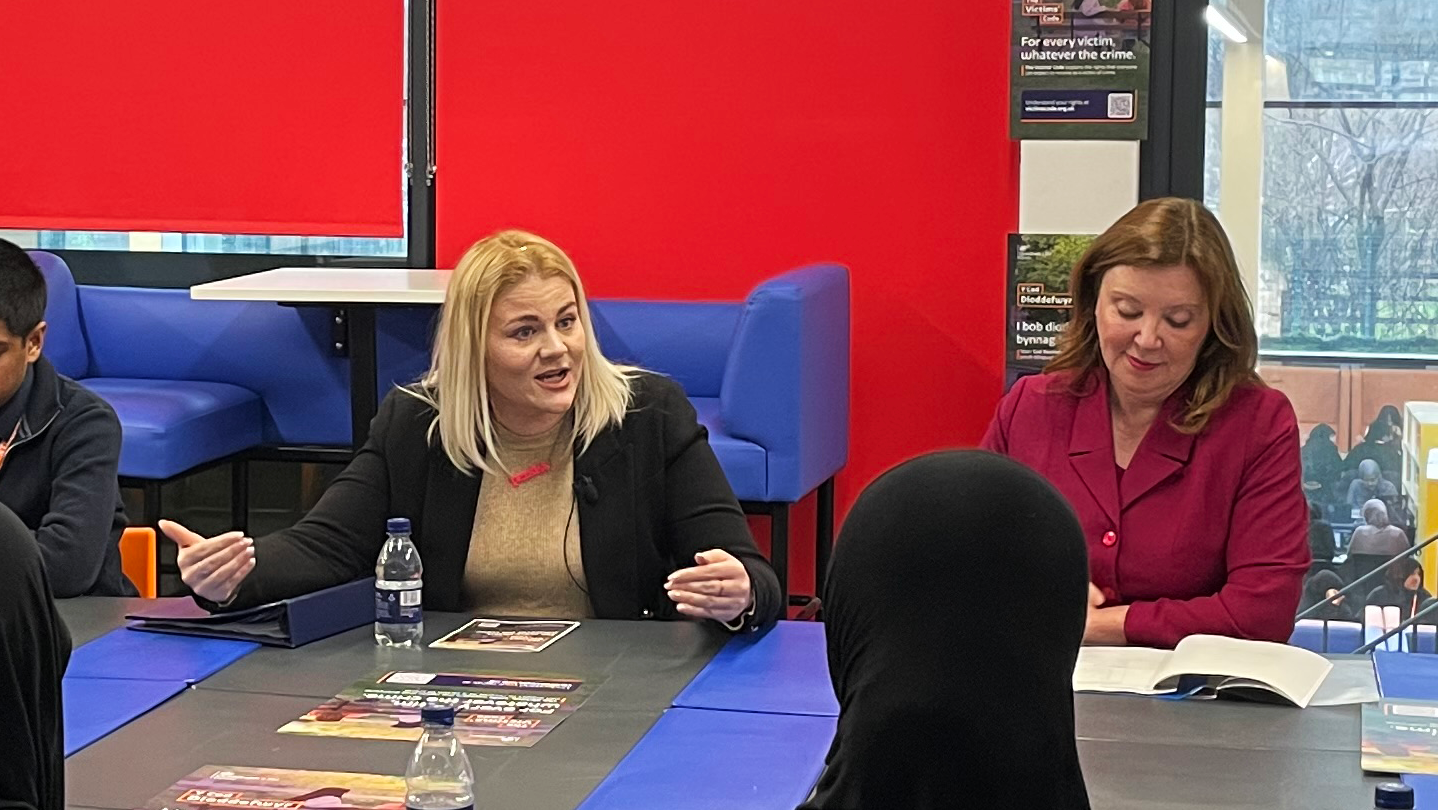
Who feels safe walking around here at night? Just three of the 18 sixth-formers around the table put their hand up, and they’re all boys.
Asking the questions at Stepney All Saints School in east London are the victims’ minister Alex Davies-Jones and children’s commissioner Rachel de Souza.
As they go round the table, one boy says about a friend who had his phone stolen three times. The police, he says, couldn’t do anything because the thieves were wearing masks. Another pupil tells a story of police failing to act when her cousin had her car stolen.
“Wasn’t that depressing? Really depressing,” de Souza tells Big Issue afterwards, of the stories of police inaction. “Some of them were quite serious crimes as well. Which makes me think, really, if children and young people are going to trust the police, then the police need to protect them, take them seriously, act on what’s said, and follow up. Some of the stories we were hearing in there, I don’t think it’s enough just to say we’re so busy.”
That’s the challenge. Davies-Jones and de Souza are visiting the school as part of the government’s efforts to update the Victims’ Code to try and help child victims of crime get justice, something which will fulfil a manifesto promise.
Advertising helps fund Big Issue’s mission to end poverty
Advertisement
Around in some form since 2005, the Victims’ Code sets out the rights victims and witnesses of crime have when interacting with the authorities – from receiving information and updates through to access to support services.
With a three-month consultation launching this week, the government is proposing that children aged 12 and up will be given more direct contact with police and probation services where necessary. The hope is that it will make it easier for children to come forward, be taken seriously and get the justice they deserve.
But what use will more rights be when the pervasive feeling is that coming forward is often pointless? Davies-Jones points to government action on low-level crime. “Those victims are feeling invalid right now, they’re feeling like they don’t matter. And that’s totally unacceptable,” she says.
“If we’re really, truly going to make our streets safer, then it involves all of us in society coming together, and that’s backed up by realistic and deliverable policy, which is what we’re trying to do as a government.”
Davies-Jones with students at Stepney All Saints school. Image: Ministry of Justice
Alongside victims knowing and having their rights, the government needs to legislate on criminal offences and fund the police, Davies-Jones adds.
Those who report crimes are increasingly disatisfied with what happens. Half of victims were satisfied with the police response, 2025’s Crime Survey for England and Wales found, down from 70% in 2015. Complaints have been raised that the Victims’ Code is “not being fully complied with”. The Independent Inquiry into Child Sexual Abuse found inconsistencies in how next steps were communicated to victims and survivors, uncertainty over whether perpetrators would be arrested and police unwilling to share information directly with young victims and survivors “in case it upset them”. One report found that some victims and survivors had to chase police for updates.
Advertising helps fund Big Issue’s mission to end poverty
Along with making it easier for children to understand – and be afforded – their rights, Davies-Jones hopes the new code will allow children from disadvantaged backgrounds better access to justice.
“We know that these types of children and young people will need even more support, because they do feel like their voices don’t matter as much. And it’s about rebuilding trust, whether that be in the police, the CPS, the court services, that if they do report a crime that’s happened to them, there will be consequences and there will be actions. It’s not easy to fix, but it’s vitally important,” says Davies-Jones.
“It’s about ensuring that they have both that safety and empowerment to know that they have a right to be heard, and they have a right under the victim’s code”
Children’s commissioner de Souza worked at All Saints 30 years ago. In 1993, she was head of religious studies and PSHE here. She tells Big Issue the story of a boy who hadn’t turned up to an exam. They found out he had been called over by a police officer, but was frightened and ran away, so got arrested and kept in a cell overnight.
“A child’s first interaction is going to colour the way they think about their relationship with the police and society forever,” says de Souza.
During the round-table conversation, one boy recounts being stopped and searched at the age of 13. “I hated it,” he says. “They were a bit rough.” He adds: “They said they didn’t have a reason.”
Advertising helps fund Big Issue’s mission to end poverty
De Souza tells me: “I will be speaking to the police commissioner about this. Just to tell him the story I’ve heard here. I know it’s not something Sir Mark Rowley would want the Metropolitan Police to be doing.”
Alongside the efforts on the Victims’ Code, the government has also promised to introduce domestic abuse and consent lessons for all pupils over 16. Currently, the classes are not compulsory in England – but are in Wales.
The promise came after years-long campaigning by Faustine Petron, a Big Issue Changemaker.
“What we heard today from the young people was the need for better education, whether that be about their rights via the victims code or around their safety and personal and healthy relationship education, for example, all of this is something that the young people themselves are crying out for,” says Davies-Jones
But the government has refused to back an amendment, tabled in the Lords by former Tory education secretary Baroness Nicky Morgan, which would bring this forward. It says doing so could delay the entire bill. Morgan tells Big Issue she believes campaigners will now look to make the change through a private member’s bill, with women and equalities minister Jacqui Smith indicating in the Lords that she would “most certainly want to engage in supporting that making progress”.
“We’re committed to doing this. We absolutely are,” Jones-Davies says, adding that they are working to get the education in place as soon as possible. “It’s in the strategy in terms of ensuring that we’ve got this appropriate education for all children in England. What we need to do is get it right. We have to have that consistency. It’s complex in terms of all of the different types of schools that we have in England available, but we’re determined to do it because it’s vitally important.”
Advertising helps fund Big Issue’s mission to end poverty
Buy from your local Big Issue vendor every week – and always take the magazine. It’s how vendors earn with dignity and how we fund our work to end poverty.