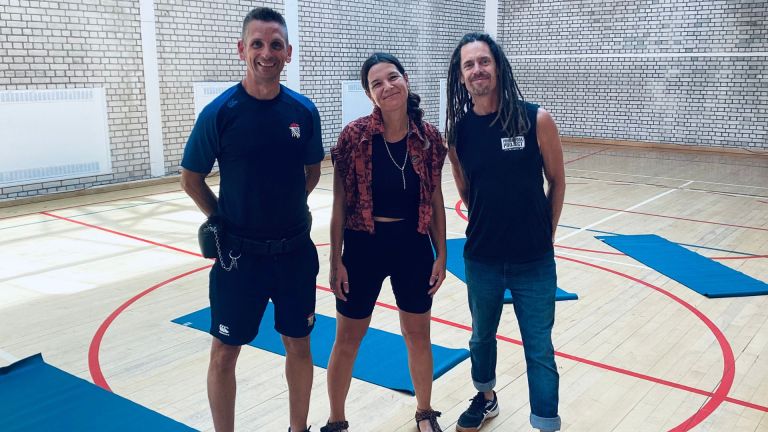
That is where Armani’s project may offer an alternative.
Take some lessons from the world of football. Leicester City’s 5,000-to-one Premier League victory in 2016. Greece’s Euro 2004 title, achieved through defensive football and grit. Or the thrill of your team grinding out a result when down to 10 men. Often, football is a game where you must overcome the odds. Life can be the same – especially for prison leavers.
“For them leaving prison, it’s never 11 vs 11. They need to get used to playing against the odds. Because that’s the only way they’re going to make a positive impact back into society, and prevent them coming back to jail,” says Armani.
Keep reading the journalism that powers our mission
Register free to continue and learn more about the stories, campaigns and the support we provide, helping people facing poverty across the UK.
So, for some Crxssbar sessions, this on-field insight is taken and used to make a link with the broader world. Drills might focus on overloads and underloads, giving away unfair penalties, and playing with a man less. Alongside this, coaches will explore ways to rebalance life – perhaps finding smart ways to find experience so a CV doesn’t look empty.
“We’re not using a language that doesn’t belong to them. We’re using stuff that they’ve grown up with,” Armani says. “We’re representing new ideas, but in a familiar language, and honestly it just feels like such a privilege to see when people make a link and learning clearly unlocks something in them.”
Read more:
Or look at set pieces. Out of vogue in recent years, throw-ins and corners have been newly embraced by Premier League clubs, with the number of set-piece goals rising and specialist coaches becoming micro-celebrities in their own right. Arsenal fans, singing “set piece again ole, ole” on their way to a first league title in 22 years, knew all too well the rewards of practising for situations that are guaranteed to happen.
“In life there are certain things that happen again and again, but we never rehearse them,” Armani says. There are situations he terms key throw-ins: sharing an offence before you get a job, being able to get it out of the way in a manner which allows you to move on and talk about your experiences; the first 90 seconds of an interview.
“There are some things that will always come up, and they’re always repeatable, and we can actually get better at them,” he says.
Sessions, then, will focus on set-piece drills off the pitch, and rehearsing the real-life set pieces during warm-ups and breaks. It is the same for the concept of stretching the pitch – in life, expanding your network, growing your social skills.
Armani, who is a designer and adjunct professor of design at the Royal College of Art, co-founded Crxssbar after beginning to think about how to do education differently.
“For the last 10 years, I’ve been drawn to prisons because they tend to be the people that often get the worst experience of education,” he says. “We’re talking about a big, big group of people with profound learning challenges, where school fundamentally let them down.”
That led him to football, and eventually to Crxssbar. Sessions at Thamesmead prison, commissioned by the prison itself, run for three hours every Monday morning. Attendance has grown to around 30, with a waiting list Armani says is ever-increasing. At Lewes prison, a fortnightly session also serves as a workshop for new ideas. Participants can gain functional skills qualifications in literacy and numeracy, equivalent to a grade 4 (a C in old money) GCSE pass.
The idea that education can break the cycle of reoffending is not a fringe belief.
“The public should expect, given the huge cost, that jails are productive places where prisoners acquire the skills and habits that will allow them get work, pay their taxes and look after their families when they are released,” wrote Charlie Taylor, the chief inspector of prisons, in 2025.
“That means they need to be taught to read, write and do maths to a reasonable standard so they can cope in a world where literacy and numeracy are more important than ever. If not, the cycle of crime and prison will continue at enormous cost to prisoners, their families and their future victims.”
And yet, with a system in crisis, and controversy over prisoners being released early to free up space, Taylor added: “In all my conversations with leaders in the prison service, no one has mentioned reducing reoffending as a way of shrinking the prison population.”
Prison education has lagged behind, Armani believes, because education as a whole has failed to innovate. “Reduction in reoffending isn’t particularly glamorous, and people may be not so interested in seeing taxpayer money being spent on prisoners. They’re interested in security, but not on prisoners. And so, it becomes a very difficult thing to invest in,” he says. Money, however, is not always the answer: “It’s the humility to collaborate with people, which is effectively how Crxssbar came about”.
Nobody who has come through Crxssbar’s Thameside programme has been released yet, says Armani. But he believes results are already emerging: one participant is making a book of lessons he can teach his children on release. Another is gaining work experience as a coach, filling in a gap on a CV. Another is developing a portfolio of scripts he can use in difficult, but predictable situations – set pieces.
“He’s feeling better about controlling a bit of his own future, he’s now not nervous about when people say, ‘OK, have you got any unspent convictions?’ Actually, now he can own that conversation. He’s planned it. He’s rehearsed it,” Armani says.
Do you have a story to tell or opinions to share about this? Get in touch and tell us more.
Change a vendor’s life.
Buy from your local Big Issue vendor every week – and always take the magazine. It’s how vendors earn with dignity and move forward.
You can also support online:
Subscribe to the magazine or support our work with a monthly gift. Your support helps vendors earn, learn and thrive while strengthening our frontline services.
Thank you for standing with Big Issue vendors.