The post was set up while James Timpson was prisons minister.
That family, him and his dad, have walked the walk for two generations when it comes to employing ex-convicts. Only a small part of that is humane. They’re decent people, want to give people a chance, but actually if you talk to Timpson, the main reason is those people are damn good workers. If you’ve got somebody out of prison trying to go straight, they’re the best workers you can get. So it is a self-interested business decision as much as anything else. He was the right guy in the right place at the right time, and so we pitched this to him, and he said, “Yeah, go for it.”
What have you learned so far?
Keep reading the journalism that powers our mission
Register free to continue and learn more about the stories, campaigns and the support we provide, helping people facing poverty across the UK.
We’ve been doing it about a year and a half, which is really too short a time to follow people through their post-release lives. What we’ve got at the moment is basic, encouraging anecdotal evidence. Prisoners are hungry for diversion. It’s very boring in prison, and if you can get them to latch on to reading as a diversion they are voracious thereafter. You hear the same thing you hear from a lot of people on the outside who are not comfortable with reading. The stuff they had in school was boring. It did not catch their attention. They ignored it basically, and I can see that completely.
I have a lot of sympathy with teachers. If you’re an English literature graduate and you get a teaching job, you love the great works of literature. I get that. But they need to get out of the bubble and think. You’re 13 years old. You don’t want to be reading Middlemarch or Charles Dickens.
We have this new resource called Quick Reads. They’re not in any way chosen for moral message, they’re chosen simply for the propulsion in the story, the excitement, and to me that is the way to get people into the habit of reading.
There’s dozens and dozens of titles. Let’s say you give a 13-year-old kid or a prisoner who is struggling with reading one of those stories. The story itself sucks them in, powers them through and spits them out the other end. It imprints their brain. Yeah, reading is fun. Reading is exciting. It doesn’t take all day struggling. You can do this in two hours, and then they read the next one and the next one.
Read more:
Eventually you can get to Dickens, but you can’t necessarily start there, right?
People are ashamed of not being able to read and I say bullshit. Nobody has got a full set of skills. I can read but there are millions of things that I can’t do. Premier League footballers are people with superhuman talent in a small narrow area. The rest of their life, they’re a complete fucking idiot. We know this. And so to not be able to read is no worse than not being able to play Premier League football. Get over the shame.
We were very aware that we needed to listen to and learn what else was going on and it turned out that writing is super important to prisoners. Completing a book improves their self-esteem. It’s an achievement. They’ve done it. To complete a piece of writing, they feel like they’re seen, they’re heard. They’re expressing their internal trauma. It’s getting out. It’s somehow therapeutic. So reading and writing go hand in hand.
What have your prison visits been like?
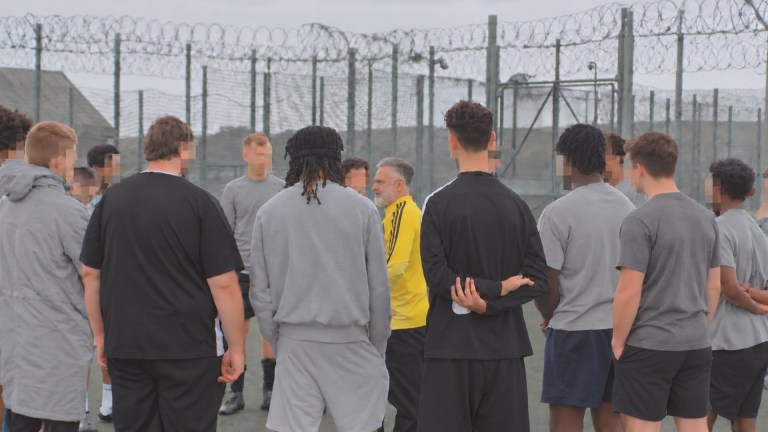
I do a three-visit programme. The first visit is to whip up enthusiasm, and that’s all about the glamour. It’s a Catch-22. If these people aren’t good readers, they’ve never heard of any authors.
Have they heard of you?
Well, yeah, because I’ve got stuff on TV and movies. I know Tom Cruise. That’s very glamorous. Then I have my publishers send them each a copy of my first book, and I say, “You read this. I’ll come back in a month and we’ll talk about it. You can tell me why you like it or why you hated it.”
What we’re hearing from the prisons is while they’re reading, the prison is quieter, more relaxed, stress is down. The prison guards are readers too. They like stories. I try and make it an integrated audience. I want the guards scattered around, sitting next to the prisoners so for that one hour, they are all equal. Anecdotally that really helps. Maybe a guard will help a prisoner with some of the words. That introduces human connections outside of the normal prison intercourse.
On the third visit inevitably they say, “I loved this book except for this part’”, you know. And I say, “It was crap, right?” And they say, “Yeah, that bit was shit”. So I say, “Alright, you do it better. Even if it’s one paragraph, even if you’re fixing one thing, fix it for me.”
What they write is really interesting, some are unbelievable. I had six completed screenplays from one guy, complete novels from somebody else. Those are obviously proficient people. The really touching things are some guy who learns to read well enough that he can read a bedtime story to his kid on the phone from prison. I’ve literally had it said to me, “Now I feel I’m not all bad”. Maybe that guy is the one in 10 who won’t come back.
In your experience, are prisons focused more on punishment or rehabilitation?
It’s an odd situation. Why do people go back? Partly it’s because they just cannot get a start outside, and partly because outside bewilders them. Sadly, I’ve had prisoners say to me, “I got out three months ago. I just hated it. I couldn’t manage. In my head was this idea: I know a place where I get a bed and three squares a day. Why don’t I just go back? It’s comfortable. It’s safe. I understand that world. I don’t understand the outside world.”
So there are a lot of reasons why they come back. But if we can equip them with at least a fighting chance of getting a job, or being able to register for housing then we’re doing our job.
You don’t need to do this. The government should be making sure prisons work. Why is it something that’s important to you?
I agree with you fundamentally. I hold that old Leninist attitude that all charity is bad because it should be a communal provision through government. We’re not each other’s doctors. If you’re feeling sick, I don’t volunteer to come over and diagnose you. I leave that to an organised profession so the government should supply this. It should not be up to charity. In a lot of ways private charity is very destructive, because it has bias and self-interest. I wish it wasn’t necessary. The problem is we could spend 20 years trying to organise and demand the government does it, and maybe we would succeed. But what happens in that 20 years? While we’re arguing, people are falling through the cracks.
When I returned to Britain at the beginning of last year, and I was very aware I need to start paying it back a bit. I feel the classical concept of noblesse oblige, or even, you know, basic Marxism: from he who has to he who needs. That is a basic human obligation.
Nearly half a million Quick Reads books will be distributed across prisons in England, Wales, Scotland and Northern Ireland this autumn as part of the UK’s largest-ever prison book-gifting programme.
Do you have a story to tell or opinions to share about this? Get in touch and tell us more.
Change a vendor’s life.
Buy from your local Big Issue vendor every week – and always take the magazine. It’s how vendors earn with dignity and move forward.
You can also support online:
Subscribe to the magazine or support our work with a monthly gift. Your support helps vendors earn, learn and thrive while strengthening our frontline services.
Thank you for standing with Big Issue vendors.