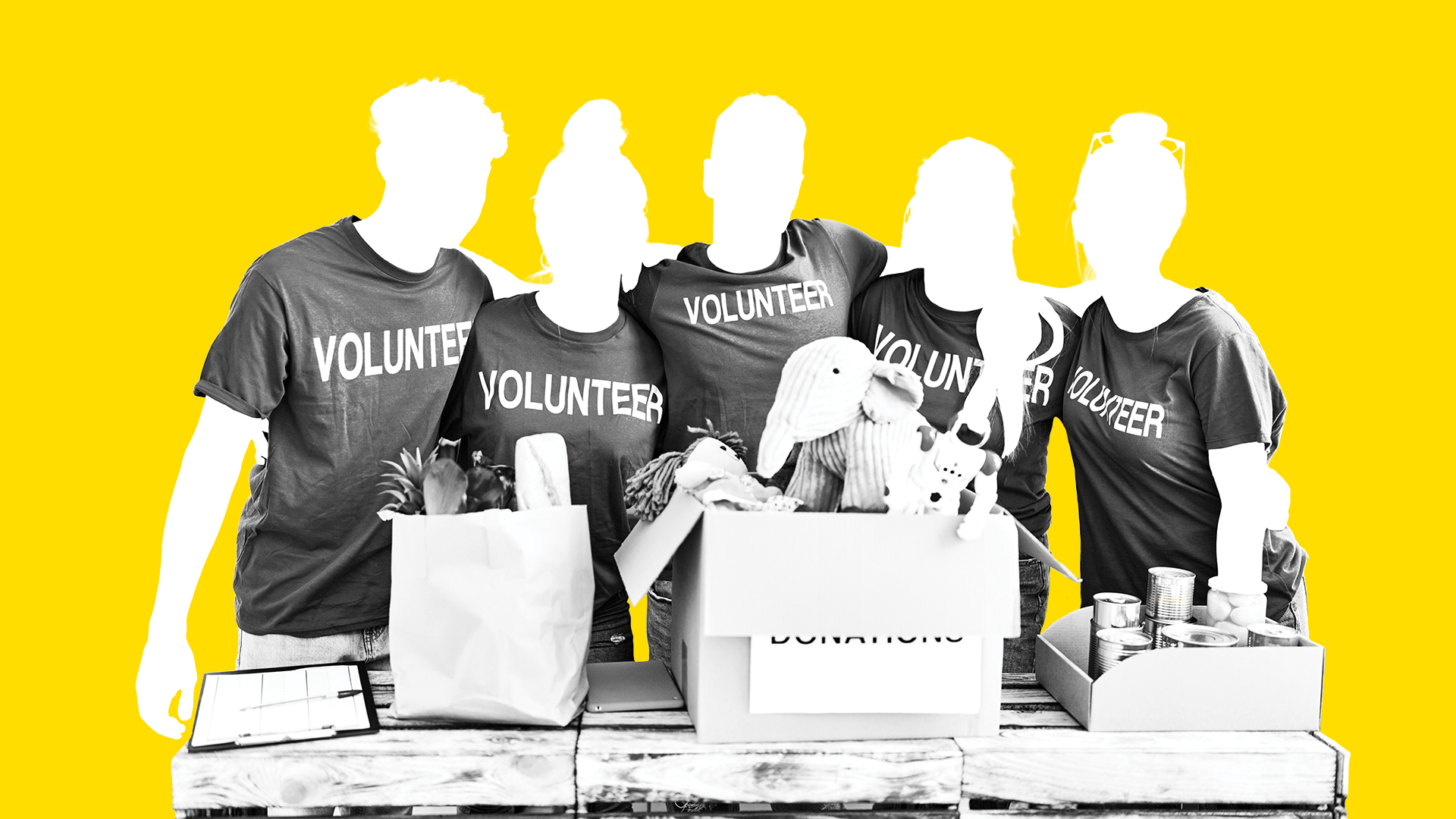
“If people stop volunteering the fabric of our society will start to fray, and we’d become increasingly isolated from each other. Crucial services like social care – already stretched – will be further damaged when people no longer volunteer to drive or provide local spaces for the elderly to connect,” Rees says.
“Local neighbourhoods will decline even further if people no longer come together to pick litter or provide community venues. And a plethora of sport and cultural activities would simply disappear if people didn’t volunteer to create and run them.”
Just 26 years ago, the UK’s first official food bank was launched in Salisbury, and now there are more than 1,700 food banks in the Trussell network, supported by 36,000 volunteers. There are at least 1,000 more independent food banks.
Demand for charity support has skyrocketed in recent years with poverty at near record levels – and that is taking its toll on volunteers.
“Food bank volunteers have often wondered if they should go on strike,” says Sabine Goodwin, the coordinator of the Independent Food Aid Network (IFAN).
They wouldn’t make demands for themselves, only the people they support, asking the government to increase social security payments and for employers to raise wages to help end the need for food banks. But food bank volunteers have never gone on strike – not wanting to hurt the people who need them.
Advertising helps fund Big Issue’s mission to end poverty
“However fragile the operations have become, they know that the buck stops at their doors and shutting them doesn’t feel realistic,” says Goodwin.
“They know that the route to ending the need for their services, and simultaneously the pressure they are under in terms of their own wellbeing, is in the hands of governments not through further institutionalising a charitable food aid response. And so, they continue to live the paradox of filling a gap they can’t possibly close.”
Read more:
Islamic Relief UK recently surveyed their partner charities – mostly small local organisations – to understand the strain that volunteers and charity workers face.
The majority (73%) of survey respondents said that they felt emotionally drained. Three in five (60%) said they felt demotivated, and a similar proportion said they felt physically fatigued or had experienced anxiety or stress. Nearly half (48%) said they felt burnt out, and 37% said they were having trouble sleeping.
Nadeem Baqir, UK programmes manager at Islamic Relief, says: “Ever since the pandemic and cost of living crisis, poverty has seen a sharp increase. As vital public services are cut and the social safety net is reduced, small UK charities have had to shoulder more of the burden without an increase in support or resources.”
Advertising helps fund Big Issue’s mission to end poverty
It means that good people are considering leaving their roles – with 42% saying that they had considered stepping back or leaving due to emotional stress or exhaustion.
Charlotte White found herself in this position as manager of Earlsfield Foodbank in south-west London. She wrote a regular column for Big Issue, Diary of a Food Bank Manager, where she raised awareness during the cost of living crisis. White left her role at the food bank in 2024.
“It’s only really since I’ve left that I’ve realised how bad it was. We were a relatively small food bank and we only operated once a week, but even so it was becoming unbearable. I think the most obvious thing is the emotional distress from talking to people at the lowest points of life and feeling you’re not doing enough,” White says.
“In the moment, you do everything you can to help, you’re in emergency mode, you’re very practical, trying to help people. But then I would come back home and I would completely dissolve and spend the afternoon crying.”
There were some especially distressing incidents. White had to call ambulances for food bank guests. Roughly one person a week faced a mental health crisis. They had a quiet spot at the back of the church where they would sit with people as they called the Samaritans.
Once, a food bank guest called White to tell her he was planning to take his own life and she helped talk him out of danger.
Advertising helps fund Big Issue’s mission to end poverty
“We had some great support services on site. We had Citizens Advice and Family Action, but we were always the first point of call. Sometimes people aren’t at the point where they’re ready to seek further support,” White says.
IFAN offered mental health training for food bank workers, but volunteers have to learn a lot on the job.
It is a similar story across the country. Black Country Foodbank runs 26 food banks across three boroughs, with 350 volunteers supporting them. Chief executive Jen Coleman says the volunteers have been “transformative” and helped them keep up with surging demand.
But she says the “weight of poverty is heavy”. She has been at Black Country Foodbank for 14 years; some of the volunteers have been there even longer, and their role has drastically changed in that time. Local services have shut in the West Midlands, placing greater pressure on the food bank and its volunteers.
“The evolving of these food banks has been quite hard to manage. There’s some who cope better than others with the challenges that are at a food bank. Sometimes you will lose volunteers. We want to create a nice, warm atmosphere, but it’s a tricky thing when you have got complex cases coming in,” Coleman says.
When White looks back at her time at Earlsfield Foodbank now, she realises she was burnt out. “I was crying all the time and not sleeping well. But there was massive guilt at leaving when I did because I was the manager. I felt I was letting people down.”
Advertising helps fund Big Issue’s mission to end poverty
The main reason White left was because of her children. She lived near the food bank and there were no boundaries. She remembers being on the bus with her daughter, who was eight, and being approached by food bank guests in crisis.
White was a staff member earning a humble salary in her last two years of running the food bank, but she was volunteering for the first three years. When she left, they made sure to hire someone who did not live too close to the food bank, and they ensured that there was emotional support in place for the individual.
White never regrets the time she spent at the food bank – it was one of the most “fulfilling” experiences of her life and widened her worldview after 25 years working in advertising. But she would like to see the burden on charity workers and volunteers lifted, and that comes with alleviating poverty and reducing the need for food banks.
Goodwin says that the end of the two-child limit on benefits and emergence of the £1 billion Crisis and Resilience Fund for councils has given food bank teams hope, but “there’s still a long way to go” before Labour meets its manifesto commitment to end mass dependence on emergency food parcels.
And there is still a long way to go to reducing levels of poverty in this country, alongside crises in social care, housing and long waiting lists for NHS services.
“It’s not that people don’t want to volunteer but it’s almost like if you didn’t have to prepare food parcels you could do something much more worthwhile,” White says.
Advertising helps fund Big Issue’s mission to end poverty
“Imagine if we had the food bank as a community hub where we could sit down with people and do stuff like helping them make sense of a bill or open a bank account.”
Coleman echoes this. “Imagine what we could do with the army of people we’ve got. Imagine what they could do within the community. We wouldn’t exist without our volunteers. They are incredible. It’s mind-blowing what they do for their community.”
Volunteers will probably never stop volunteering, not en masse. There are so many kind people in this country eager to help. But perhaps their goodness could be better used if they are relieved of the burden of the poverty crisis.
Big Issue and volunteering
Whether you’re interested in helping out with office admin, or supporting vendors at the front desk, volunteering with Big Issue is a great way to develop your skills and meet new people while helping to make a difference to the lives of hundreds of Big Issue vendors across the UK. You can volunteer as an individual or with your company. Email us to find out how you can be a part of it.
Do you have a story to tell or opinions to share about this? Get in touch and tell us more.
Change a vendor’s life.
Advertising helps fund Big Issue’s mission to end poverty
Buy from your local Big Issue vendor every week – and always take the magazine. It’s how vendors earn with dignity and move forward.
You can also support online:
Subscribe to the magazine or support our work with a monthly gift. Your support helps vendors earn, learn and thrive while strengthening our frontline services.
Thank you for standing with Big Issue vendors.