Advertisement
Opinion

London’s community gardens show it’s not just a diesel-choked city on its last legs

There are far more opportunities to grow food and produce wine in London than you may think. Urban Wine Company’s Richard Sharp takes a tour of London’s inner-city growers

Last night I had a very strange dream that involved a long procession of people carrying a vast amount of fruit and vegetables into community kitchens. Their laden bounty appeared in glorious technicolour including blood vessel-bursting red tomatoes, brilliant green, long and slender cucumbers, and the deepest and darkest purple aubergines.

Inside their neighbourhood kitchens, the characters from within my dream enjoyed and shared their healthy meals together as they laughed and chatted amicably. Amongst this convivial and warm-hearted atmosphere, delicious and hearty soups and stews made from locally grown inner-city London vegetables were placed in front of the expectant and hungry diners.

When I woke up, I realised that this early hour’s hallucination was not about some wealthy hipsters in a new and trendy neighbourhood restaurant using local produce to entice people inside. No, the reality is much more down to earth and is taking place within a mind-boggling network of local community food projects across London. This local food growing revolution is driven by a belief in combatting food poverty, helping the environment and getting people eating healthily together. I wanted to find out more and so I set off to hear from those involved.

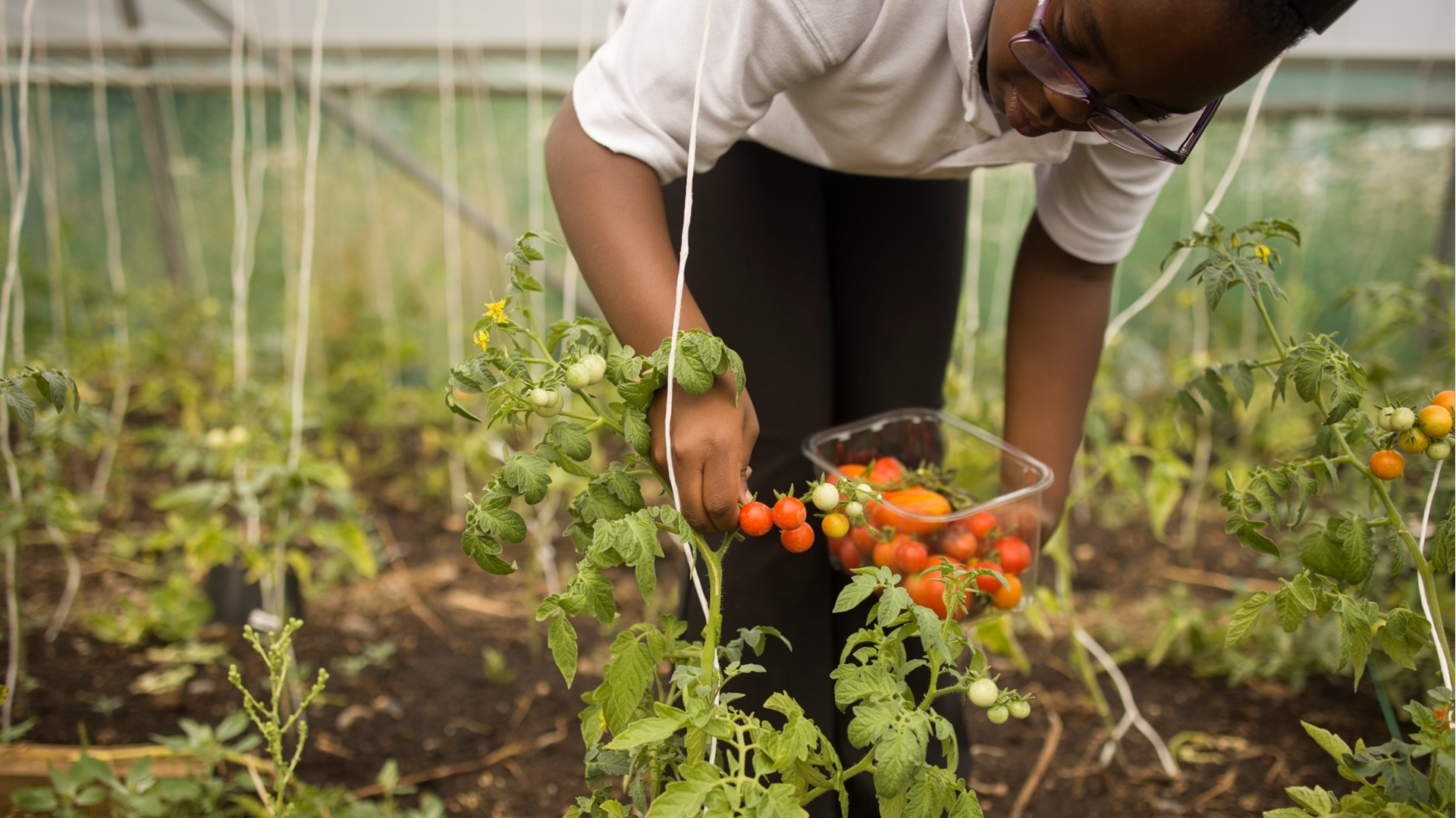
Richenda Wilson, marketing coordinator at Growing Communities – a community farm in Dagenham Farm East London, grows crops including organic salad leaves and herbs for a vegetable box scheme that serves the local community. She said: “Our produce is just a few miles and a few hours from our plot to people’s plate, and this helps to maintain freshness and nutrition. The farm’s covered space also allows tomatoes, cucumbers, beans, and courgettes to flourish in this East London Garden of Eden.

On another site, Michaela Crunkleton-Wilson, market garden lead from Black Growth, operates an amazing quarter-acre market garden in South London where they have grown a belly busting 350 kg of fresh produce. Hosting regular community days and collaborating with 27 local organisations, the project ensures access to land, skills, and culturally relevant food. They plan monthly community days on their land and are expanding their growing and engagement programmes. Some of the produce is also turned into chutneys and sold at local retail pop ups such as Herne Hill market and at Brockwell Park Community Greenhouse Shop.

My conversations led me to realise that London, led by groups of like-minded individuals, are helping to convert patches of urban spaces into food-growing networks, partly meeting the food needs of the local community. This also challenges the perception that London’s simply a diesel-choked city on its last legs.


Advertising helps fund Big Issue’s mission to end poverty
Advertisement

Read more:

Just down the road, Jesicca Wiper, community gardener at Vauxhall City Farm, said: “We use fruit grown on the farm such as surplus apples and pears and this is turned into jams and chutneys. We use some of the produce in our community café. Vegetables and herbs grown in our raised beds or in the greenhouse are also used in soups and salads, and items like courgettes and leeks are ideal for big pot dishes for soups and sauces.”

I had a similar recurring dream-like thought when I started the Urban Wine Company that kept spinning round my head. It involved standing on a high vantage point in Crystal Palace. As I gazed across the tower blocks, railway sidings and industrial units of this congested city, there were rows-upon-rows of grape vines entwined around every urban nook and cranny. The vines reached out and wrapped themselves around washing lines and climbed up terrace house warm summer walls.

It was as if the vines were determined to integrate themselves into the fixtures and fittings of busy urban life. In my imagination, the vines grew in 10-mile rows from Morden all the way up to Camden. Every available green space was turned into a pocket vineyard, and the grapes were harvested annually and made into wine for every London urban village to enjoy. Chateau Tooting, Camden, and Ealing anyone?

Fast forward 15 years later and this crazy idea of a communal urban wine making London has turned into a reality. Over the last few years, thousands of Londoners have had their garden grapes made into their very own critically acclaimed wine.

Ed Howden, a member of the Urban Wine Company, said:” If I had not read about the Urban Wine Company eight years ago, I wouldn’t have thought to plant a couple of vines on our roof terrace in Stockwell. It’s remarkable that grapes grown on it are turned into a communal wine that we and our neighbours enjoy. The Urban Wine Company’s approach provides a blueprint for how communities in urban areas can collaborate to reduce food waste, lower food miles and strengthen community links between people. And taking part is also tremendous fun!”

So, if you want to eat, drink, and communicate with new friends and neighbours, get digging and planting today. You may also be able to ditch those boring trips to the supermarket more often.

Richard Sharp is the founder of the Urban Wine Company

Do you have a story to tell or opinions to share about this? Get in touch and tell us more

Change a vendor’s life this winter.

Buy from your local Big Issue vendor every week – and always take the magazine. It’s how vendors earn with dignity and how we fund our work to end poverty.

You can also support online with a vendor support kit or a magazine subscription. Thank you for standing with Big Issue vendors.

Advertising helps fund Big Issue’s mission to end poverty

HELP VENDORS KEEP WORKING THROUGH THE COLD

For £36.99, help a vendor stay warm, earn an extra £520, and build a better future.
Grant, vendor

Recommended for you

Read All
Taking action against climate change could also help end the need for food banks. Here's how
Lisburn Foodbank in Northern Ireland. Image: Trussell/ Robert Stothard
Helen Barnard and Mike Childs

Taking action against climate change could also help end the need for food banks. Here's how

Prime minister is a job for the odd fishes
winston churchill
John Bird

Prime minister is a job for the odd fishes

There are 2.5 million people trapped in credit card debt in the UK. This is why it happens
Woman with credit card
Vikki Brownridge

There are 2.5 million people trapped in credit card debt in the UK. This is why it happens

Domestic abuse is getting worse. Education alone isn't enough to stop it
Laura McCarthy

Domestic abuse is getting worse. Education alone isn't enough to stop it

Most Popular

Read All
Renters pay their landlords' buy-to-let mortgages, so they should get a share of the profits
Renters: A mortgage lender's window advertising buy-to-let products
1.

Renters pay their landlords' buy-to-let mortgages, so they should get a share of the profits

Exclusive: Disabled people are 'set up to fail' by the DWP in target-driven disability benefits system, whistleblowers reveal
Pound coins on a piece of paper with disability living allowancve
2.

Exclusive: Disabled people are 'set up to fail' by the DWP in target-driven disability benefits system, whistleblowers reveal

Cost of living payments: Where to get help in 2025 now the scheme is over
next dwp cost of living payment 2023
3.

Cost of living payments: Where to get help in 2025 now the scheme is over

Citroën Ami: the tiny electric vehicle driving change with The Big Issue
4.

Citroën Ami: the tiny electric vehicle driving change with The Big Issue