Meet the people raising awareness of dementia in the South Asian community
‘There’s no word for dementia in Gujarati.’ Alzheimer’s Research UK has launched a Dementia Community Champions project to help raise awareness in underrepresented communities
by:
2 Sep 2026
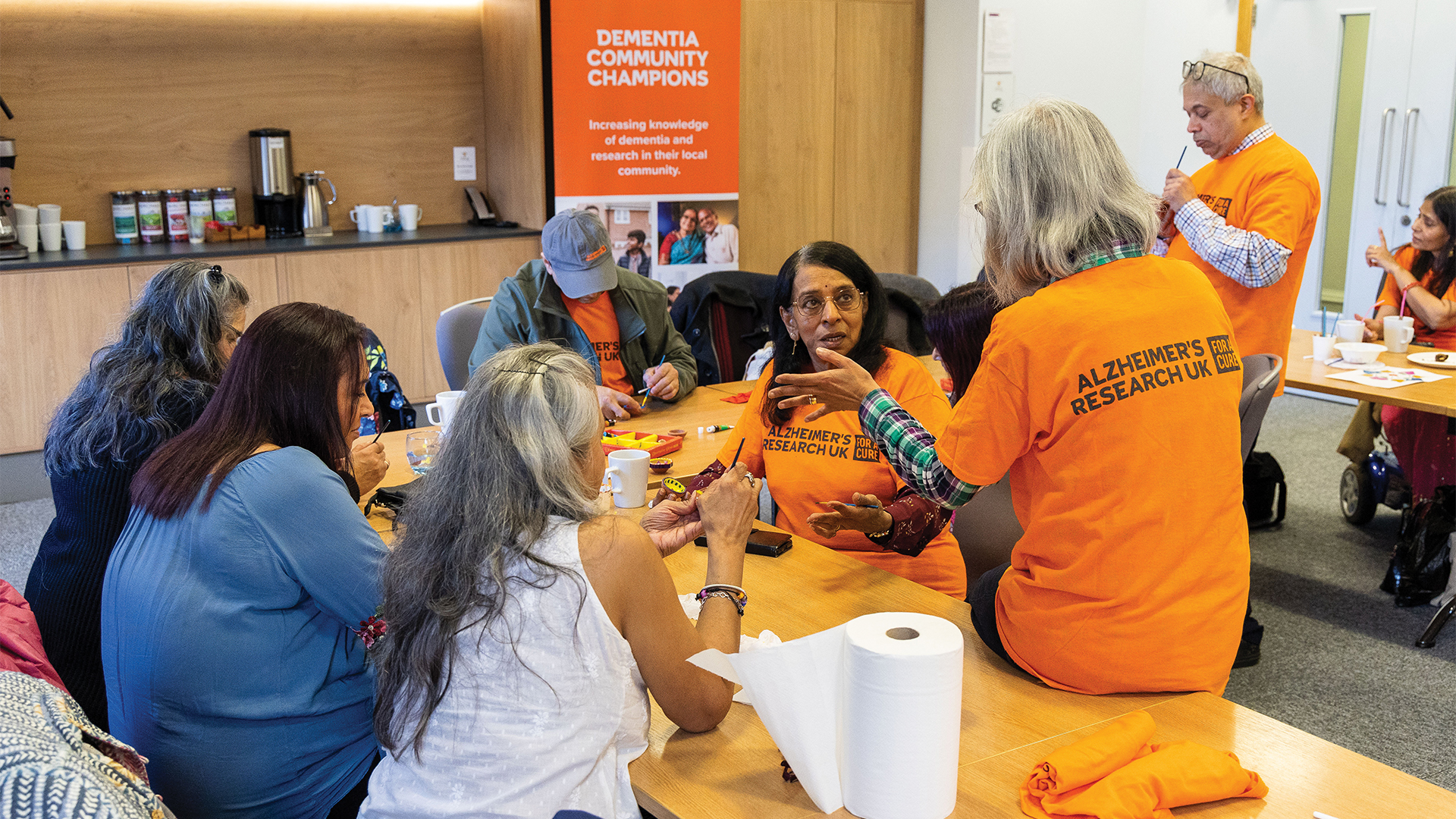
The Dementia Community Champions deliver a workshop at the Jain Centre in Leicester. Image: Alzheimer’s Research UK
In association with Specsavers
Share
People from black and South Asian communities are more likely to be diagnosed with dementia at a younger age and die earlier than white people, but awareness remains lacking.
South Asian people die 2.97 years younger and black people 2.66 years younger than their white counterparts, according to research from the University College London and the London School of Hygiene and Tropical Medicine.
Alzheimer’s Research UK has launched a Dementia Community Champions project to help raise awareness in underrepresented communities. This includes volunteers from the South Asian community, who are trained to help people understand more about dementia and discover ways to look after their brain health, in areas such as Derby, Nottingham and Leicester.
Sabah Ali, community engagement officer at Alzheimer’s Research UK, says that “stigmas still exist when it comes to dementia and Alzheimer’s”.
She says it has been “great to see the lightbulb moments people have when they recognise it isn’t a mental condition and there are so many physical factors”.
She adds: “There are things that you can do to help prevent dementia. There is hope. There is something that can be done, even if it’s a small-scale thing of walking more or speaking to somebody.
Advertising helps fund Big Issue’s mission to end poverty
Advertisement
“It’s challenging because you’re going into communities where people don’t want to acknowledge that dementia exists, but I see the change already happening.”
Volunteers set up sessions to share the knowledge they have learned. Here’s why they do it.
Jas Segal, 58, Derby
Keep reading the journalism that powers our mission
Register free to continue and learn more about the stories, campaigns and the support we provide, helping people facing poverty across the UK.
I live and breathe anything to do with health and wellbeing. I have an autoimmune condition and I’m interested in the principles of nutritional therapy. Dementia is not a subject I’m a specialist in, but it was suggested to me that I might enjoy being a dementia community champion.
It has been such an eye-opener. I didn’t realise dementia is now the leading cause of death in the UK. I’ve learned there is so much stigma within South Asian communities.
People think they are going mad. The more we talk to people, the more they realise that it’s a condition, and there are so many things you can do to prevent it or prolong symptoms from happening. Knowledge is key, and the more education we can provide, the better.
We may not have the answers all the time, and we go back to Alzheimer’s Research UK to find out, but it’s good that we can spark interest. We’re stronger together and we can support one another. It can be daunting, but it doesn’t have to be scary if we’re together and we can fight it together.
I’m a biomedical scientist and I started researching Alzheimer’s more than a decade ago. While I was doing my PhD in biological sciences, I took part in an event at the university where we presented our research to members of the local community. Until then, I had mainly focused on laboratory-based research. That made me realise how important it is to communicate with people living with dementia, their families and the wider community. It was hard to translate what I had learned into laymen’s language, but over time I learned how to explain complex ideas in a much simpler and more accessible way.
I connected with the Dementia Community Champions project while working as a visiting lecturer for the University of Roehampton. I wanted to do something meaningful, and I’m multilingual, so I wanted to use that as an advantage to help people.
We have been able to help people talk about how they are feeling. It’s not only champions working together; the community itself is working together to figure out what they are going through.
Whenever I talk to people, they think dementia is a part of normal ageing. But it’s not. It’s caused by diseases in the brain. Research is helping us understand these diseases and develop treatments, and ultimately it may help us find cures.
Bharti Mistry, 65, Leicester
I got involved with Dementia Community Champions after my mother-in-law was diagnosed with vascular dementia. None of the family understood what it was, so it seemed like a good idea to learn more so we could increase her understanding and support her. I’d heard the term before, but I really didn’t know much about it. Vascular dementia is on the rise in the South Asian community because of things like diabetes and heart problems.
It’s such a serious topic, but we add a little bit of fun to it. We do brain exercises and put music on. It can be simple hand exercises. If you do it to music, then there’s a bit of joy in it. We sometimes do exercises where we talk about all the fruits we know about. It doesn’t have to be fruits – it could be vegetables, flowers, countries, anything.
There isn’t a word for dementia in Gujarati, and in the old days, a person with dementia was referred to as ‘Ganda’, meaning they had gone mad, so these awareness sessions are crucial.
Research is so important too. If we don’t have a diverse range of people participating in research, then whatever research they’re doing to try to find a cure won’t include those people. We always try to promote that.
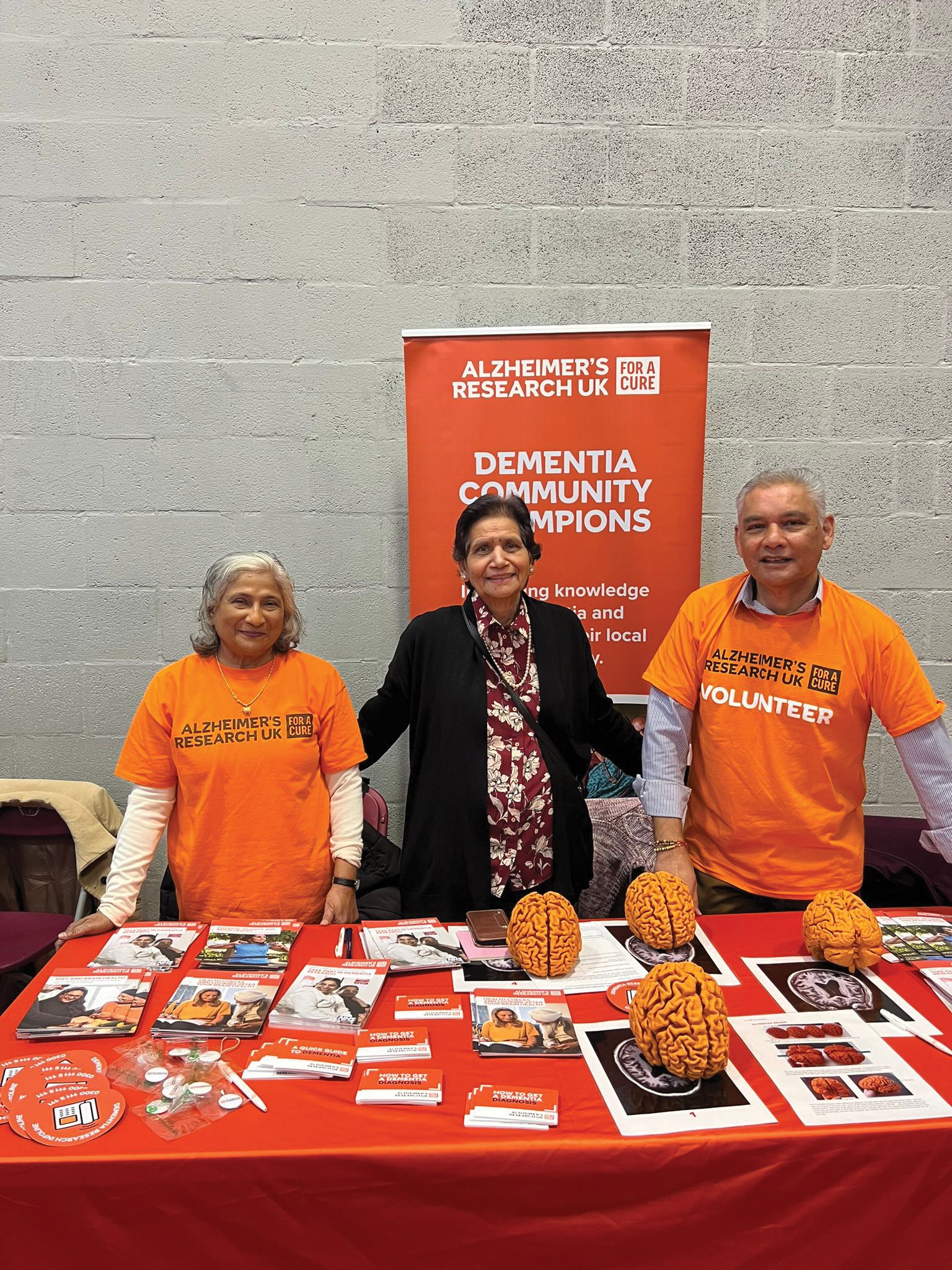
Kirit Gabe (centre) with fellow volunteers Madhu and Kanta. Image: Alzheimer’s Research UK
Kirit Gabe, 65, Nottingham
I became interested in Alzheimer’s when my elderly mother had symptoms of dementia, and a few years later my father had similar symptoms. I wanted to gain awareness to learn how to help them and so I became a dementia community champion.
People can be very conscious about letting other people know what issues they are facing and so getting help is difficult. Even the word ‘dementia’ can be frightening. Another issue we have, especially among the elderly, is the language barrier, so we have literature that people can take away in different languages. In our awareness sessions, we encourage people to do various exercises to keep their brain active. It might be going through items in your home and talking about them. There’s also memory recall: what did they have for breakfast? Who are their relatives?
I always believe the one takeaway people should have is not to be frightened about the disease. I want people to have hope.