I was 35 before I had my own lawn to mow. For many, there’s a growing barrier to having a garden
With home ownership out of reach for many, access to green space is increasingly a social justice issue
by:
22 Apr 2026
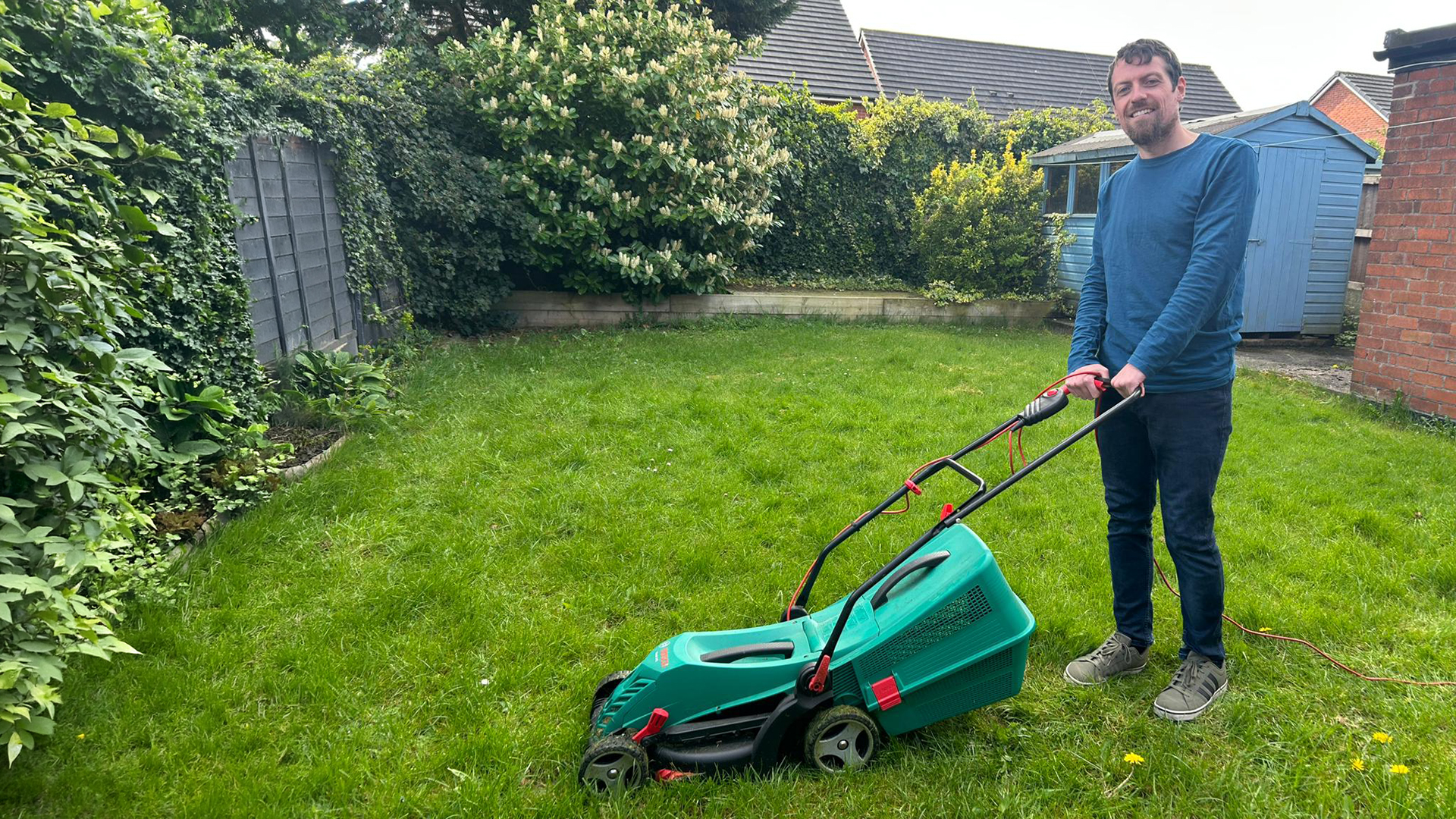
Big Issue deputy editor Liam Geraghty with his lawnmower. Image: Big Issue
Share
I’ve just bought a house and, unironically, the thing I’ve been most excited about since moving in back in January is mowing the lawn.
At 35, this is the first time I’ve had my own lawn and leafy garden space. It’s half my life – from before I went to university – since I’ve lived in a home with a garden.
Since then, there’s been years of renting: living in a former hotel with a derelict swimming pool in the basement, or in a Glasgow tenement block, or enduring lockdown with no garden and calling the council to complain about neighbours burning rubbish in their own.
The last stop before homeownership offered a ‘yarden’ at least: a strip of concrete that wasn’t quite a garden but was nonetheless a treasured space after the pandemic.
So after waiting for the wave of rainfall to subside, I was finally able to face my new lawn in March following a few dry days and some unseasonably high temperatures.
Advertising helps fund Big Issue’s mission to end poverty
Advertisement
I grabbed the slightly knackered lawnmower we’d inherited from the previous owners, sussed out how it worked and started mowing lines in the grass.
To tell the truth, it wasn’t quite the meditative monotony I’d envisaged. I made a bit of a hash of it. There were a few tufts I missed, we’ll need to invest in a strimmer and the grass isn’t looking quite as green as I’d like.
But it’s early days. I’ll hopefully have time to sharpen my skills – along with the lawnmower blades.
Keep reading the journalism that powers our mission
Register free to continue and learn more about the stories, campaigns and the support we provide, helping people facing poverty across the UK.
My housing history is nothing unique and, if I’ve struggled to get access to some outdoor space, that planted a seed of an idea: surely I’m not alone?
Richard Benwell is chief executive of Wildlife and Countryside Link, a coalition of 96 organisations calling for the protection of nature.
He tells Big Issue that access to green space is an issue rife with injustice.
“I start from the point that access to a healthy environment should be a basic human right,” says Benwell.
“That’s true for the air we breathe. It’s true for water, obviously, that we drink but also what we expect to bathe in. And it’s true for access to green space. The fact is, at the moment, that even in a country like ours, lots of people don’t have access to a healthy environment.
“There are definite shortfalls and they don’t fall equally. That’s why it’s a social justice issue.”
Digging into data
The Office for National Statistics (ONS) last looked at access to gardens and green space back in 2020. It was a hot topic back then, of course, with Covid lockdowns limiting opportunities to go outside.
The stats body found one in eight households in Great Britain has no access to a private or shared garden.
London was described as “easily” the place with the best access across the country. There, one in five households were able to get to green space or a garden.
But the price Londoners pay is in size. Gardens in the English capital are 26% smaller than the national average, and the smallest of anywhere else in the country at a median size of just over half a tennis court.
To use ONS’s comparison, in Na h-Eileanan Siar (the Western Isles council area) in the Outer Hebrides, gardens are 45 times bigger on average than in the City of London. Around 13% of households in Scotland have access to green space.
The disparity wasn’t just geographic. Survey data from Natural England showed black people are nearly four times as likely as white people to have no access to outdoor space at home, even counting a patio or a balcony.
People in semi-skilled and unskilled manual occupations, casual workers and people who are unemployed were almost three times as likely as those in managerial, administrative, professional occupations to be without a garden.
The flipside is that parks are most accessible in the poorest areas. People in the most deprived neighbourhoods in England are around twice as likely to be within five minutes’ walk of a public park.
Age was a dividing line too. Just 8% of people aged 65 years and over were without access to a private outdoor space.
Image: Beth Walrond
Toby Whelton is a senior researcher at the think tank Intergenerational Foundation, which promotes intergenerational fairness on behalf of younger and future generations.
He’s not quite so fortunate on the gardening front.
“Anecdotally, I wanted to plant some veg this year but I’m renting and my tenancy is up in September,” he says. “I realised it’s pointless because by the time they grow I’ll be gone. So It removes a sense of permanence and stability that young people desperately need.”
Space invaders
House prices have locked around 1.5 million potential homeowner households out of buying their own home, the Home Builders Federation estimated earlier this year.
ONS statistics show the median average home in England costs 7.6 times average earnings for a full-time worker, while in Wales a home costs six times the average salary.
The picture has actually been improving since 2021 as wages have risen faster to keep up with inflation. But homeownership remains out of reach for many young people.
As the humble bragging at the start of this article demonstrates: a house with a garden remains a status symbol.
“Historically, especially post war, gardens can be a symbol of the democratisation of England,” says Whelton. “It became very ordinary for the working class or middle class to have their own garden. It was their own patch of land. Their own stake in the country in a symbolic sense.
“It’s quite representative of young people’s apathy and feeling that they don’t have a stake in the country. They quite literally don’t have the place to lay down their roots.
“I think more broadly it links to a feeling of precarity amongst young people.”
The Intergenerational Foundation (IF) argues that part of the issue of access to a garden comes down to the way space is distributed between young and old and rich and poor.
Downsizing is a touchy subject. Homes are more than just a plot of land and bricks and mortar: people form connections to the environment and a pristine garden is, quite rightly, often seen as a reward for a lifetime of work.
But IF argues that the current housing crisis leaves us in a space jam.
ONS figures show 57% of over-65s owner-occupied households had two or more bedrooms free.
Additionally, a report IF released last year found older age groups have consistently had nearly twice as much living space per person as under-30s at an average of 68 square metres compared to 38.
“While there have been policy attempts to encourage downsizing, often they’ve been met with a cultural resistance and an entitlement to the space. Older generations will argue they have memories tied up in their home and it’s where they put all their belongings,” says Whelton.
“These are all fair arguments but implicit in it is a denial of young people to have a space of their own to accumulate objects, express their identity and purpose.
“So I think there is a distorted attitude to space. I think we can see access to gardens as an extension of that.”
Similarly, Benwell’s coalition found last year that first-time buyers in England are increasingly having to move into ‘nature deserts’ with limited access to nature to get on the housing ladder.
“We are aware of a growing sense of a potential divide between young people who care about nature and also young people who are desperate to get on the housing ladder, which is absolutely understandable,” he says.
“What we want to see is the two being dealt with together so that you’re not seeing nature protection as a barrier to housing development.”
Green shoots of hope
The UK government’s planning reforms and push to build 1.5 million homes before 2029 has often pitted nature lovers against YIMBYs.
The debate reared its head in Labour’s deliberations over where its proposed new towns would be located, particularly in Adlington in Cheshire.
The proposed 20,000-home development on the Cheshire green belt was dropped following local protests.
It was a reminder that the demand for green space and human infrastructure is a juggling act.
Wildlife and Countryside Link is campaigning for access to nature to be considered a human right as well as a cast-iron guarantee in new developments.
“Time and time again, people are asked what matters to them in the places where they live and, time and time again, green spaces are right at the top of the list,” says Benwell.
“So when the government’s thinking about new towns, it’s got to design them to make sure that they are filled with nature.
“We’ve got to build loads of stuff in this country. We’ve got to build new water resources and sewers and reservoirs. We’ve got to build new renewables and energy infrastructure to make sure everybody can afford clean energy to heat their homes. We’ve got to build more homes, but we’ve got to recognise that nature is infrastructure too.”
For those without a garden, houseplants offer some comfort but community gardening is an option too.
The Royal Horticultural Society (RHS) found last year that 2.5 million people have taken part in community gardening over the past three years with a further 14.7 million people keen to join.
“Community gardening can provide essential access to the myriad benefits of being in nature,” says Sarah Galvin, RHS head of national community programmes.
“This growing appetite reflects a desire for connection, wellbeing, and greener neighbourhoods, demonstrating how community gardening can help tackle some of the biggest issues facing both people and planet.”
Which underlines that it’s not just the mental health and wellbeing benefits people are locked out of if they can’t spend time in gardens and green spaces.
“The more people connect with nature, the more they love nature and the more they know how much it needs protection,” says Benwell. “If generations grow up without that access to nature, it’s bad for them, physically and mentally, but it’s also bad for our focus as a nation on looking after our natural environment.”
That’s certainly something to ponder next time I fire up the lawnmower.
Find a local gardening group or community garden at RHS.
Buy from your local Big Issue vendor every week – and always take the magazine. It’s how vendors earn with dignity and move forward.
You can also support online: Subscribe to the magazine or support our work with a monthly gift. Your support helps vendors earn, learn and thrive while strengthening our frontline services.
Thank you for standing with Big Issue vendors.
Advertising helps fund Big Issue’s mission to end poverty