One of the nation’s most beloved poets, Roger McGough is now fronting a project taking a mobile poetry library to coastal towns across the UK
by:
29 May 2026
Roger McGough. Image: Vicki Sharp
Share
Roger McGough is at the Southbank Centre in London. An 88-year-old vision of health, vitality and intelligence, the revered poet wears a red jumper, a smart earring and a moustacheless beard. If there was ever an advertisement for the benefits of a lifetime of poetry and wordplay, this is your guy.
He is here as an ambassador for the Southbank Centre’s flagship project, A Poet in Every Port, taking a mobile National Poetry Library to 11 coastal towns across the UK. At each port, from Penzance to Bangor, Southend, Blackpool, Dundee, North Uist and more, there will be events, workshops and readings, plus a studio in which to record your own poetry. The whole shebang is inspired by the travelling exhibitions of the Festival of Britain in 1951, and is timed to mark the Southbank Centre’s 75th anniversary.
It took McGough a while to realise his calling. While he was attending grammar school, he was sent by his mum to elocution lessons. It’s where, he says, he “learned to mumble more clearly”. One lesson involved standing on stage, in front of a crowd, reading poems.
“When I was growing up in Liverpool, I was not aware of poetry. We’d have nursery rhymes and at school I loved it when the teachers made us recite poetry – it was a pretty language to read. We read them aloud, the way you spoke in Liverpool.
“But that was what poetry was for me. You didn’t write poetry. Other people did. Like we’d go to the cinema and watch a film but you’d never think of making a film yourself. It’s what other people do, isn’t it? I thought you had to be very clever or talented or special to do something like that.
Advertising helps fund Big Issue’s mission to end poverty
Advertisement
“Part of this project is to make people realise that it’s within all of us, the gift for poetry. It’s dreaming aloud. It’s dreaming on paper. My writing has always been that. It’s why we need poets everywhere.”
Fast forward to 1967, and McGough was part of a new wave of poets bringing verse to new audiences. The Mersey Sound, an anthology of poetry by McGough, Adrian Henri and Brian Patten, exploded into the public consciousness – a new wave of witty, modern, accessible verse giving poetry the same shot in the arm their pals The Beatles had for popular music.
Keep reading the journalism that powers our mission
Register free to continue and learn more about the stories, campaigns and the support we provide, helping people facing poverty across the UK.
McGough’s At Lunchtime: A Story of Love, a titillating tale of pre-apocalyptic passion breaking out on the bus is perhaps the best known of the poems. “It’s one of those poems that got me in trouble. Years ago, it was burned in America because it seemed to be promoting sexual freedom,” he recalls, before explaining how the last two lines turn it into more of a cautionary tale.
His poetry has continued to evolve. “It’s a rail that guides you through life,” he says. “So you can write about the world outside or about yourself. But keeping on writing is so important, to keep the brain moving. I go to bed and wake up in the middle of the night, but not with a nightmare, with a bloody poem!”
McGough is an ideal ambassador for the Southbank Centre’s anniversary celebrations. After all, he was there, 75 years ago, when it opened.
“We came when I was a teenager, in 1951,” he recalls.
“My mum and dad brought my sister and me down from Liverpool. We drove. My dad had just got a car. He worked on the docks, so it wasn’t a Tesla or anything. It broke down on the way, so we spent the night sleeping in the car in Whitchurch [in Shropshire].
“But we got down to London and stayed with our uncle and auntie in Eltham. One of the first things we did was to come to see the Festival of Britain – whatever that is. At the Southbank – wherever that is. On the River Thames – whatever that is.
“And we were overawed, really. Wow. This wonderful place. Over the years I’ve been invited to perform here and do readings. It’s a gift to London. And to the world, really. And it’s got to use that gift to spread its wings and throw the pages and the poems out around the country. So that’s what we’re doing.”
Chris McCabe is a poet, author and librarian at the National Poetry Library. He joins us via Zoom as one of the architects of the Poet in Every Port project.
“The Southbank Centre is focused this year on how it can be a meaningful arts centre for the future. We can only do that through showing people that art and culture has a positive impact on lives,” McCabe says.
“It can be really transformative. The people really matter. The National Poetry Library would just be shelves of books if people didn’t interact with them. But we’re a living library. It all comes back to getting out into places that have less investment. Some of the locations we will go into, Blackpool, South Shields, for example, haven’t had the cultural investment we’ve got used to in parts of London. So it’s hopefully turning that light on for people so they can take poetry forward themselves.”
And there is much to write about. As well as proving popular, McGough’s poems have always had a political edge. Poetry can always rise to the political moment.
“Poetry and politics are great partners. I’ve always written political poems as well,” he says. “Including a very famous one about unemployment figures.”
He plucks it from his memory:
Conservative government.
Unemployment?
Figures.
“And I’ve got another one called The Chamber. You wanna hear that?”
When the chamber becomes smelly, politicians being full of hot air
The Speaker of the House, upstanding, will declare
Odour, odour, odour!
We talk about the importance of arts education. And of the arts more generally. As a site of protest, sure, but also as a site of joy.
“The world is increasingly racing towards computerised ways of thinking,” says McCabe. “And I think the artist explodes that. The more we fight our way out of these boxed-in thought processes that lead us to some terrible places, the more we can be more joyful. That’s where the imagination comes alive. And the biggest antidote we have got to everything that’s happening in the world is our imagination.”
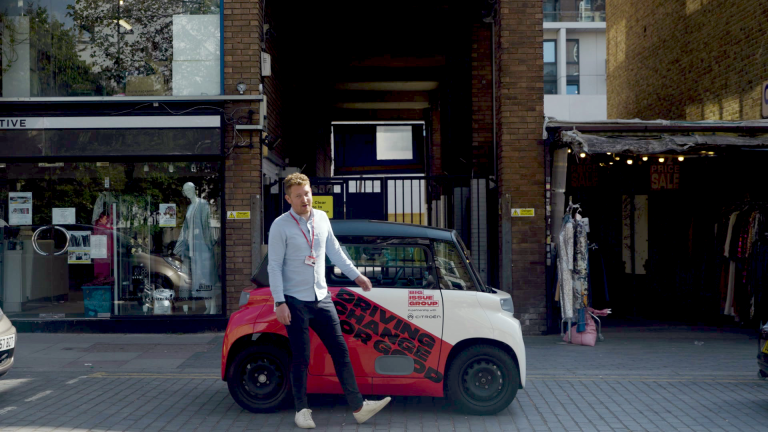
The Poet in Every Port bus. Image: Jo Underhill
McGough thinks about his latest poems – new additions to his latest edition of Collected Poems 1959-2024 for the paperback version.
“There may be some about the president of the United States. I can’t remember his name right now. But on the whole I’m trying to be positive.”
He continues: “When the National Poetry Library comes around, the tyre marks it leaves might change lives if people turn to poetry – writing poetry, reading poems. Maybe they’re not going to make a living out of it. But it might enlighten them. And it will definitely make them happier.
“So I would urge people to have a go,” he says. “Be joyful. Be hopeful. Be poets.”
A Poet In Every Port launches its tour in Great Yarmouth on 29 May with Roger McGough in attendance.