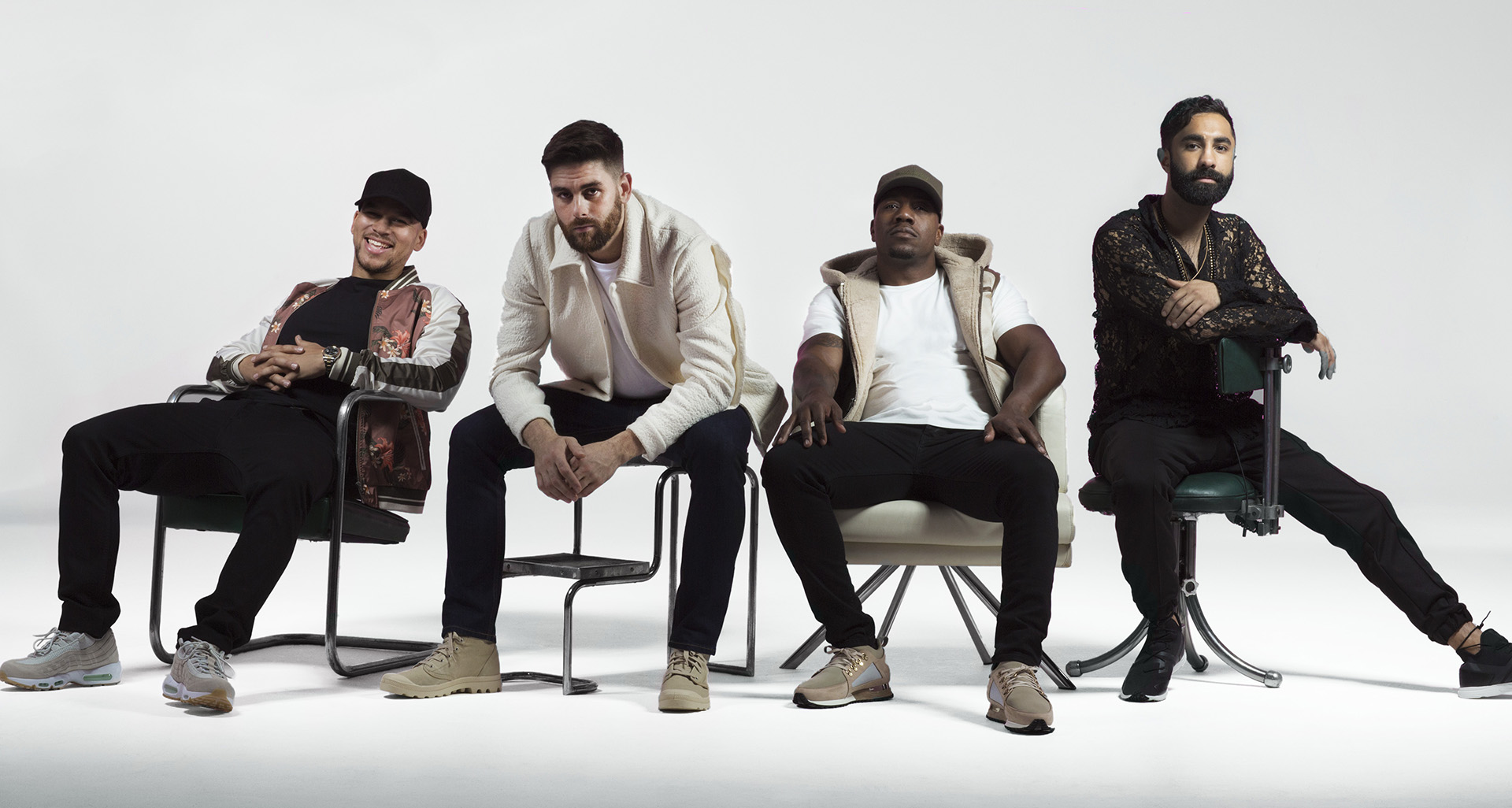
Rudimental: Backstage with the band soundtracking a changemaker generation
Homelessness, immigration and displacement framed them yet their core message is unity. Backstage at the Royal Albert Hall before their headline show, Sylvia Patterson hears plans for a brighter future
by: Sylvia Patterson
30 Apr 2019
Share
We the generation and we have had enough, you have had enough, I have had enough…
So sings Birmingham-based singer Mahalia, exquisitely, to an empty Royal Albert Hall where Rudimental are rehearsing their headline show for the annual week-long Teenage Cancer Trust events. We The Generation is a song that seemingly sums up these wretchedly divisive times: it’s 10 days since a far-right extremist slaughtered 50 Muslims in a New Zealand mosque, two days since a constitutionally collapsing UK Parliament saw hundreds of thousands march for a Brexit People’s Vote, the very day airstrikes return to the Gaza Strip and mere hours before the young England football team, in 2019, is racially abused by Montenegro fans.
Bad vibes are with us, it so often seems, permanently. It’s a song, though, originally released in 2015, Rudimental are a band with permanent messages of their own: unity, resilience, hope. The title of this year’s third album spells it out once more: Toast To Our Differences. Up on stage, with no audience to impress, there’s a party going on, the brass section dancing, backing singers’ arms aloft as more guest singers arrive, each greeted with enormous bear hugs. Inside the Rudimental Family, the vibes are always good.
None of our music is divisive or exclusive, it’s the opposite,
“Our group is about compassion,” says the slight, bearded figure of Rudimental’s producer/songwriter/multi-instrumentalist Amir Amor upstairs in a side room. He’s up close on a sofa and you’re immediately hypnotised by his eyes: ink black, almond, unblinking and serene, they seem to hold the very secrets of the universe. Perhaps they do. “None of our music is divisive or exclusive, it’s the opposite,” he explains. “It’s just in our nature. We try. And the more of a voice you have the more effective you can be.”
Since their Number One debut album Home in 2013, Rudimental have been the toast of their millennial generation, a multicultural one-band carnival, the nation’s premier drum’n’bass/R&B/soul-revue collective whose roster of featured singers (some they discovered themselves) spans a spectrum of contemporary voices: Jess Glynne, Ella Eyre, Tom Walker, John Newman, Anne-Marie, Ella Henderson, Ed Sheeran, James Arthur, Rita Ora, Emeli Sandé.
Today they’ve sold more than 20 million singles, These Days (featuring Jess Glynne, Macklemore and Dan Caplen) the biggest-selling UK song of 2018, their often-euphoric feelgood anthems amassing one billion streams worldwide. And yet, still, we barely know their names, four enigmas in their early to mid-thirties for whom fame, they’ve often said, is “fake, nonsense, an illusion”. Sitting alongside Amor is whiskery songwriter/producer/keyboardist Piers Agget, while songwriter/keyboardist Kesi Dryden and Hype Man/toaster Leon ‘DJ Locksmith’ Rolle are involved in Teenage Cancer Trust workshops. Tonight, smiles Amor, “is the most prestigious show we’ve ever played,” an event previously headlined by Paul McCartney, Noel Gallagher and The Who (Roger Daltrey is the charity’s founder). They were thrilled to be approached.
Advertising helps fund Big Issue’s mission to end poverty
Advertisement
“Because it’s about young people,” nods Amor, who was 14 when his mum was diagnosed with cancer (she died 12 years later in 2011). “Getting cancer at such a young age, it doesn’t have to be the end. And it’s a night for them to feel connected.”
Since their formation Rudimental have been synonymous with trying to make a difference, their early videos in 2013 story-led shorts highlighting social and personal empowerment (Feel The Love celebrated youthful horse-riding therapy in poverty-blighted Philadelphia, Waiting All Night told the true rehabilitation story of American BMX rider Kurt Yaeger, who lost a leg in 2006). Ever since, they’ve kept trying, from worldwide gigs for Amnesty International, to selling merchandise in support of Malawi schools, to working with global refugees since 2016.
“Peace of mind was overlooked and actually that’s the thing,” he notes. “If you’re struggling with anxiety, insecurity, language barriers, yoga is a key, fast route to your subconscious, to clear your mind. There’s a misconception that yoga’s about cosmos pants and handstands. But it’s about breath, our most basic life force, it changes everything if you can breathe better. It’s about karma, a way of life.”
Suddenly, with those hypnotic eyes, he seems like a venerable guru.
“He is a guru,” agrees an admiring Agget, “to many of us.”
Advertising helps fund Big Issue’s mission to end poverty
Sons of social workers and teachers
In a music industry increasingly populated by the privileged, Rudimental’s background made them who they are. Agget, Dryden and Rolle were childhood friends in east London’s Hackney, long before regeneration and vegan hipsters arrived. Sons of social workers and teachers, their worldview reflected (and still reflects) those vital professions: belief in community, education, family, positive identity and opportunity for all. Their multicultural Nineties streets pulsed with drum’n’bass, UK garage, Irish folk, Jamaican roots, African drums and their parents’ classic soul albums.
Soon fledgling teenage musicians, they held post-school jobs as youth mentors and year supervisors in then-beleaguered Hackney schools (Dryden’s first school, notoriously bad, was demolished in 2004). The three met Amor in 2011, a 26-year-old musical boffin with his own studio, Major Toms in Hoxton, who’d forged a transcendent musical life from brutal beginnings. In 1992, aged seven, he’d arrived into Britain with his parents, sister and two brothers, Iranians fleeing the Iran-Iraq war, his eldest (late) brother severely disabled with a brain tumour, who could neither talk nor walk. His parents (engineer dad, teacher mum) struggled with language, accommodation and education, and were eventually helped by social care individuals.
“We were homeless for two years,” nods Amor. “I didn’t go to school. We didn’t necessarily live on the street. Stayed out there a couple of times. We moved around, lived in a little room with all our possessions.”
He pauses, incapable of negativity.
“But this country gave us freedom,” he stresses. “A free education, free health, my brother was ill. I can’t be more thankful.”
No wonder a belief in altruism beams through Rudimental’s music, the band itself reflecting its inclusive ethos. “It’s who we are,” says Amor, “but you can project what you want to see.” Today, he’s stopped watching relentlessly negative mainstream news, sources information online, recommends website Democracy Now! and Instagram account Tanks Good News.
Advertising helps fund Big Issue’s mission to end poverty
“Mainstream news is designed to invoke fear, a primal reaction,” he adds. “They want you to watch adverts, generate income. I feel like watching the news makes me more ignorant.”
His positivity, though, remains steadfast, urges the value of perspective.
It’s easy to get cynical and not believe in anything. We are not powerless.
“However many years ago we were in a world war,” he notes. “Before that we barely had any hygiene. We have many reasons to be positive right now. We’re living in mental freedom, physical freedom.”
We ponder how it must be, now, to be 17, at your most righteously idealistic, most in need of powerful voices to guide your way. They’d think, surely, with today’s political classes, “the world is run by idiots!”
“But the danger of that is feeling powerless,” laments Amor. “And that’s really dangerous. It’s easy to get cynical and not believe in anything. We are not powerless.”
Both Amor and Agget believe, still, in humanity as primarily good, have empathy for even the worst of ourselves and understand how circumstances inform how we think and behave.
Advertising helps fund Big Issue’s mission to end poverty
“Human beings, our core values are the same,” says Amor. “And any action, even if it seems evil or bad, ultimately that human being has made that decision based on those same principles. In circumstances different to yours. So it’s just about understanding each other. No one is inherently evil. We need each other, we’re social beings.”
One new song, They Don’t Care About Us, was written, says Agget, in the wake of Brexit, about today’s divisive politicians. “But the song also has the line,” adds Amor, “they ain’t stronger than love.”
We contemplate whether music, in 2019, can still change the world.
“Absolutely,” decides Amor, a man fast becoming the Dalai Lama of contemporary dance music. “Anything that connects with your emotions in such a primal way, that surpasses words, that surpasses barriers, that surpasses any sort of system, is super-important. When you connect with music, automatically you’re letting go. That opens you up. That’s an older language than words. Growing up, listening to Marvin Gaye, Parliament-Funkadelic, rap music, it definitely made me think differently about the world. You can’t listen to Bob Marley and then go and bash someone’s head in, d’you know what I mean? Good music brings love! Even to the most hardened soul.”
Five hours later the Rudimental Family are dancing towards the end of their life-affirming set, DJ Locksmith bringing onstage a girl of around eight from the Teenage Cancer Trust wards, dancing together, feeling the connection to the colossal hit single Waiting All Night. The sold-out Albert Hall, naturally, goes berserk. “Thank you from the bottom of our hearts,” declares their irrepressible frontman. “We are trying to save our future, people!”
Music, as ever, bringing the love.
Advertising helps fund Big Issue’s mission to end poverty
Advertising helps fund Big Issue’s mission to end poverty