‘I fled domestic abuse with my daughter. We were placed in a property with no furniture or floors’
For those trying to escape domestic violence or homelessness, social housing should be a lifeline. Yet when they get the keys, they open the door to an empty shell. As momentum grows for the government to address endemic furniture poverty, we delve into a crisis that campaigners say is hurting kids’ chances and even holding the economy back
by:
5 Nov 2026
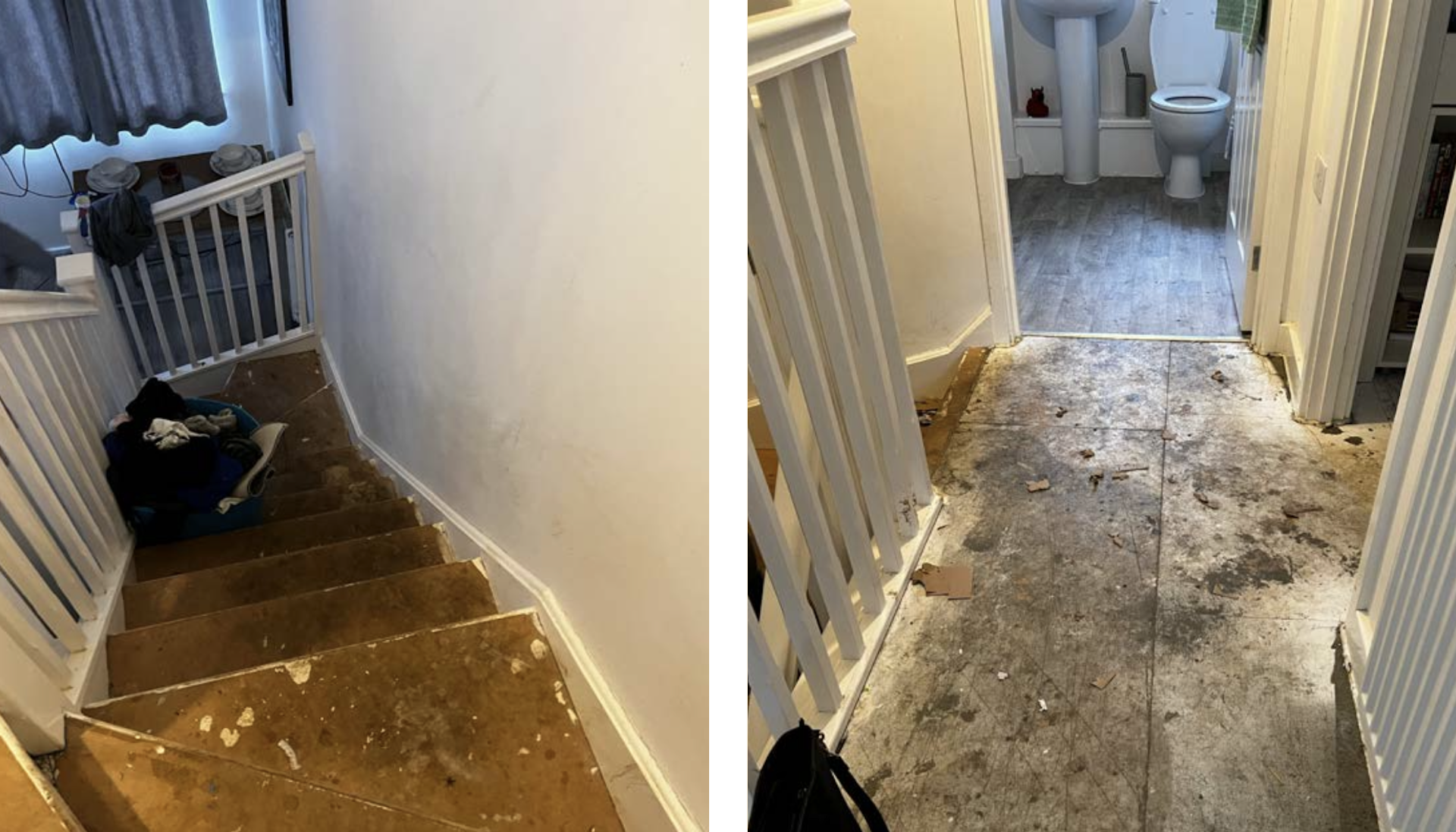
These are the conditions that social homes can be found in. Image: The Angels Foundation
Share
When Sophie found out she’d finally secured housing, it should have been a moment of celebration. She had spent a year in a domestic violence refuge with her daughter, applying for property after property. Instead, as she got hold of the keys, panic set in. “It was just very overwhelmingly anxious for me,” she says.
That was because the home Sophie had been allocated had no furniture – and no floors. “I just assumed that it would be unfurnished, but I didn’t know that it would have no flooring whatsoever,” she says, recalling the bare, dusty concrete underfoot.
“Even if it was someone else’s old flooring it would have made a difference, but it was nothing. It was just like a carcass.”
Sophie, whose name we have changed as she is a survivor of domestic violence, had to put off moving in while she scrambled around for help. A £300 grant from the council would barely cover the basics – she was being quoted thousands for flooring alone. She had no car to collect freebies off Facebook.
“This is everything I could have wanted and hoped for. I definitely didn’t expect to get housed when I moved into the refuge,” Sophie says. And yet, she adds: “I was just so overwhelmed by how much work it needed.”
Advertising helps fund Big Issue’s mission to end poverty
Advertisement
Just one in 50 families move into a furnished social home
For those who have never been in a situation like Sophie’s, a simple statistic may seem shocking: 98% of social housing tenancies are unfurnished. It means that just one in 50 families move into a new home with essential furniture, flooring or window coverings. Stripping out the old wooden floors and carpets is standard procedure for housing providers.
An estimated four million adults and one million children live in furniture poverty, according to End Furniture Poverty. Social tenants, like Sophie, are more likely than private renters or homeowners to be in furniture poverty. Many more sit on the edge: almost a quarter of households cannot afford to replace broken furniture.
Andy Burnham made it his first mission as prime minister to tackle homelessness and get people off the streets with a ‘housing first philosophy’. Those with an eye on furniture poverty say it is a key piece of the puzzle and should be considered a public health crisis. Momentum is growing.
Keep reading the journalism that powers our mission
Register free to continue and learn more about the stories, campaigns and the support we provide, helping people facing poverty across the UK.
Earlier this year, inspired by his own experience of homelessness, Mr Motivator launched a campaign to tackle bed poverty and Gordon Brown lent his zeal to the cause. “The compounded effect of the austerity years means, even when there is food, there may be no table or a chair to eat it from,” Brown said in a foreword to an End Furniture Poverty report.
‘They genuinely rescued me’
Sophie’s daughter is autistic, with “no sense of danger”. She’ll run around like Naruto, her mum says. “When we moved into my place, I felt like we had gone backwards, because I was restricting my daughter to where she could go. I used to snap at her when she would get on the floor and play, because I knew she could feel the broken tiles under the sheet,” she says. Unable to work during her time in the refuge, Sophie faced going into debt to find furniture.
Help came in the form of Furnishing Futures, a London-based charity. They say the lack of furniture in tenancies like Sophie’s can be a barrier to victims escaping domestic abuse, bringing a worry about how they would find the money to start afresh.
In its most recent report, End Furniture Poverty estimated that it costs an average of £8,500 to furnish and floor an entire two-bedroom property.
But Refuge figures from 2020 show that survivors of domestic abuse are burdened with an average of £3,272 in debt, meaning that it is almost impossible to furnish a property for survivors who have incurred those debts or are on low incomes.
On the day Sophie and her daughter moved in, Furnishing Futures made sure a bed was delivered. They also sent bedding, a TV, pots, pans, a fridge, a freezer, a washing machine and a cooker. “They genuinely rescued me in that moment,” says Sophie. When it came to sorting out the flooring, Sophie was given a choice between options.
“The general consensus when you’re being housed in social housing is just shut up and be grateful,” Sophie says. “Society has really turned on social housing and believes that everyone that has it is taking a handout, which is not true. It was almost like I wasn’t allowed to complain. You wouldn’t rent off a landlord if they had no flooring. If that’s not acceptable for a private landlord, why is it acceptable in social housing?”
‘Surely that’s got to be good for the country’
The current crisis is a result of systemic failures, argues The Childhood Trust. We have a housing system which places people into unfurnished emergency, temporary or social accommodation. Couple that with short-term and uncertain crisis funding, and inconsistent housing standards, and here we are.
“If you’re in a situation where you’ve been fleeing domestic violence, you may be working but your individual salary definitely won’t be enough for you to be able to cover all of your costs and so you’re immediately in debt,” says Josephine McCartney, chief executive of The Childhood Trust. “Often because of being in an abusive relationship, they certainly weren’t in control of their finances. So they will have whatever they left with.”
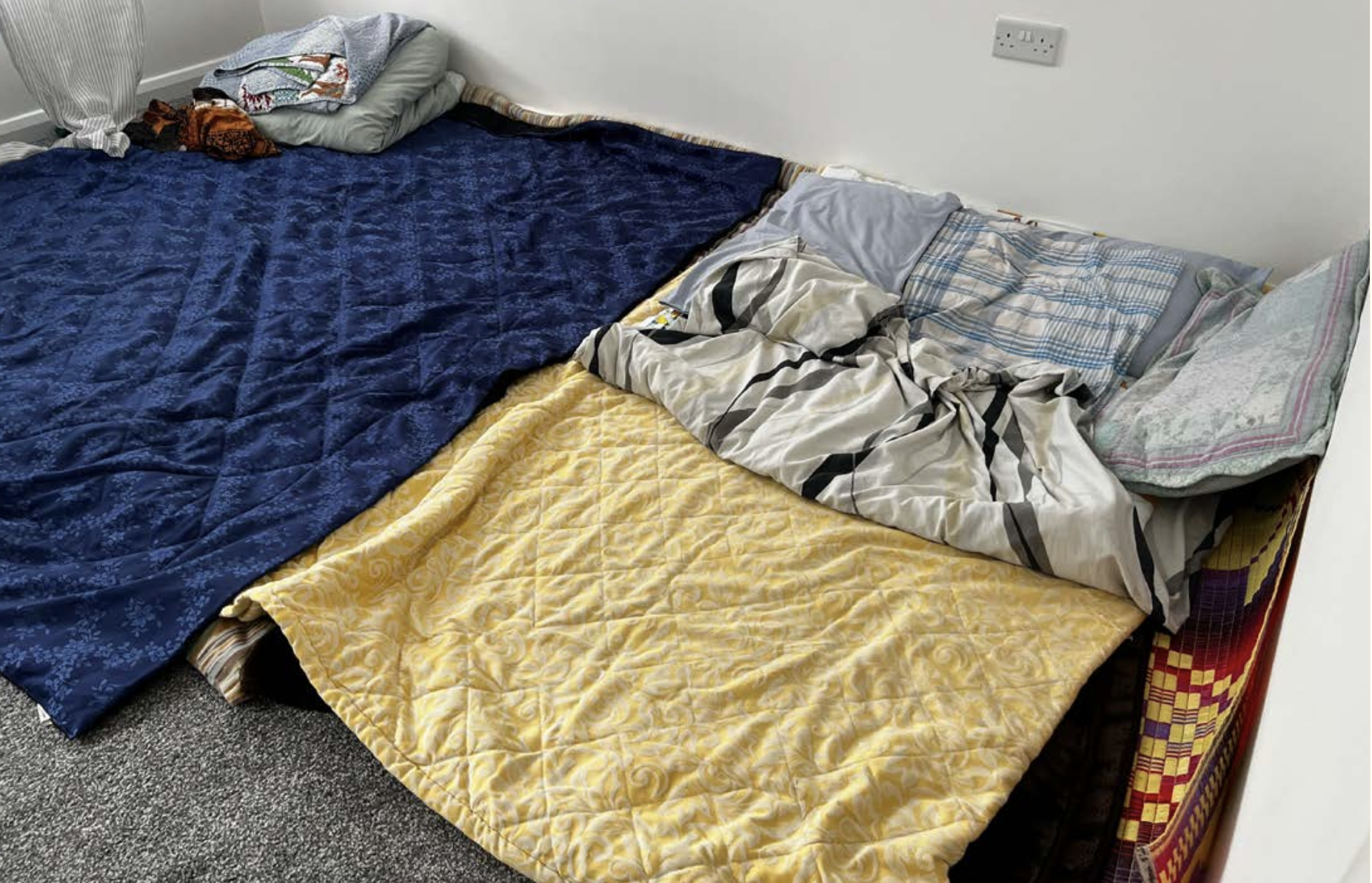
People often move in to a home without furniture and have to sleep on the floor. Image: The Angels Foundation
The lack of flooring is also a frustration for McCartney – a situation not shared in Scotland and Wales, where local authorities won’t rip up carpets by default. “I feel that it’s a waste. There could be a bit more effort put into getting them cleaned. The cost of ripping those carpets up and disposing of them, surely that money would be better used to have those carpets cleaned,” McCartney says.
Yet it can feel that the touted solutions boil down to: get the government to stop it. Recent reports carry a series of recommendations. End Furniture Poverty want the government to ensure at least 10% of social homes are let as furnished. The Childhood Trust want a long-term, ring-fenced, national essentials support fund, as well as an essentials guarantee put into universal credit.
Furniture poverty, McCartney believes, should be treated as a core child wellbeing issue in a similar vein as access to healthcare and furniture poverty and placed on a statutory footing. Rather than another financial burden on cash-strapped councils, McCartney thinks this will save money and improve the economy.
‘I can proudly say my daughter isn’t a bedroom kid’
Economics is one thing. Help has set Sophie and her daughter on a different road. A year on from getting the keys and discovering the empty shell, a cycle is falling away.
“Growing up, I came from a domestic abuse home and I was what I call a bedroom kid. I was always in my bedroom, I was never in communal spaces in my home. I can proudly say now that my daughter isn’t a bedroom kid. She’s a living room kid,” Sophie says. That living room, she says, is decorated with one thing in mind: dopamine decor. Colourful tat, she describes it.
“She’s always in my space. Always running when I’m about to watch a programme,” Sophie says. Bluey will be on the TV – nothing else. Sophie’s daughter will only be in her room because she wants to be, not because she has to hide. Sophie adds: “She takes great pride in her room, she makes her bed every morning. Her room is probably the most beautiful room in the flat.”